

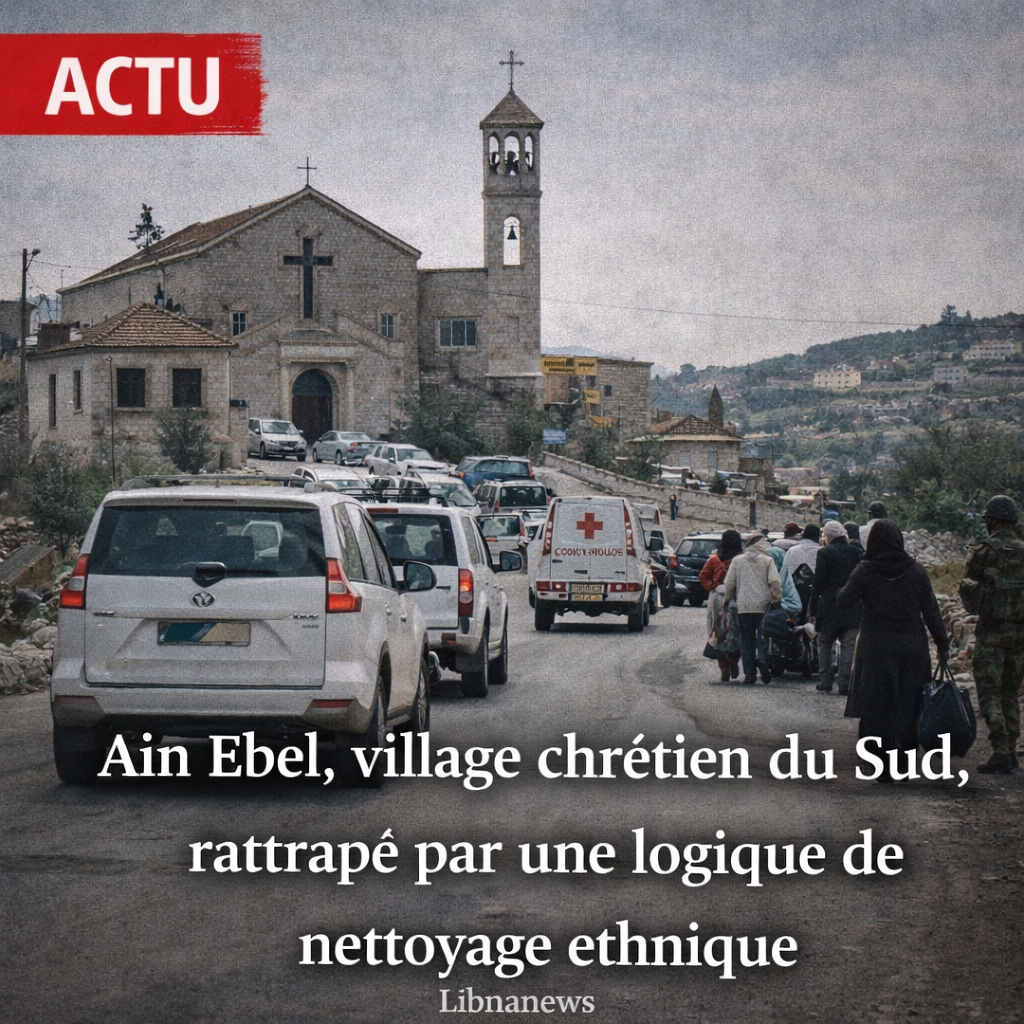
The evacuation order for Ain Ebel, reported Friday 3 April at midday by MTV Lebanon TV channel, cannot be read as just another tactical episode in the war in South Lebanon. It takes place in a sequence in which Israeli leaders now clearly describe a territorial control strategy going as far as Litani, with the destruction of villages close to the border and preventing the return of a large part of the displaced. In this context, the departure of families from Ain Ebel accompanied by the Red Cross does not only refer to a security emergency. It tells of the entrance of a Christian village that is historic from the South in a mechanism of uprooting that now affects the entire border band.
Ain Ebel is not an anonymous place on the map of Bint Jbeil Caza. It is one of the most famous Christian villages in southern Lebanon, with a strong religious, social and memorial burden. For several days, he had been among the villages that were still trying to keep up, despite anguish, shortages, uncertain roads and the growing feeling of encirclement. The fact that people are now starting to leave with humanitarian support is therefore politically heavy. It shows that the area that the Israeli army wants to empty and control is no longer limited to the localities usually described as Hezbollah strongholds. It also includes long-rooted Christian villages whose presence even contradicts the idea of a South reduced to a single political or denominational colour.
Since the beginning of March, travel orders have been extended to wider areas. The Israeli authorities called on the inhabitants of southern Lebanon to return north of the Litani River, while the ground and air operations were intensifying. The UN Human Rights Office has denounced displacement orders covering the entire area south of the Litani, as well as other parts of the country, stressing that they add further misery to a population already broken by the strikes. The message is clear: the evacuation of Ain Ebel does not result from a one-time incident. It is inserted into a larger framework where the whole South is treated as a space to be depopulated before being remodelled militarily.
Ain Ebel is a Christian village, and this changes the political scope of evacuation
It must be said as soon as the analysis opens: Ain Ebel is a Christian village in southern Lebanon. This point is not incidental. It changes the political reading of the evacuation order. During the first weeks of the resumption of the open war, an idea circulated in part of the Lebanese debate: Israel would seek to concentrate its strikes and pressure on areas directly linked to Hezbollah, while caring as much as possible for certain Christian border villages. This reading could be based on informal assurances, local calculations or the mere willingness to believe that a distinction still existed. The evacuation of Ain Ebel seriously weakens this hypothesis. It shows that the Israeli strategy applies to the coveted space, not to the identity of the inhabitants who are there.
For many Lebanese, the symbolic significance is considerable. Ain Ebel, like Rmeish or Debel, embodies a plural South, rooted, whose Christian presence is part of the historical continuity of the region. Seeing such a village also enters the chain of forced departures feeds the idea that the Israeli project not only aims at a military environment, but a territory to empty from its inhabitants. This does not mean that the denominational dimension is the sole driving force behind the Israeli strategy. Rather, it means that this strategy does not stop in the face of any local affiliation when the village is in the area that Israeli leaders want to transform into deep security.
The strength of this episode is also due to the contrast between the will to remain and the logic of departure imposed by the war. In several Christian localities in the South, residents had explained these last days that they wanted to hold, especially as Easter approached, by attachment to the ground, families and churches. This attachment to the earth is not a formula. It structures the way these villages think about their historical survival. When an evacuation order reaches them in turn, the departure is not only material. It becomes an identity trauma. He tells a community that its roots no longer protect it and that it also enters into the geography of possible non-return.
Israeli leaders now talk about evacuating and holding the whole South to the Litani
The background of the Ain Ebel case is the increasingly explicit statements of Israeli leaders. Defense Minister Israel Katz explained that his country wanted to establish a buffer zone up to the Litani River, take control of it, including bridges on the river, destroy all houses in villages close to the border and do not allow about 600,000 Lebanese displaced people to return south of the Litani River until the security of northern Israel was assured. This doctrine goes far beyond a classical military response logic. It describes a space to hold, empty and prevent repopulation.
Prime Minister Benyamin Netanyahu confirmed this direction by ordering the expansion of operations in southern Lebanon. In the Israeli military communication, the Litani is presented as a de facto security line, in other words as a strategic pillar behind which Hezbollah should no longer exist militarily. But when an army combines this military line with massive displacement orders, the announced destruction of homes and the ban on the return of displaced persons, we no longer find ourselves in the mere neutralization of a threat. One finds oneself in a logic of lasting transformation of the territory and its settlement.
The most striking is that this strategy is now publicly formulated. For years, Israel could present its operations in Lebanon as ad hoc responses or as the defence of its northern border. Today, words change. It is no longer just a matter of containing or repelling. The aim is to install a presence, control an area, destroy housing structures and exclude part of the population. The case of Ain Ebel must therefore be read in this light. When a Christian village in the South receives an evacuation order, it is not only caught up in fighting. It is caught up in an Israeli doctrine that targets the entire area between the border and the Litani.
Ain Ebel is no exception: it is proof that the whole South is targeted
This is one of the most important points to make. Ain Ebel is not an anomaly in the Israeli system. On the contrary, his case confirms that the project does not make any more real selection between villages. When a locality is in the space that the army wants to empty, hold and cut off from the rest of the country, it becomes exposed to evacuation, siege, fear or destruction of the building. In this sense, being Christian, Shiite or Sunni does not guarantee anything. The decisive variable is not the identity of the village, but its position in the Israeli strategic map.
This also sheds light on the sense of humanitarian support seen this Friday. When the Red Cross accompanies a part of the population in their departure, it acts urgently to reduce the immediate risks. But politically, the image tells something else: the passage from a village still inhabited to a village that enters the cycle of emptiness. In South Lebanon of 2026, this vacuum is no longer just the side effect of fighting. It becomes one of the concrete objectives of the Israeli strategy. Each departure facilitates the formation of a more easily controllable area, easier to strike, easier to separate from the rest of Lebanon.
It should be recalled here that the area south of the Litani River represents almost one tenth of Lebanese territory. Talking about evacuating this space does not mean moving a few isolated villages. This means reconfiguring an entire region, with its villages, agricultural lands, churches, schools and family networks. For Ain Ebel, this means that the question is not only about the safety of a few families within an hour. It is the question of whether the village will remain a place of life, or whether it will be integrated into a border strip permanently emptied of its inhabitants.
From evacuation order to non-return policy
In any war, the word « evacuation » carries in principle an implicit promise: you leave to survive, then you come back when the danger moves away. It is precisely this promise that is collapsing today in southern Lebanon. When the Israeli authorities announce in advance that hundreds of thousands of internally displaced persons will not be allowed to return south of the Litani River, they turn the evacuation into a non-return policy. Departure ceases to be a moment of protection. It becomes the first act of territorial exclusion.
For the inhabitants of Ain Ebel, this dimension changes everything. Leaving the village in these conditions no longer amounts to getting sheltered while waiting for the shelter. This amounts to a radical uncertainty about the right of return, the future state of the houses, the possibility of re-establishing the land and the very continuity of the local community. This is what makes the sequence so heavy on the human plane. The exodus is no longer merely temporary. It threatens to become structural. And in a region where land and community roots count as much, this threat touches the heart of collective existence.
The Lebanese authorities themselves are preparing for this. The prospect of a prolonged displacement of hundreds of thousands of people is now seen as a credible scenario. The country already lacks financing, sustainable shelter and absorption capacity. In this context, each new evacuation order does not only weigh on families leaving. He weighs on the whole of Lebanon, which must absorb increasing human flows while seeing the fear that some villages in the South will not become habitable again for a long time, or are no longer allowed to repopulate.
The debate on ethnic cleansing exists, but the established legal framework mainly refers to forced displacement.
In the Lebanese public debate, many people describe what is happening in the South as a form of ethnic or territorial cleansing. The evacuation of a Christian village like Ain Ebel reinforces this perception, as it shows that even communities that lived as peripherals to the military heart of the confrontation are now pushed towards departure. Politically, this expression reflects a deep sense of dispossession: that of seeing a historical region emptied of its inhabitants, whatever their membership, in order to make it a safe space for Israel.
At the legal level, however, the strongest terms already established must be used. The United Nations has denounced widespread displacement orders covering the entire area south of Litani. Independent experts have warned that when civilians are bombed, their homes are destroyed, their communities are broken and their return becomes impossible, displacement ceases to be temporary and can constitute a war crime or a crime against humanity. The Human Rights Office also found that some Israeli strikes in Lebanon could constitute war crimes. At this stage, these qualifications are based on the most solid basis.
Terminology prudence does not lessen the gravity of the background. It only allows us not to assign a definitive qualification too quickly where the institutions still speak in terms of forced displacement, arbitrary destruction and possible war crimes. But in the case of Ain Ebel, what can be said without hesitation is already very heavy: the evacuation of a Christian village in the South is part of an Israeli strategy assumed from territorial emptying to Litani, with the announced destruction of houses near the border and explicit refusal to return for a massive part of the displaced.
A Christian village as a sign of a larger project
The case of Ain Ebel therefore far exceeds the fate of the village itself. It reveals that South Lebanon is no longer just a theatre of confrontation. It becomes a space that the Israeli army wants to reconfigure sustainably. What is at stake is not simply a retreat of civilians from danger. This is the possibility that entire villages will cease to exist as places of continuous life, because they will have been emptied, cut off from the rest of the country, then kept in the impossibility of returning.
In this perspective, Ain Ebel becomes a symbol. The symbol of a South Lebanon where departure is no longer merely a leak under the bombs, but the possible beginning of a lasting absence. The symbol of a war that no longer really distinguishes between communities when it comes to implementing a territorial strategy. And finally, the symbol of a question that goes beyond the only village: if even a Christian historical locality of the South enters this cycle, then it is indeed the whole of the South that the Israeli authorities intend to evacuate, hold and transform.
Beyond evacuation, the risk of de facto annexation
The evacuation of Ain Ebel is even more serious when placed within the political framework set by Israeli leaders in recent days. Defense Minister Israel Katz explained that Israel wanted to establish a buffer zone up to Litani, take control of it, destroy the houses of villages close to the border and prevent the return of approximately 600,000 Lebanese displaced people south of the river. Prime Minister Benyamin Netanyahu, for his part, ordered the expansion of Israeli operations in the South, while Finance Minister Bezalel Smotrich went further by saying that the Litani should become the « new Israeli border ». These declarations do not mean that a formal annexation is already decided. But they show that, in the medium term, the Israeli strategy can very well lead to a de facto annexation of southern Lebanon, or at least to a prolonged occupation thought as a new territorial reality.
In this context, an evacuation order is no longer limited to a measure presented as temporary. It becomes one of the instruments for a deeper transformation of the territory. When people are forced to leave, their homes are promised destruction and their return is explicitly denied, the human vacuum created by the war can serve as a basis for de facto Israeli sovereignty over the area. This gives the case of Ain Ebel an importance that far exceeds the village alone. The issue is no longer just the immediate security of the inhabitants. It is also important to know whether South Lebanon is being prepared for a lasting occupation, with in the background, among some Israeli officials, a temptation to annexation that has become less and less hidden.
The evacuation of Ain Ebel does not therefore merely refer to military logic. It can also announce, in the medium term, an Israeli will to de facto annex southern Lebanon, emptying the area of its inhabitants, preventing their return and imposing a new border by force to the Litani.






