

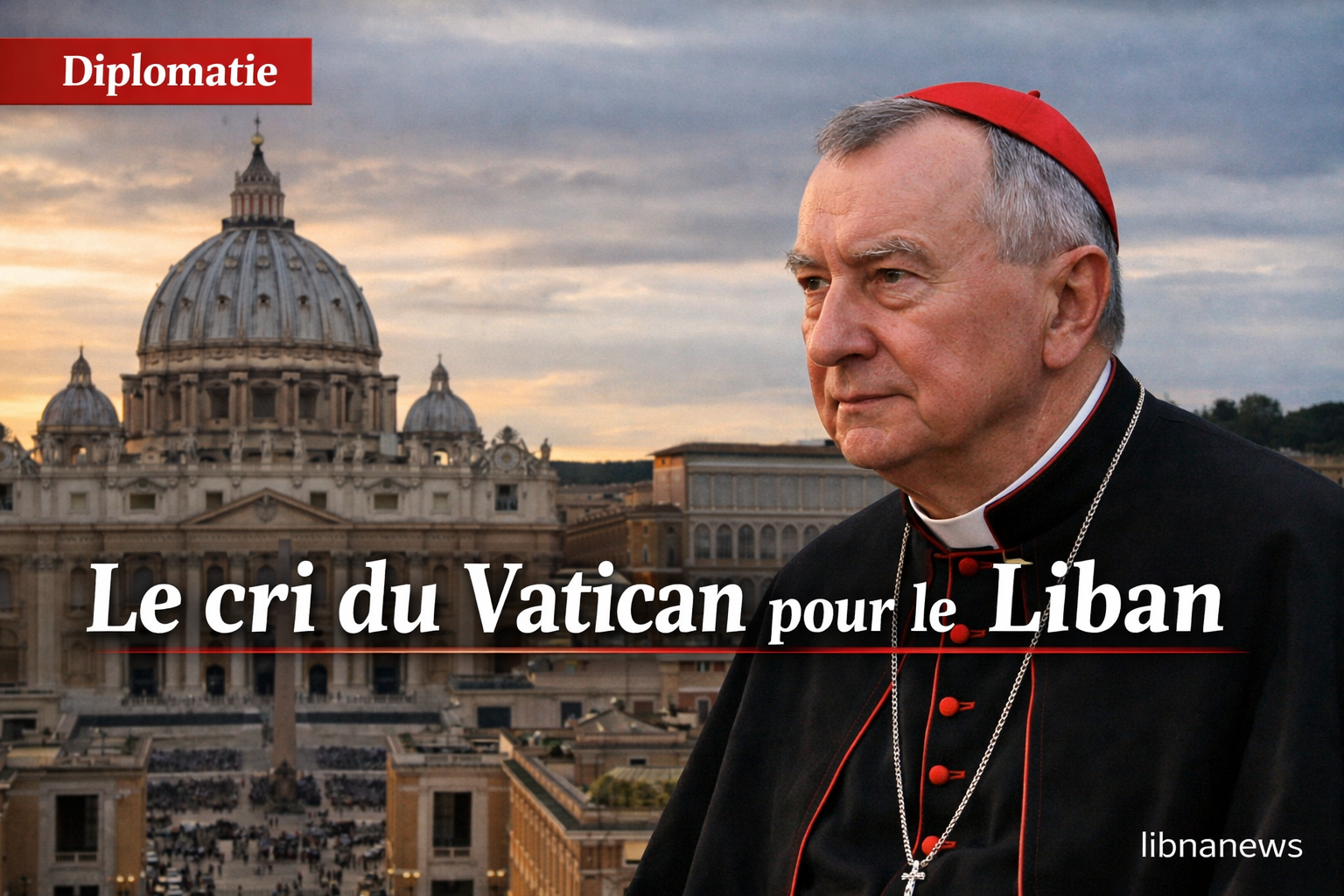
In a few words, the Holy See has put Lebanon back at the centre of a regional crisis that tends to erase behind Iran, Israel and the calculations of the great powers. By asking Donald Trump to put an end to the war « as soon as possible » and to « leave Lebanon alone », Cardinal Pietro Parolin formulated one of the clearest diplomatic interrogations of the past few days. Rare in its tone, strong by its target and heavy of meaning for Beirut, this speech revealed both the moral singularity of the Vatican and the relative silence of more powerful actors.
A simple sentence, but a diplomatic shock
The Vatican cry does not weigh in armored divisions or anti-missile batteries. Yet, in the regional tumult of the last few days, he struck the spirits with his sharpness. « Leave Lebanon alone. The formula of Cardinal Pietro Parolin, Secretary of State of the Holy See, reported in the Vatican press and taken up with force byAl Jumhouria, pierced the fog of prudent press releases and strategic calculations. It did not come from a military power, nor from a capital directly involved in the conflict. It came from Rome, an actor who does not have the coercive means of the great powers, but whose speech remains charged with a singular historical, moral and diplomatic density. In a region saturated with threats, d It is precisely this simplicity that has given intervention its rare strength, at a time when Lebanon sees war coming closer and when the very idea of a country preserved from burning seems to be more fragile every day.
The starting point of the story is in this sequence reported on March 24 byAl Jumhouria. The Lebanese daily highlights the phrase addressed by Pietro Parolin to Donald Trump: to end the war « as quickly as possible » and « to leave Lebanon alone ». The newspaper insists on the direct nature of the message, its lack of ambiguity and the fact that it also applies to Israel. The text sees it as a signal all the more notable as it emanates from the « capital of Catholicism », that is, from an authority that does not speak on the register of force, but on that of universal moral responsibility.Vatican Newsconfirmed the terms of the speech: questioned what he would say to the American president if he was facing him, Parolin replied that he would ask him to end the war as soon as possible, adding that he would also say « Leave Lebanon alone ». He said that this message should be addressed « also to the Israelis », who should focus on diplomacy and dialogue.
Why did this speech mark
Why did this speech mark more than many others? First of all because it contrasts with Vatican usages. Reuters notes that the diplomats of the Holy See usually avoid frontal injunctions to foreign leaders and favour discreet work, measured formulations and background mediation. Pietro Parolin himself, Secretary of State since 2013, is rather identified at this school of restraint. The fact that a man known for his bent tone chooses such an explicit formula indicates that the Vatican considers the time serious enough to leave, at least briefly, its usual reserve. It is not just a message of compassion for Lebanon. It is a diplomatic alert issued by an institution that only exposes itself publicly in this way when it considers that a threshold has been crossed. The rarity of the gesture thus counts almost as much as its content.
This scarcity also explains the immediate resonance of the sentence in the Lebanese debate. The country has been living in strategic fatigue for years, where international messages often follow one another without any tangible effect. Between statements of support, calls for restraint and abstract warnings, few words are still able to break the feeling of impotence. But Parolin’s formula had this effect because it named Lebanon in a sequence where many international actors mainly speak of Iran, Israel, maritime routes, deterrence and regional red lines. The Holy See has moved the centre of gravity of the discourse. He recalled that Lebanon was not only a secondary theatre or a possible collateral damage to the ongoing confrontation. It is a country in its own right, with an already exhausted society, a fragile institutional balance and a vulnerability that prohibits treating it as a mere extension of the regional battlefield. This repositioning of the Lebanese case explains part of the echo caused by the intervention.
The Holy See Facing the Silence of the Powerful
She also scored because she intervened in a vacuum. The powers capable of exerting the strongest pressure on the belligerents speak a lot, but they do not rush when it comes to explicitly preserving Lebanon. Washington remains the most central external actor, given its influence on Israel and its direct role in the regional crisis. Yet, in recent days, the White House has mostly alternated threats, demonstration of force and prudent openness to a diplomatic sequence centered on Iran. In this context, Lebanon appears to be more a strategic element than a specific political emergency. The contrast is therefore striking: the power which has the greatest lever speaks first in terms of the ratio of regional force, while the Vatican, without a military lever, makes the clearest call for a departure from Lebanon. This asymmetry gives the word of the Holy See a symbolic reach greater than its material weight.
The same gap applies to several European and Arab capitals. Many express their concern, call to avoid escalation and reaffirm their commitment to Lebanese stability. But few go so far as to produce such a simple and direct inquiry to the centre of American power and Israeli officials. The Holy See has thus filled, at least symbolically, a lack of clarity among even more influential actors. This is one of the recurring paradoxes of Vatican diplomacy: it may seem peripheral in power relations, then suddenly occupy the moral heart of a crisis by saying what others do not dare to formulate with the same sharpness.Al JumhouriaThis dimension is precisely emphasized by describing a word that « does not tolerate any interpretation ». In an environment saturated with double languages, this lack of ambivalence becomes in itself a diplomatic fact.
Why Lebanon matters so much to Rome
The Vatican message also finds its strength in its special relationship with Lebanon.Al JumhouriaThe intervention takes place in a long history: that of a constant commitment of the Holy See to a pluralistic, united and open Lebanon, where the Christian presence is not reduced to protected enclaves but is part of the entire territory. The newspaper refers explicitly to the Holy See’s commitment to the dissemination of Christian communities in all border regions and to the preservation of « Lebanon One ». This grid is not confessional in the narrow sense. It touches upon a certain idea of Lebanon as a laboratory of coexistence and as a space where religious diversity does not absolve political unity. When Rome says, « Leave Lebanon in peace », it does not defend only a threatened territory. It also defends a model of society which it considers historically valuable and regionally irreplaceable.
This explains why the formula was perceived in Beirut as more than a declaration of circumstance. In the Vatican vision, Lebanon is not one of many. There remains a political, ecclesial and civilizational question. Each major destabilization is read as a weakening of a fragile balance whose disappearance would be far beyond the country’s borders. Cardinal Parolin did not detail this whole background in his brief statement. But this background is understood by those who follow the diplomacy of the Holy See. It gives the message a particular depth. The demand to end the war as soon as possible is not only aimed at avoiding further destruction. It seeks to prevent a country already damaged by the economic crisis, institutional collapse and displacement from tipping into a form of irreversible alteration.
A moral intervention that says more than a call to calm
The moral character of the intervention does not make it abstract. On the contrary, he gives him a clarification that some diplomacy has lost. In asking to « leave Lebanon alone », Parolin does not describe a technical arrangement. He formulates a limit. He says, in essence, that there is a point beyond which the logics of war can no longer be justified by the language of security alone. He recalled that vulnerable societies should not be absorbed in confrontations that exceeded them. This speech does not erase military calculations, strategic interests or the responsibilities of Lebanese actors themselves. But it reintroduces a moral hierarchy into a debate dominated by the mechanics of climbing. It calls what geopolitical reasoning tends to dissolve: the fragility of a concrete country, its inhabitants, its roads, its institutions and its very possibility of standing.
However, the scope of this word should not be overestimated. The Vatican had no army, sanctions or operational control over the belligerents. Its influence depends on its ability to shape consciences, to weigh on frameworks of legitimacy and to recall ethical limits that others prefer to bypass. In the immediate future, there is no indication that Parolin’s call changed the calculation of the main actors. Reuters already noted, at the time of his statement of 18 March, that the Secretary of State of the Holy See was expressing himself as the war continued to spread and that the pope was also multiplying calls to end the conflict. The strength of the message is therefore symbolically real, but its practical effects remain uncertain. This is the whole tension of Vatican diplomacy: it can say the essential with clarity, without having the instruments that impose the essential on the ground.
A real but indirect influence
However, this concrete limit does not nullify the usefulness of intervention. In a regional crisis, not all words have the same function. Some order operations. Others are preparing for negotiations. Still others, rarer, work in the field of legitimacy and memory. The message of the Holy See belongs to this third category. It may not immediately change the behaviour of armed actors, but it produces a benchmark. It establishes a formula that can be taken up, rereaded, quoted and incorporated into the diplomatic narrative of the conflict. In diplomacy, this kind of statement counts more than it seems. It may not stop the bombs today, while helping to define tomorrow what will be deemed acceptable, excessive or politically unsustainable. The Vatican does not impose; He’s registering. And in long crises, this registration work is never negligible.
The share of substitution in this intervention must also be measured. When the powers with direct influence fail to make sense of the Lebanese urgency, a moral authority takes over to formulate it. The Holy See does not replace States, of course. But he reminds them of their deficit. It shows, in contrast, what the best armed capitals did not know or did not want to say with the same intensity. This reminder function is valuable in the Lebanese case, because the country often suffers from being invoked in principle and relegated to practice. We celebrate its plurality, we say we want its stability, then we integrate it into the equations of others without making its preservation an operational priority. In a few words, Parolin exposed this imbalance. It meant that, in the midst of major regional manoeuvres, Lebanon should not become a sacrificial space.
Moral strength, and its very concrete limits
The sentence also touched because it marries the deep grammar of Lebanese fears. In the country, haunting is not just that of open war. It is also that of being treated again as an available scene, a porous territory where wider confrontations are settled. To say « let Lebanon in peace » is to speak this fear in its most direct language. It’s not promising a solution. It is to recognize a historical vulnerability. The Holy See, by its ancient report to Lebanon, knows that this type of formula reaches a sensitive nerve of national consciousness. It reminds the country that it is seen, and it reminds the rest of the world that the Lebanese embodiment is never a local episode, but a fracture that erupts throughout the region.
A more political question remains: can this word open anything other than a moment of diplomatic emotion? The answer, for the time being, remains cautious. The Holy See has not presented any new mediation initiative or announced any specific mechanism. He chose the warning, not architecture. This is due to its method, but also to the configuration of the moment. In a context where the main decisions are made in Washington, Jerusalem, Tehran and in the headquarters, Rome cannot impose a channel by the virtue of his word alone. On the other hand, it can help create a climate where the idea of even hitting or destabilizing Lebanon is becoming more expensive in terms of image and legitimacy. This influence is indirect, diffuse, sometimes frustrating. It is no less real in the long term.
It is perhaps there, in essence, that lies the most just meaning of this Vatican cry. Its strength does not come from an ability to compel, but from an ability to appoint. He says what many people think without saying it loud enough. It fills the silence left by more powerful but more cautious actors, or more involved in their own calculations. It recalls that war is not only a problem of military balance, but also a question of moral threshold. And it reaffirms, in a sequence dominated by the logic of the fronts, that a small fragile country can still be defended by the sole authority of speech. It may not be enough to protect him. But in the present disorder, this word has already produced a diplomatic fact: it has given Lebanon a centrality that the powers of the moment tend to refuse.



