

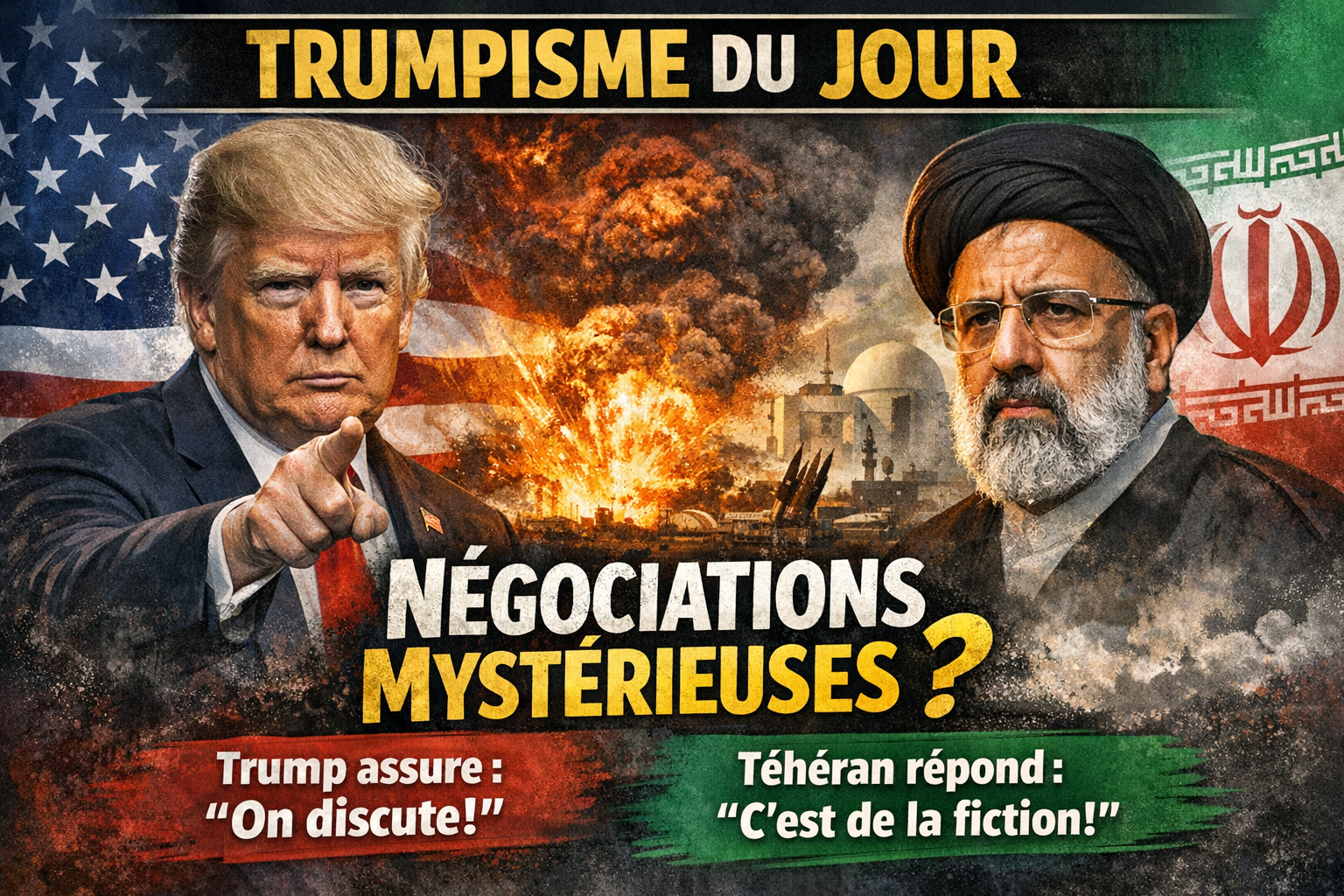
Donald Trump assures that « very fruitful and constructive » discussions have taken place with Iran over the last two days, to the point of justifying the five-day postponement of any US strike against Iranian power plants and energy infrastructure. But Tehran opposes a clear denial: there would be « no dialogue » with Washington. Behind this contradiction is a central question: what exactly does Trump say, who would negotiate for the United States, with whom on the Iranian side, and what would these exchanges really involve? At this time, the evidence shows above all a battle of narratives. Washington speaks diplomatic progress. Iran speaks of political fiction. In between, no negotiating framework recognized by the two sides has yet appeared publicly.
What Trump exactly said
Donald Trump first published a solemn message on Truth Social. He claims that the United States and Iran had, during« the last two days », discussions« very fruitful and constructive ». It states that these exchanges are intended for a regulation« complete and definitive »hostilities in the Middle East. In the same message, he announced that he had ordered the « War Department » tofive-day delayany strike against Iranian power plants and energy infrastructure. He added that the carry-over remainedto the success of ongoing meetings and discussions. This formulation is important. It means that, in the U.S. presidential narrative, the suspension of strikes is not merely a unilateral act of caution. It is presented as a direct consequence of a dialogue already initiated and considered promising.
Trump then completed this message in front of the press. According to the available reports, he stated that there were nowMajor points of agreement, i.e.major points of agreementbetween the two parties. He suggested that an agreement could be reached quickly, possibly within a week, if the momentum continued. He also gave this sequence a very wide perimeter. He is not just talking about avoiding imminent strikes. He talks about a possible comprehensive settlement of the crisis. This extension of the field is decisive. It allows Trump to present his announcement not as a mere military break, but as the beginning of a war exit.
The problem is that Trump provides almost no operational detail to solidify this story. He did not publish a common document. He did not announce a meeting place officially recognized by both sides. He did not give a public roadmap. He did not further detail the precise nature of the « major points of agreement » he claims to have obtained. It is this lack of precise follow-up that weakens its announcement. In such a crisis, real negotiation normally leaves more visible traces, even minimal ones. Here, the public substance remains very weak in terms of the scope of the words used.
Who would be negotiating American side
On this point, Trump gave some names. The discussions would have been led on the American side bySteve Witkoffhis envoy to the Middle East, and byJared KushnerHis son-in-law and long-time counselor. This duo is explicitly quoted in the most solid reports of the day. Their role is central to the presidential narrative. Trump wants to show that it’s not just an improvised exchange or a diplomatic test ball. On the contrary, it seeks to give the image of an already structured channel entrusted to relatives with direct political confidence.
The choice of these two names is not insignificant. Steve Witkoff embodies Trump’s parallel and personalized diplomacy. Jared Kushner, on the other hand, remains associated with the major Middle Eastern issues of trumpism. Their involvement, while very real in the terms described, points out that the White House favours negotiations with strong political centralisation, more than a long-institutionalized traditional diplomatic process. This corresponds to the Trump method: customize the negotiation, make it politically readable and directly attribute its possible success. But this method also has a weakness. It is based more on the words of the President and his entourage than on transparent diplomatic arrangements.
At this time, no other American actor was also clearly highlighted in the presidential communication. This does not mean that no other channel exists. This simply means that, publicly, Trump chose to focus the narrative on this tandem. This personalization further increases the political dimension of the announcement. More than a state-to-state negotiation already marked, the sequence appears as a Trompian initiative claimed as such.
With whom does Trump say he speaks on the Iranian side
It’s the most blurry point. Trump claims to speak to Iranian official« respected », but he says it’snotthe supreme guideMojtaba Khamenei. This clarification immediately aroused speculation, as it removes the official summit of the religious and military power while suggesting that a high-level interlocutor would indeed exist. Reuters reports this formulation without the US President publicly giving the name of that interlocutor. It’s a major element. Washington claims to be talking to someone important, but without being able to verify who.
Some press speculations have evoked other figures of the Iranian system, but the strongest sources do not allow, at this time, to present a unique name as established. The only rigorous thing we can write is therefore: Trump claims that an Iranian senior official is involved in the process, but he does not publicly identify in a verifiable way. This opacity naturally weakens its version. In such a tense crisis, the identity of the interlocutor is not a detail. It determines the actual level of the channel, its credibility and its potential capacity to produce an agreement.
The absence of a name also has a possible political usefulness. It allows Trump to argue that there is a serious dialogue, while preventing an immediate denial of name from destroying all its narrative. But this caution has a cost. The more undocumented the channel, the stronger the Iranian denial. For Teheran speaks clearly: he says that there is no dialogue with Washington.
When would these discussions have taken place?
Trump places exchanges on« the last two days »prior to its announcement. The available records indicate that the discussions would have taken place mainlySunday, with a planned prosecutionMonday. This corresponds to a very short, intense window placed just before the expiration of the American ultimatum for the Strait of Ormuz and the Iranian energy infrastructure. There’s nothing innocent about the calendar. It allows Trump to say: I put the pressure, got some discussion, and I’m suspending the strikes because these discussions are moving forward. All the political effect of his message depends on this chronology.
But this brevity of the calendar also nourishes scepticism. Two days of discussions are rarely enough to produce « major points of agreement » in such a heavy conflict without any minimal architecture being made public. This does not make the existence of contacts impossible. This makes the idea of an already advanced negotiation more fragile to justify Trump’s triumphal vocabulary. The shorter the time, the more caution is required on the true depth of what has been discussed.
Chronology also reinforces another reading. Trump himself had created a risk of extreme escalation by his ultimatum. The five-day delay therefore occurs at the precise time this ultimatum was to produce its effects. In other words, the time window for the supposed discussions also coincides with the time when Washington had to choose between threat execution and tactical retreat. This superposition feeds Iran’s reading that Trump does not announce a breakthrough, but rather seeks to re-qualify a retreat.
What the discussions would focus on
The first identifiable subject is theStrait of Ormuz. The whole recent sequence revolves around freedom of navigation, partial blocking of traffic and American threats if Tehran does not reopen the maritime passage. Reuters recalls that postponing strikes is a direct part of this crisis. The strait is therefore at the heart of Trump’s claims, although no public document details the parameters.
The second issue is the American threat againstpower plantsandIranian energy infrastructure. This is even the most immediate concrete point. Trump suspends this option for five days. This means that this dossier, whether at the centre of a real negotiation or a simple exchange of signals, is part of the practical content of the sequence. This is a major challenge because an attack on these facilities would open a cycle of extremely dangerous regional reprisals, particularly against the Gulf’s energy and water infrastructure.
The third likely topic is broader:Regional de-escalation. Trump talks about a « complete and definitive » settlement of hostilities. This suggests that it does not limit the exchange to Ormuz or the energy issue alone. But again, we must be rigorous. It is a logical interpretation of his words, not a detailed framework made public. At this time, there is no officially confirmed road map on any military, nuclear, maritime or regional tracks. The exact substance of the « major points of agreement » therefore remains unknown.
Why Iranian denial is so important
Iran was not content to remain silent. His Ministry of Foreign Affairs stated that there was« no dialogue »with Washington. He acknowledged mediation efforts by regional countries, but refused to present them as American-Iranian negotiations. This nuance is decisive. It means that Tehran admits the existence of potential mediators, while frontally contesting the American version of an already initiated dialogue between the two capitals.
This denial changes the political meaning of Trump’s announcement. If there was only an Iranian silence, Washington could still keep the blur. But a clear and immediate public refusal turns the sequence into a narrative confrontation. Trump says: we talk, we move forward, we already have points of agreement. Iran says: No, we don’t talk with you, and what you’re presenting as a negotiation doesn’t deserve that name. From then on, the main fact is no longer an alleged diplomatic advance. This is the incompatibility of official accounts.
This denial also serves Iranian internal objectives. It allows the power not to appear as a threat trader after an American ultimatum. It protects the firm position of the regime. He finally avoids giving Trump a free symbolic victory. In this type of crisis, recognizing talks is already a political concession. By denying them, Tehran specifically refuses to offer this concession.
Mediators may exist, but this is not enough to talk about negotiations.
Reuters states thatTurkey, Egypt and Pakistanwould be involved in mediation efforts. Other reports also refer to action by regional countries to reduce tensions. This opens up a reasonable hypothesis: there may be indirect contacts, messages, exploratory proposals or facilitation attempts. But this assumption does not resolve the main issue. An indirect channel becomes a recognized political negotiation only if both parties agree to recognize its existence or scope. But Iran refuses that.
Two levels must therefore be distinguished. The first is possible mediation, very plausible in a crisis of such gravity. The second is the substantial negotiation claimed by Trump. In between, there’s a gap. At this time, the facts available make it possible to talk about American mediation and advocacy efforts for advanced dialogue. They do not make it clear that a negotiating process recognized by Washington and Tehran is already in place.
This distinction is essential to writing right. To say that there is absolutely no contact would be excessive. To say that there are proven negotiations would also go too far. The most rigorous formula remains this: Trump affirms that a substantial dialogue is underway; Iran denies it; regional mediations exist or are mentioned; but no framework recognized by both sides has yet been publicly demonstrated.
The postponing of strikes also looks like a tactical American retreat
Even by setting aside the question of the talks, one fact remains: Trump has pushed back five days of strikes that he threatened to launch against Iran’s energy infrastructure. This delay immediately reduced oil and raised stock markets. This shows that investors have read the announcement as a decrease in the immediate risk of extreme escalation. But this financial reaction does not prove the existence of a solid negotiation. It shows above all that Washington has temporarily removed the most explosive threat of the moment.
Several reasons may explain this break. Iran had threatened reprisals against regional infrastructure, including energy and water. The risk around Ormuz remained high. The Arab Gulf countries were concerned about their own facilities. And a campaign targeting civilian power plants would have raised considerable legal and humanitarian objections. In this context, the postponement can be read as a pause imposed by the potential cost of a new military step. The Iranian denial reinforces precisely this reading: for Tehran, there is no negotiation, there is a Trump who has retreated.
In other words, the battle of the story also concerns the interpretation of this five-day delay. For Washington, it is the result of diplomatic progress. For Tehran, it reveals the deterrent effect of its threats and regional risks. As long as nothing more concrete emerges, these two readings will continue to confront each other.



