

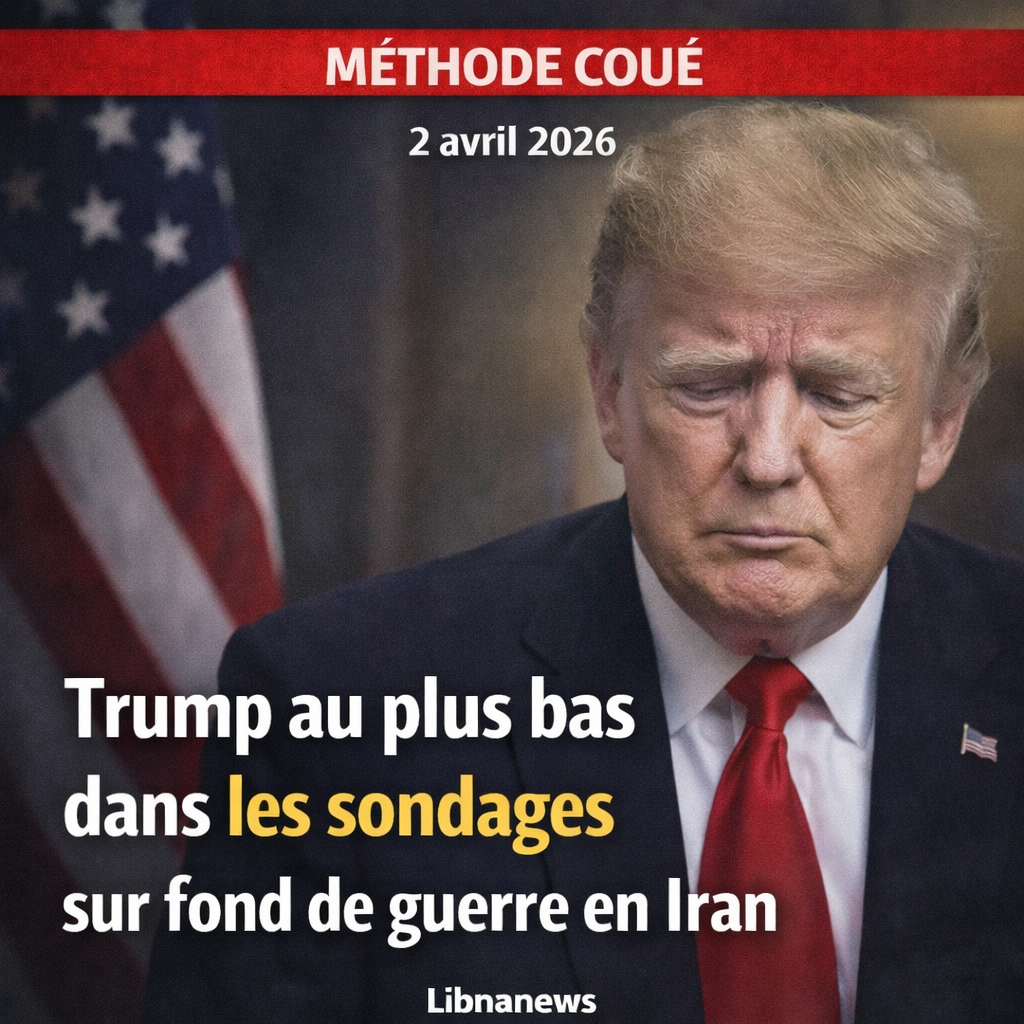
A month after the opening of the Iranian front, Donald Trump is seeing a net deterioration in his popularity. Between the boom in gasoline prices, the lack of a clear horizon over the duration of the war and the fatigue of an opinion that wants a rapid cessation of operations, the US President is entering a politically more fragile phase of his second term. Nineteen months before the mid-term elections, war in the Middle East began to weigh far beyond military ground.
Donald Trump still claims « decisive victories » against Iran. But in opinion polls, dynamics are no longer to its advantage. RealClearPolitics’ aggregate was 41.1 per cent approval on 1 April, compared with 56.7 per cent disapproval, its lowest level since its return to the White House in January 2025. At the same time, a Reuters/Ipsos poll published at the end of March brought it even lower to 36% approval. The differences are due to the method and date of the measurements, but the trend is converging: the President is receding, and the conflict with Iran is accelerating this decline.
The sequence is all the more sensitive since Trump had built a large part of his return on a promise of controlled strength: to appear as a leader capable of intimidating, hitting quickly, and then closing crises without simmering. However, the war that broke out on 28 February did not have anything to do with a parenthesis mastered in opinion. It lasts, costs, blurs the presidential message and revives an old contradiction of trumpism: promising strategic retreat while opening a new major front in the Middle East.
The war in Iran brings down membership
The central factor of the current deterioration is clearly identified: war. According to Reuters/Ipsos, 60% of Americans disapprove of the strikes against Iran and 66% now want a speedy end to the conflict, even if this means not achieving all the targets posted by the administration. This figure is politically heavy. It shows that a majority no longer reason in terms of complete victory, but in terms of the fastest possible exit. Clearly, the debate is shifting from support for the operation to managing the cost of the extension.
Other investigations are in the same direction. A survey relayed by theWashington PostBased on a CNN/SSRS study, approval of the decision to use force has fallen to 34%, down since the beginning of the war. Two thirds of respondents also believe that Donald Trump does not have a clear plan for the conflict. Again, the issue is not just acceptance of the use of force. This is the perception of a blurred, changing, difficult-to-read strategy, including for some of the conservative electorate.
This fragility is amplified by the very style of the president. In recent days, Trump has successively claimed that military objectives were almost achieved, that a regime change had taken place, that the United States would leave « very soon », and that they would continue the strikes for another two or three weeks. This gap between the promise of a quick exit and the announcement of new strikes is fuelling the idea of a war without a stabilized course. In an American public opinion marked by Iraqi and Afghan precedents, this kind of uncertainty weighs quickly.
The return of the American political nerve: essence
The deterioration of the polls is not only from the military front. She also plays at the pump. The war has led to a new surge in energy prices in a country where fuel costs remain one of the most sensitive markers of the political climate. Reuters noted an increase of about one dollar per gallon in one month, with an average national price approaching or exceeding four dollars at times and States. More than half of the respondents say they expect a negative impact of the conflict on their financial situation, and two thirds anticipate further price increases.
For Trump, this is bad news on a terrain he claims to dominate: the economy of everyday life. His political narrative has been based for months on a simple idea, that of a president capable of restoring power while protecting the household portfolio. But the Iranian conflict blurs this promise. When gasoline climbs, the average voter does not first judge the geostrategic finesse of the White House. He sees the cost of filling, the effect on the races, and then the general impression of instability.
The difficulty is even greater because this increase occurs in an environment already marked by concerns about inflation. A summary of a CNN/SSRS poll relayed by several American media shows that Trump’s approval of the economy and inflation has also deteriorated. Even if war does not explain everything, it acts as an accelerator. It adds an energy shock to a climate of economic fatigue. And politically, it turns a distant conflict into an immediate domestic problem.
A Republican base that holds, but conditional
Trump didn’t lose his hard core. This is the other major education in the surveys. Among Republicans, support for the President remains high, including on Iran. Reuters reports that at CPAC, the conservative base was placed massively behind the offensive. Another Reuters/Ipsos poll, however, shows a more subtle crack: if a majority of Republicans still want to continue the war to achieve the announced goals, 40% already want a quick end to American involvement. In other words, partisan support exists, but it is not without time limits.
This is where Trump may be playing the most serious risk zone. Its coalition is not based on classical interventionism like the Bush years. It is based in part on an electorate that rejects long wars, expensive outbound expeditions and the idea of a « world gendarme ». As long as the President can present the Iranian operation as a brief, controlled and winning coup de force, he keeps his base. But if the conflict stretches, if the losses increase, if the energy prices remain high and if no clear exit appears, this base can become more nervous.
This tension explains Trump’s recent insistence that the war will be over « very soon. » It also explains its repeated statements on objectives already achieved. The President seeks to maintain the political benefits of demonstrating force without paying the cost of wear and tear. The problem is that opinion increasingly perceives the gap between the announcement of a near victory and the absence of a clear calendar.
Democrats see a field return
At this point, Trump’s fall does not automatically mean a spectacular Democratic rebound. At the end of March, Reuters noted that the president’s decline was not yet mechanically reflected in a massive push for opposition. But for the democrats, the war opened up a much more exploitable campaign angle than at the beginning of the mandate: that of a president who promised control and delivered uncertainty, who denounced the outside adventures and found himself trapped in a new front, and who weakened American households at the same time as he boasted to restore their security.
The timetable reinforces this sensitivity. The mid-term elections of 3 November 2026 are still far away, but US policy is already entering a pre-positioning phase. Each additional month of war reduces the White House’s ability to turn the conflict into a successful power episode. On the other hand, every sustainable price increase and every strategic float feed the Democratic campaign on incompetence, unpredictability and the concrete cost of trumpism.
On this point, the signals are not neutral for Republicans in Congress. They are already approaching a more complicated political environment, marked by tensions over the financing of the Department of Homeland Security and internal tactical divisions. An unpopular White House does not always lead to a defeat of its camp, but it makes electoral discipline more difficult, especially in competitive districts where the price of gasoline and the rejection of prolonged war speak more than ideological slogans.
Second mandate enters a more unstable area
Perhaps the most worrying for Donald Trump is less the exact number of his approval than the nature of the decline. When a president recedes because of a passenger scandal or communication controversy, he can hope for a quick recovery. When it retreats on a triptych war-energy-cost of life, erosion is more dangerous. It affects perceived competence, credibility and daily life. This is precisely what the surveys published over the past week show.
Trump retains real assets: a faithful base, an intact capacity for polarization, and a Republican Party still largely aligned behind it. But the past month has changed the nature of his second term. Until then, he could still present himself as a breaking president capable of imposing his rhythm. From now on, it must manage the effects of a war whose inner perception it no longer fully controls. And in contemporary American politics, a president can survive controversy. It survives much less easily to the impression of losing hands.






