

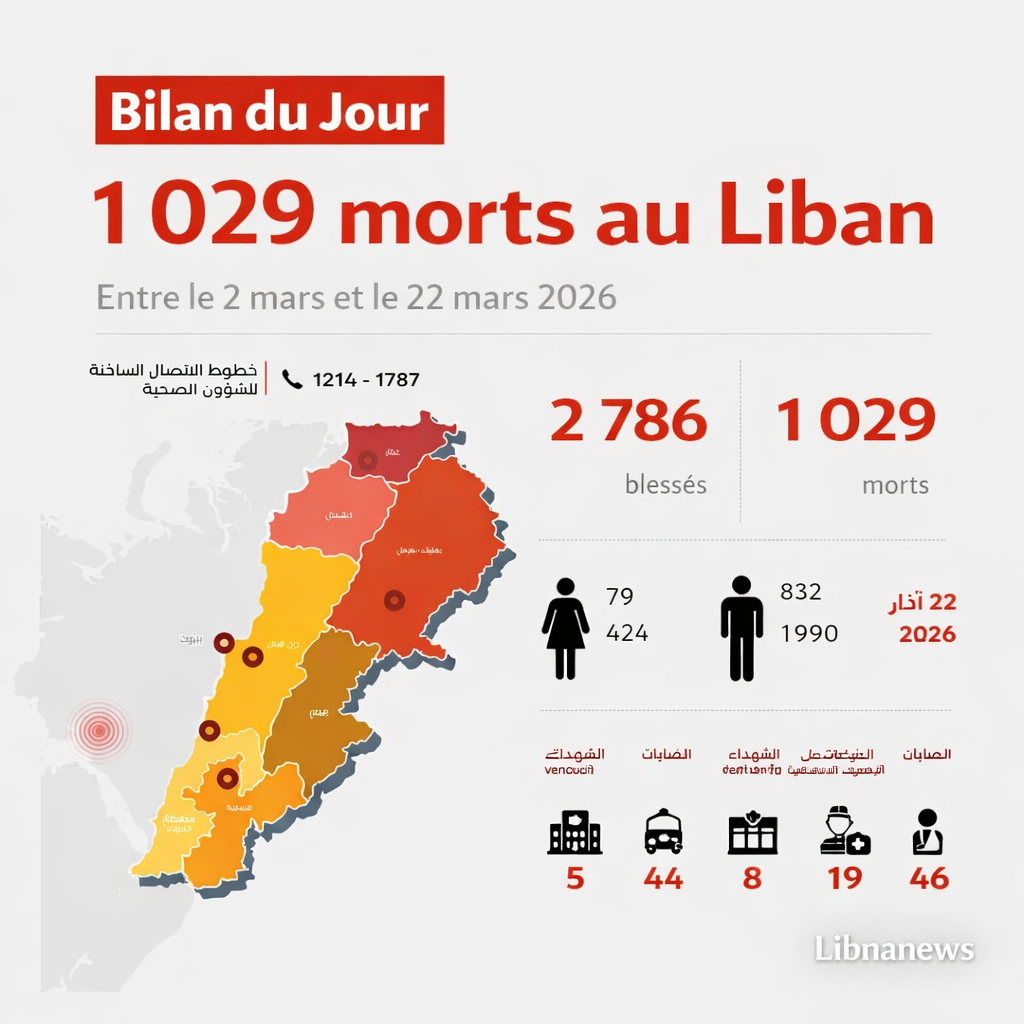
The Lebanese Ministry of Public Health announced on Saturday, in its daily report published by the Centre for Emergency Health Operations, that the Israeli offensive in Lebanon now amounted to1,029 deathsand2,786 injuredbetween2 March and 22 March 2026. This new official point confirms a continuing increase in the human cost of the war, in a context marked by the intensification of strikes in southern Lebanon, the destruction of civilian infrastructure and the raising of warnings from the Lebanese authorities about the risk of an expansion of the offensive.
The report states that for the first day of the22 March, the balance sheet5 deadand46 injured. These figures, relayed by the Ministry, give a measure of the daily violence that continues to strike Lebanese territory, even as the authorities warn against an even more serious deterioration of the humanitarian and security situation. The official information provided by the Ministry also shows that the loss affects the entire population, with victims among men, women and children, a sign of a conflict whose impact is far beyond the scope of military confrontation.
A Human Balance Continues to Climb
The threshold of 1,000 deaths, now crossed in official statistics, marks a new stage in escalation. Between 2 March and 22 March, the conflict1,029 deathsand2,786 injuredAccording to data from the Ministry of Health. This figure reflects less an isolated sequence than a wear and tear dynamic that extends day after day. In Lebanon, the balance sheet is no longer only read through the strikes of the moment, but in the accumulation of losses that redraws the reality of entire regions, especially in the South.
Official information also indicates a breakdown of victims by category. It states that79 women killed and 424 injured, of832 men killed and 1,990 injured, and118 children killed and 372 injured. These data show that the cost of war is not limited to abstract combat zones. It directly affects civilians in all parts of society and recalls that bombing and destruction affect inhabited areas, families and entire communities.
March 22: 5 dead and 46 injured in one day
The daily report points out that the only day of the22 March 2026has done5 deadand46 injured. Even when the daily record appears to be lower than on some particularly deadly days, it confirms that violence remains constant. War is not only expressed in dramatic peaks of intensity. It also settles in the repetition of strikes, in the accumulation of the wounded, in the damage to infrastructure and in the increasing fatigue of emergency services.
These figures are increasing in weight as they intervene as the Lebanese authorities denounce the attack on the bridges, roads and vital facilities in southern Lebanon. The Ministry of Health is not content with this report to update an assessment. It also documents the prolonged effect of a military campaign that undermines the ability of people to move, treat and access relief. The human balance sheet is therefore part of a broader environment of territorial disorganization and damage to civil structures.
The health sector itself under pressure
The information published by the Ministry also shows the direct impact of the war on the health sector. Visual data indicate loss of personnel and damage to emergency facilities and hospital facilities. Even without going into the detailed interpretation of each secondary indicator, one point emerges clearly: the war does not spare the devices that should precisely save the wounded and limit the scale of the disaster.
This aspect is central. When a conflict affects not only residents, but also relief networks, ambulances, medical teams and health facilities, it has a multiplier effect. Every attack, every destruction, every road cut off or every disorganized service mechanically increases the vulnerability of civilians. The official record of 1,029 deaths and 2,786 injuries must therefore also be read in the light of this pressure on the entire health system.
A figure that becomes a political message
In Lebanon, the findings of the Ministry of Health are also politically relevant. They are not only used to count the dead and wounded. They are a document addressed to public opinion, national institutions and the international community. By publishing consolidated figures and a detailed infographic, the Lebanese authorities want to establish an official record of the ongoing humanitarian degradation. The passage over 1,000 dead therefore acts as an additional alarm signal.
This course is all the more sensitive as it comes at a time when Beirut accuses Israel of targeting civilian infrastructure in southern Lebanon and of creating the conditions for an even heavier escalation. In this context, the health report is not only a statistical survey. It becomes part of the Lebanese political and diplomatic record, intended to show that the human cost of the offensive continues to worsen despite calls for restraint and warnings from the authorities.
A war that is long-term
The1,029 deathsFinally says something else: the war has entered into an installation temporality. When balances accumulate over several weeks, they cease to be perceived as the consequences of a single sequence. They describe a lasting reality, where loss of life, displacement, material destruction and saturation of emergency services become the ordinary framework of life in a part of the country.
The Department of Health’s report is not just about March 22. It tells, in a hollow, three weeks of intensification, exhaustion and enlargement of the human cost. Over the days, the number of deaths and injuries is no longer limited to the scale of the strikes. It also measures the rooting of war in the Lebanese landscape, and the gradual removal from any immediate prospect of stabilization.



