

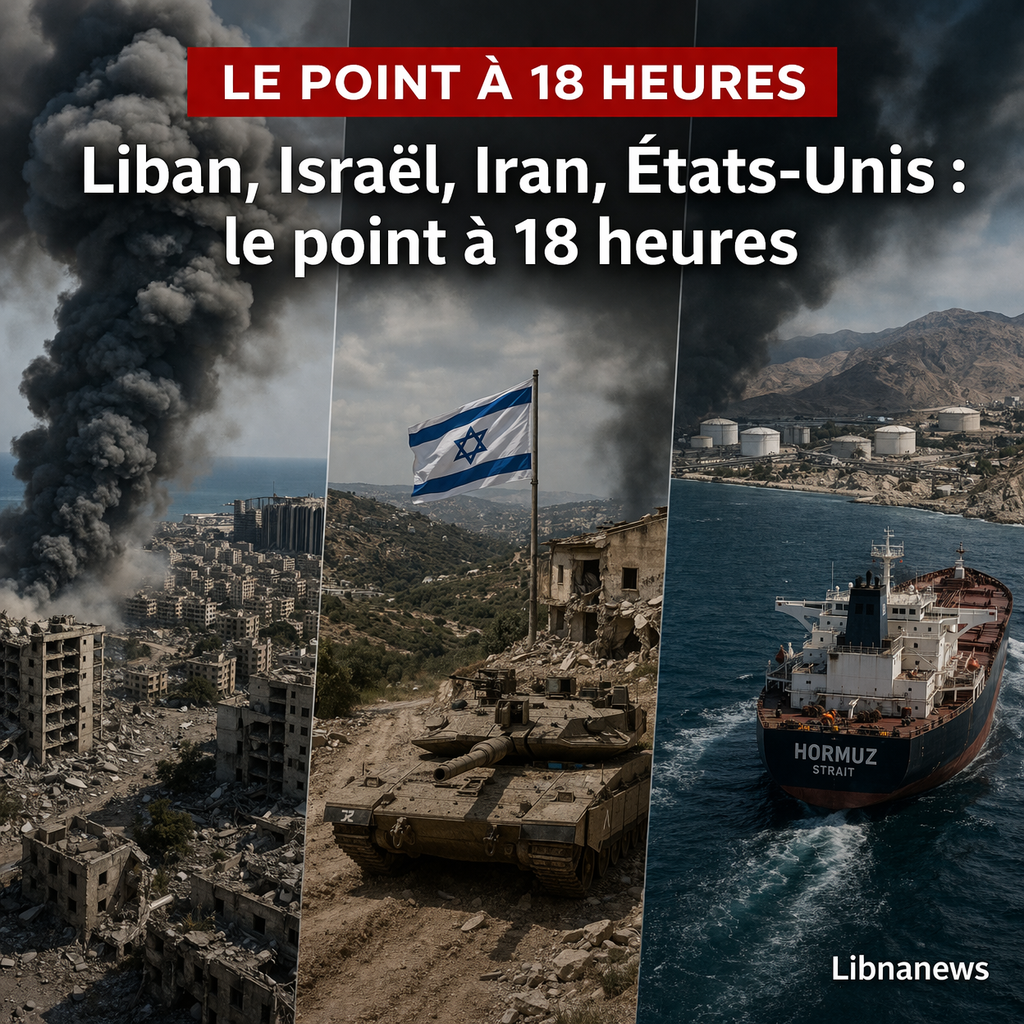
The situation at 6 p.m., Lebanon time, shows a conflict that continues to widen on two interrelated but distinct axes. In Lebanon, the day is marked by an ever heavy human balance, strikes that affect both the South, the Litani axes and the Beirut agglomeration, as well as an Israeli verbal hardening that feeds the fear of a territorial recomposition of southern Lebanon. On the Iranian-American side, the novelty of the day lies in the five-day suspension of American threats against Iranian energy infrastructure, even though Tehran denies the existence of negotiations as presented by Donald Trump. So at 6:00 p.m., there’s nothing to talk about. Rather, the available signals describe a war sequence where military pressure continues, while political discourse becomes more radical and contradictory.
In Lebanon, a human balance that continues to grow
In Lebanon, the official report of the day provided by the health authorities states that10 dead and 90 injuredfor the only day of23 March. The official infographic transmitted for this date brings the cumulative total to1,039 deathsand2,876 injuredSince the beginning of the offensive. These figures confirm two trends. First, the threshold of the thousand dead is now crossed, which changes the nature of the national debate: one no longer follows only an escalation, but a war settled in the long term. Second, 23 March, although not among the deadliest, remains at a sufficiently high level to maintain extreme pressure on hospitals, relief workers and displaced families. The same infographic also shows that the health sector itself has suffered serious cumulative damage, with the40 deaths,119 injured,69 attacks on relief operations,18 affected health centres,44 ambulances reachedand5 hospitals affected. These data reinforce the idea of a crisis that no longer affects only civilians, but also the apparatus responsible for saving them.
Bombardments : Hazmieh, the Litani and the geographical extension of the strikes
In the field, the day confirmed the geographical extension of the strikes. In East Beirut, an apartment was targeted atHazmiehand the initial report on the Lebanese side states at leastone dead. Israel claims to have targeted a member of theAl-Quds ForceIranian. At this time, the identity of the victim was not publicly confirmed by Beirut in the same terms. The scope of this strike goes beyond its immediate record. Hazmieh is a residential area on the outskirts of the capital, and its targeting feeds the fear of a banality of strikes within neighbourhoods that did not, in the perception of a part of the inhabitants, belong to the usual heart of confrontation. The day thus prolongs a dynamic already visible for several days: the war is no longer only distant or border, it also becomes urban, mobile and unpredictable in the Beyrouthin agglomeration.
Further south, the situation around theLitanithe other major event of the day. Israel continued its attacks on crossings and bridges, ordering the destruction of crossings of the river and the acceleration of house demolitions near the border. Strikes again hit passages on the Litani on Monday, after the attack on a major axis during the weekend. In concrete terms, this means that the isolation of southern Lebanon is progressing, with immediate consequences for the movement of civilians, the delivery of basic goods, the movement of ambulances and the territorial continuity of the country. In border localities that still refuse to empty themselves completely, local officials already describe a shortage of public electricity, water and fuel. The military effect sought by Israel is therefore coupled with an obvious humanitarian effect: the more roads are cut off, the more the inhabitants of the South live under the threat of lasting enclavement.
Israeli speech: The Litani at the heart of a more radical discourse
The Israeli statements made or reaffirmed today further reinforced this reading. The most commented comes from the Minister of Finance,Bezalel Smotrichwhich stated that the « new Israeli border » should be theLitani. This is, at this stage, the most explicit formulation by an Israeli minister on the idea of a sustainable take of Lebanese territory to the river. The Prime Minister’s office did not formally endorse this position, but it intervenes at the same time as the army expands its manoeuvres, destroys bridges, razes houses and orders the inhabitants to leave the areas south of the Litani. In these circumstances, Smotrich’s sentence is not perceived in Lebanon as a mere ideological abuse. It is read as the political expression of an already observable military logic on the ground.
This line is part of a wider sequence on the Israeli side. In recent days, the Minister of Defense has threatened Lebanon with a « loss of territory » if he did not disarm Hezbollah, while the Israeli Chief of Staff has spoken of « many days of prolonged combat » to come. The army continues to present its operations as targeted land manoeuvres and raids against Hezbollah fighters and weapons depots, with the stated aim of protecting northern Israel from cross-border fire. But the gap between this security argument and the reality of the destruction of civilian infrastructure is becoming increasingly difficult to ignore. At 6 p.m., the Israeli message thus combines two registers: on the one hand, the conventional military justification through the fight against Hezbollah; and on the other, an increasingly political discourse on the transformation of space south of the Litani River.
Comment by Lebanese officials: sovereignty, humanitarian aid and diplomatic pressure
On the Lebanese side, the official response is organized around three ideas. The first is humanitarian: the President of the Republic yesterday denounced the attacks on infrastructure in the South as acollective punishment policyagainst civilians, warning that they could prepare aLand invasionand hinder humanitarian aid. The second is political: Beirut is still trying to get enough external pressure to stop the war. The third is diplomatic: the Lebanese authorities maintain the idea of opening up to direct discussions if this can help stop the escalation, while reaffirming the State’s willingness to monopolize the military decision in its territory. This line remains fragile, as it unfolds under bombardment and against a Hezbollah that retains its own capacity for action. But at 6 p.m., it is this line that structures the Lebanese official word.
The point on the Lebanese side can be summarized in four elements:
- HumanThe official total now exceeds a thousand dead.
- Territorial: strikes on the Litani bridges, roads and localities in the South increase the risk of lasting isolation of part of the country.
- PolicyIsraeli statements on the Litani give even more worrying content to the ongoing military campaign.
- InstitutionalThe Lebanese power is trying to hold a double discourse of firmness on sovereignty and diplomatic openness, but it does so in a profoundly unfavourable balance of power.
At this point, there is no indication that the evening should mark a change. The available signals are more in the direction of a war that continues to extend its territorial and psychological depth.
Iran–United States: Washington moves back, Tehran denies
On the Iranian-American front, the main development of the day came from Washington.Donald Trumpannounced that he would postponefive daysany strike against Iranian power plants and energy infrastructure. The US President justified this postponement by what he described as « very strong » and close to an agreement, led by his envoy for the Middle East and Jared Kushner. According to his account, both sides would now have « major points of agreement » and a compromise could be reached quickly. This announcement immediately affected markets: oil has declined and stock markets have expanded. But at 6 p.m., this suspension remains conditional, limited in time and surrounded by considerable blur. Donald Trump did not detail the exact format of the discussions, did not publicly identify the Iranian interlocutor and did not provide any specific diplomatic timetable.
It is precisely this lack of concrete follow-up that weakens the scope of the American announcement. Because across the street, Iran is lying. Channels close to the Iranian power denied direct or indirect discussions with Washington, and the Iranian Foreign Ministry publicly rejected the very idea of a dialogue with the United States as presented by Donald Trump. In other words, at 6 p.m., the two accounts do not coincide. Washington talks about diplomatic progress and near-agreement. Tehran speaks of the lack of negotiation and suggests that the US President has mostly declined under pressure. This contradiction forbids presenting the American postponement as a real breakthrough. The most accurate at this stage is to see an American tactical pause in a context where the military, energy and political cost of a strike on Iranian power plants appeared to be increasing.
Ormuz, marine mines and threats of reprisals
The other decisive data concern theStrait of Ormuz. Donald Trump had linked his threat against Iran’s power grid to the complete reopening of the sea passage. Iran continues to use the effective closure or restriction of traffic as a strategic lever. The Iranian authorities warned that an attack on their south coast or their islands would lead to a total closure of the Gulf by the laying of marine mines. At the same time, Tehran threatened to retaliate against Israeli power plants and regional facilities feeding United States Gulf bases if its own power grid was targeted. The conflict is therefore not only taking place on Iranian territory. It also threatens the energy and maritime architecture of the entire region, which explains the continued nervousness of riparian states and global markets.
This tension has a humanitarian extension often underestimated: the vulnerability ofdesalinationin the Arab Gulf countries. Iran’s threats of reprisals against regional energy and water infrastructure have been of great concern, as several countries rely heavily on desalination for drinking water. A strike on these units would not only cause industrial damage; it could create a near immediate health and social crisis. This is one reason why several Arab capitals have argued to prevent an American attack on Iranian power plants. At the same time, disturbances are already affecting the regional energy sector: temporary production adjustments have been announced in the Gulf due to the risks to maritime traffic and infrastructure. At 6 p.m., the issue is no longer only military. It is also water, energy and economic at the regional level.
An American break, but no crisis exit framework
The Iranian situation itself remains very opaque. Donald Trump claims to speak to a « respected » official, while saying that this is not the supreme guide. This formulation maintains uncertainty about the real chain of decision in Tehran, already weakened by the strikes that decapitated part of the Iranian leadership since 28 February. At the same time, Iran maintains a public line of firmness: no normalization of traffic in Ormuz under duress, no recognition of the discussions praised by Washington, and threat of increased reprisals if its vital infrastructure is hit. So the American break does not change the face-to-face structure at the moment. It suspends an extreme scenario without yet creating the conditions for a genuine negotiating framework recognised by both sides.
Lebanon remains caught between two fronts
At 1800 hours, the link between the two theatres, Lebanese and Iranian-American, appeared clearer than ever. In Lebanon, the war continues to expand with deeper strikes, a growing human balance and an increasingly explicit Israeli discourse on the Litani. Between Washington and Tehran, the tone has changed in form but not yet in substance: threats to energy infrastructure have been pushed back, not lifted, and the very existence of substantial discussions remains contested by Iran. This means that Lebanon remains at double risk. On the one hand, the logic of the Israeli campaign against Hezbollah and against Iranian networks on its soil. On the other hand, the effects of a wider confrontation between the United States and Iran, centred on Ormuz, energy and regional retaliatory capabilities.
In summary, the situation at 6 p.m. draws an area that is not entering a phase of de-escalation, but a phase of uncertain reconfiguration. Lebanon still records deaths and injuries every day, sees its infrastructure in the South methodically attacked and hears statements on the Israeli side that undermine the de facto border inherited from the post-2000 and post-2006 era. Iran, for its part, denies the discussions claimed by Donald Trump while maintaining its threats on Ormuz and regional infrastructure if its own vital networks are hit. The United States has retreated one step from Iranian power plants, but for the time being it has not provided a credible mechanism for exiting the crisis recognized by Tehran. In this configuration, the Lebanese evening opens up to a simple certainty: war may change pace, but it does not change logic yet.



