

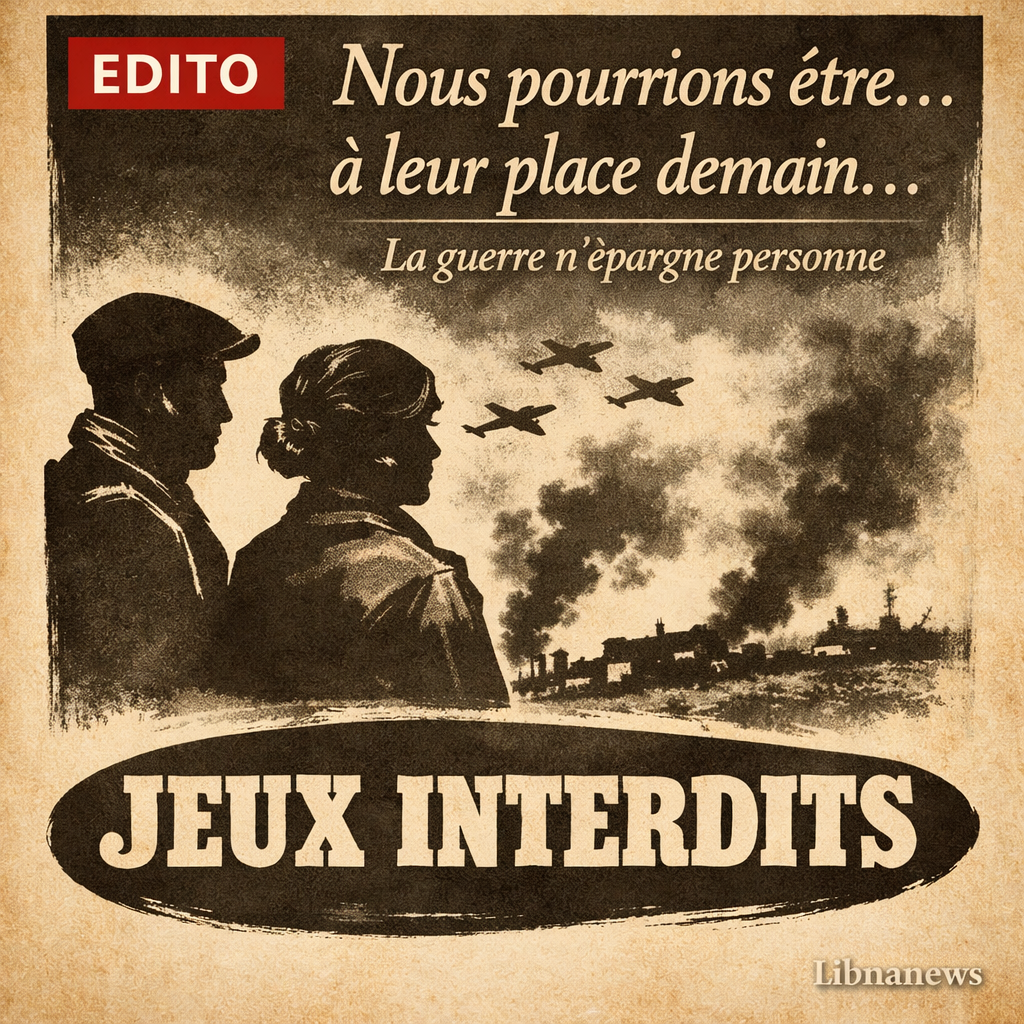
There’s a scene in the Prohibited Games that never really leaves memory. Aircraft are coming up. The sky is becoming a threat. Panic replaces everyday life. Civilians flee, without strategy, without protection, with this naked fear that erases habits, certainties and belongings in seconds. The bombing doesn’t ask who you are. He does not distinguish the innocent from the guilty, the rich from the poor, the believer from the unbeliever, or the village of the neighborhood. He’s falling. And when he falls, he turns ordinary lives into displaced lives, families into escape columns, children into refugees.
Perhaps that is what we must remember today, in Lebanon, with seriousness. One day, each of us can become that face on the road. Each of us can end up running away with a bag, a child, a few papers, an old mother to support, a house behind us that we may never see again. There is no denominational immunity from war. No Community protection against exile. No party card, no family name, no religious affiliation can guarantee that a missile, that a raid, that a bombardment will always spare you. Our enemies don’t make that difference. They do not stop at the threshold of an identity to say: this one deserves to stay at home, this one can die on the road. In war, the first truth is brutal: we can all become displaced people, all become refugees, all depend one day on the door that another will or will not open.
That is precisely why racist relents, rejection speeches, calls to refuse refugees and to ban them until they have the right to exist somewhere are not only shameful. They’re suicidal. They are preparing our own moral fall before even preventing an alleged threat. Today we hear extremists speak louder than others. They are meant to refuse even the idea of camps, places of reception, minimal organization for those who flee. They speak as if the trial of displacement only concerned others, as if the misfortune could be attributed to a particular population, as if suffering could be kept at a distance by decree, by slogan, by hatred. But what exactly do they offer? Where do these families go? What do they sleep on the roads? Do they disperse without water, care, shelter? That they disappear in the ditches of our good conscience? Let them die, simply, so that some fanatics may feel purer in their rhetoric of refusal?
We must have the courage to ask the question in its most cruel nudity: when we refuse even the idea of a camp, i.e. a minimum of organisation, protection, assistance, what do we want instead? Chaos? L’errance? Hunger? Disease? Slow death out of the field? Forms, modalities, guarantees, controls, location, duration, supervision can be discussed. We can and must do it seriously. But, in principle, to refuse any reception arrangements, at a time when civilians are fleeing the bombing, is not patriotism. It’s not lucidity. It is an abdication of the most elementary humanity.
It is necessary to be fair, too, even when anger, fear and exhaustion lead to hardening. Yes, Israel says it targets Hezbollah members, including those in civilian areas. Yes, this reality places people at the heart of unbearable violence, where the border between the military target invoked and the destroyed civilian environment becomes more fragile every day. Yes, this is already a horror, because no strategic formula removes shredded bodies, open buildings, terrorized children, displaced families. But this horror does not exempt us from anything. It does not allow us to respond to a crime by another order of moral misconduct. It does not allow us to add to the war crime a second crime, perhaps quieter, but just as devastating: that of the lack of humanity towards civilians.
Because you have to call things by their name. When people are hit in civilian areas, there is already a deep injury to the right, morals and even the idea of protecting non-combatants. But if, at the same time, the society that receives the displaced begins to treat them as an unworthy burden, as a demographic defilement, as an abstract danger that should be repelled without solution, then it also participates in the collapse of the human minimum. She’s not bombing, of course. She doesn’t launch missiles. But it removes from the victims what was left of them: the right to be recognized as human beings to help.
There is something deeply abject in some speeches today, because they claim to defend the country by amputating its conscience. They speak of security, but they undermine the only thing that gives collective meaning to the survival of a country: the ability to distinguish between fear and cruelty. A people is not saved because they can close their doors to the most vulnerable. He is saved when, even if wounded, even threatened, even at the end of his life, he refuses to let himself be governed by the reflex of dehumanization. Racism is never a protection. It is always a beginning of ruin.
It will be objected that Lebanon is at the end, that its resources are limited, that the state is weak, that the balances are fragile, that history has left too many wounds for the reception to be a simple evidence. All this is true. But it is precisely in extreme situations that justice takes its real weight. Being just doesn’t mean being naive. To be fair means to recognize that the fleeing civilian has rights, whatever his name, his region, his community, the political formation that is suspected around him, or the calculations that others project on his presence. To be fair means to organize instead of giving up, to frame instead of giving up, to protect instead of designating to vindiction.
No Lebanese worthy of this name should forget that the history of this country is also a story of displacement, fears, crowded roads, improvised shelters, houses left in haste. In our collective memory, we have enough escape images to know that we don’t joke about refugee status. She can hit anyone. Today it’s them, tomorrow it can be us. And on the day when it will be us, we hope that there are still some men and women who can see in us something other than a threat to repel.
That’s why you have to keep a simple but firm line. Yes, those who endanger civilians by operating from inhabited areas can be unequivocally condemned. Yes, we can denounce the strikes that affect these areas and the military logics that turn them into death spaces. Yes, we can demand that the practices that make neighborhoods, villages and buildings theatres executed under the pretext of hunting fighters there cease. In the same breath, however, Lebanese society must not become complicit in another form of abandonment by treating the displaced as undesirable.
Justice is not divisible. We cannot claim the protection of civilians from bombs and then refuse to grant them minimum protection when they knock on our door. We cannot denounce the violence that strikes upon them, then condemn them to wandering so as not to disturb our prejudices. There is a moral coherence to hold, especially when everything pushes to give up. This consistency says one very simple thing: faced with the displaced civilian, the obligation is not to suspect first, but to rescue first.
A country doesn’t just fall under bombs. It also falls when it lets extremists define what is acceptable, when it lets fear disguise itself in doctrine, when it ends up considering that a family on the road is a problem before being a distress. By that time, the fall had already begun. Not only the fall of institutions, but of the public soul.
And maybe that’s where the forbidden Games scene still looks at us. Not as a cinema memory, but as a political and human truth. Aircraft always arrive first in someone else’s sky. Until the day this sky becomes ours.



