

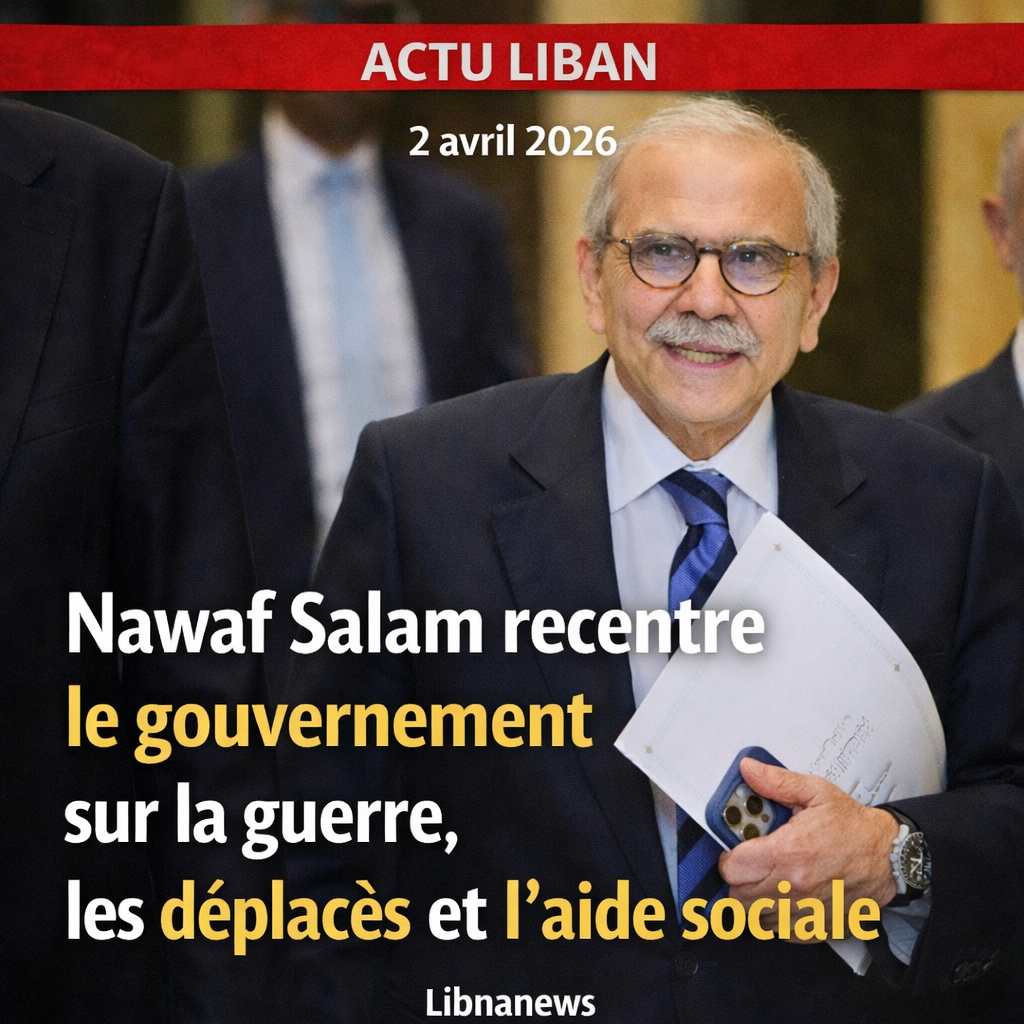
At the conclusion of the Council of Ministers meeting in the Grand Sérail, Prime Minister Nawaf Salam reaffirmed his government’s line: to work to stop an « imposed » war in Lebanon, to strengthen aid to the displaced and to support the residents remaining in the exposed localities. The meeting also resulted in concrete decisions, including the approval of a $200 million loan for social safety nets and a monthly allowance for active soldiers and retirees.
A month after the changeover to a wider war, the Council of Ministers wanted to display a twofold line: political firmness over state sovereignty, and social management of a crisis that is rooting out. Before the ministers, Nawaf Salam recalled that the government had, from the outset, rejected any military action outside the legal institutions and reaffirmed that the decision on war and peace must remain in the hands of the State. He again presented Lebanon as the country of a war suffered, but not chosen, stressing the need to use « all available means » to obtain a cessation of hostilities and to mobilize wider Arab and international support.
The head of government also tightened the tone against Israel, believing that the ongoing offensive was no longer limited to the continuation of military operations observed since the cessation of hostilities agreement of November 2024. In his statement, statements by Israeli officials and the Israeli army reflect broader objectives, ranging from the occupation of new parts of Lebanese territory to the idea of buffer zones or safety belts. The aim of this reading is to place war in a broader political framework: that of an attack on the sovereignty, territorial integrity and internal stability of Lebanon.
A speech centered on the state and the rejection of parallel wars
Nawaf Salam sought to lock the official position of the executive. His message is clear: Lebanon does not want to be drawn into regional conflicts that do not meet any Lebanese national interest. In this context, he warned against anything that might link the country’s fate with wars led by other regional actors. This formulation is a continuation of the line advocated by the government since the beginning of its mandate, with particular emphasis on the state’s monopoly on security and strategic decision-making. Reuters already reminded early March that Nawaf Salam had publicly affirmed the executive’s will to ban any Hezbollah military activity outside the state framework in response to regional escalation.
At the same time, the Prime Minister avoided locking his intervention in the institutional register alone. He also stressed the risk of internal fracture. For him, one of the priorities of the moment is to prevent external war from turning into civil tension on Lebanese territory. Hence his call to raise « the spirit of national solidarity and human brotherhood » above the reflexes of mistrust, hate speech and the logics of mutual denunciation. In other words, the government attempts to link state sovereignty, internal cohesion and humanitarian management in a single political discourse.
The most sensitive part of his intervention concerns internally displaced persons. Nawaf Salam recalled that they are the « first and main victims » of a war that they are neither determined nor desired. The Government therefore intends to obtain more support for their accommodation, care and security, while ensuring that the host populations throughout the country do so. This is central, as the displacement crisis is no longer a matter of urgency. It becomes a structural fact of war, with effects on social balances, the local economy, public services and the national political climate.
A social dimension under economic pressure
The meeting of the Council of Ministers was not only political. It has also led to social and financial support measures. The most important is the approval of a $200 million loan agreement from the World Bank to finance a social safety net enhancement project. This decision is part of a broader framework already validated by the international institution: at the end of January, the World Bank approved $200 million in funding to support poor and vulnerable people in Lebanon, following the economic collapse that began in 2019. Reuters said this funding was part of a larger package of $350 million.
The Government has also decided to grant monthly financial assistance to serving members and retired members of the military institution. In the Lebanese context, this is politically important. It aims to support a body considered one of the last functional pillars of the state, while responding to the erosion of the purchasing power of uniformed personnel. It is also part of the broader commitment of the authorities to preserve the cohesion of security institutions as military, social and territorial pressure increases.
Information Minister Paul Morcos also detailed the economic background of the meeting. According to his report, the Minister of Finance referred to a global environment dominated by war, the slowdown in trade, rising prices, particularly oil, and a decline in foreign exchange inflows. He also noted that the international aid response was less important than in 2024. This diagnosis led the executive to consider budgetary adjustments in the light of the increasing health, social and subsistence needs.
An economy under stress and aid diplomacy
The Minister of Economy has also drawn up a degraded picture. According to the figures presented to the government, the Lebanese economy is already suffering the effects of an imposed war, with an estimated contraction between 7 and 10 per cent according to an ongoing field study. The authorities also stressed the rise in unemployment, fuelled by the magnitude of internal displacement, as well as the risks associated with inflation, speculation and commodity retention practices. However, the Government states that the situation remains « under control » at this stage on certain indicators, including procurement, through interventions by the Ministry of Economy against fraud and grabbing.
In this sequence, another signal deserves attention: the Minister of Finance must go to Washington with a small delegation to meet with the World Bank and try to mobilize more aid, including the conversion of certain loans into humanitarian aid. The choice of Washington is not trivial. It reflects the government’s belief that managing the current shock cannot be based solely on the internal resources of a state already weakened by years of financial crisis. The aim is to transform the humanitarian emergency into a broader lever of international support.
This recourse to external assistance occurs in a country whose social vulnerability is already massive. The latest World Bank publications recall that Lebanon saw a large part of its population shift below the poverty line after the collapse of 2019, and that strengthening social protection mechanisms has become a structural priority, far beyond the current war alone. In other words, the conflict does not create Lebanese fragility; it worsens and accelerates.
Journalists, health sector and villages in the South at the heart of alerts
The Council of Ministers also devoted part of its work to the direct human cost of war. According to the Minister of Health, quoted by Paul Morcos, 95 direct attacks targeted health, medical and relief teams. Ten hospitals were reportedly hit, five closed by force, twenty rescue centres attacked and 67 ambulances or rescue vehicles damaged. The same assessment shows 53 deaths and 137 injuries in the health sector alone. These figures have led the Government to broaden its consideration of legal and diplomatic remedies for attacks on medical and humanitarian facilities.
On this point, Paul Morcos also presented his efforts to protect journalists, recalling a previous government mandate from October 2025 on the examination of legal options related to Israeli attacks on the press. He spoke of contacts with Finul, Unesco, the UN Special Coordinator and representatives of the European Union. The Council of Ministers decided to entrust to the National Commission on International Humanitarian Law, chaired by Deputy Prime Minister Tarek Mitri, the examination of these cases, in coordination with the Ministry of Foreign Affairs, in order to bring complaints and documented material to the relevant international fora, including the Security Council and the Human Rights Council in Geneva.
The needs of the villages remained on the front line, especially in the South, were also raised during the meeting. The Minister of Justice stressed the need to protect remaining communities and ensure humanitarian, food and medical extensions. Nawaf Salam, in his closing address, also addressed « the greatest greeting » to the inhabitants who remained in their towns and villages, promising them that the government would spare no effort to provide them with the means to hold. Again, the official discourse combines national firmness with concrete assistance.
A majority of governments who want to show coherence
Beyond the technical decisions, Paul Morcos’ report sought to convey an additional political message: that of coherence between the Presidency of the Republic and the Government. Asked about the fact that some meetings were not held in the presidential palace, the minister assured that this reflected the agreement between President Joseph Aoun and Nawaf Salam, stressing that « the government is one » and that the diplomatic action of the Head of State was proceeding in parallel with that of the executive. This insistence is not insignificant in a Lebanon accustomed to institutional rivalries. It aims to present the hour as that of minimum alignment at the top of the state.
This desire for unity is also reflected in Paul Morcos’ defence of « the presidential initiative ». According to him, Joseph Aoun’s proposal to end Israeli attacks and war is one of the few sequences in which Lebanon speaks with one political voice. The government is therefore seeking to capitalize on this rare institutional clarity to strengthen its external credibility. In a country often accused of ambiguity or fragmentation, the executive wants to appear as the bearer of a legible position: cessation of war, refusal of occupation, assistance to displaced persons, protection of civilians and strengthening of State institutions.
This Thursday’s Council of Ministers has not only managed emergencies. He tried to set a government story straight: that of a country caught in a war he said he was going through, of a state that wanted to take over politically, and of an executive who was at the same time seeking to contain the social collapse. Between the World Bank loan, aid to the military, advocacy for the displaced and reporting violations of sovereignty, Nawaf Salam wanted to show that in times of war, governing still consists of holding three fronts at once: diplomatic, social and institutional.






