

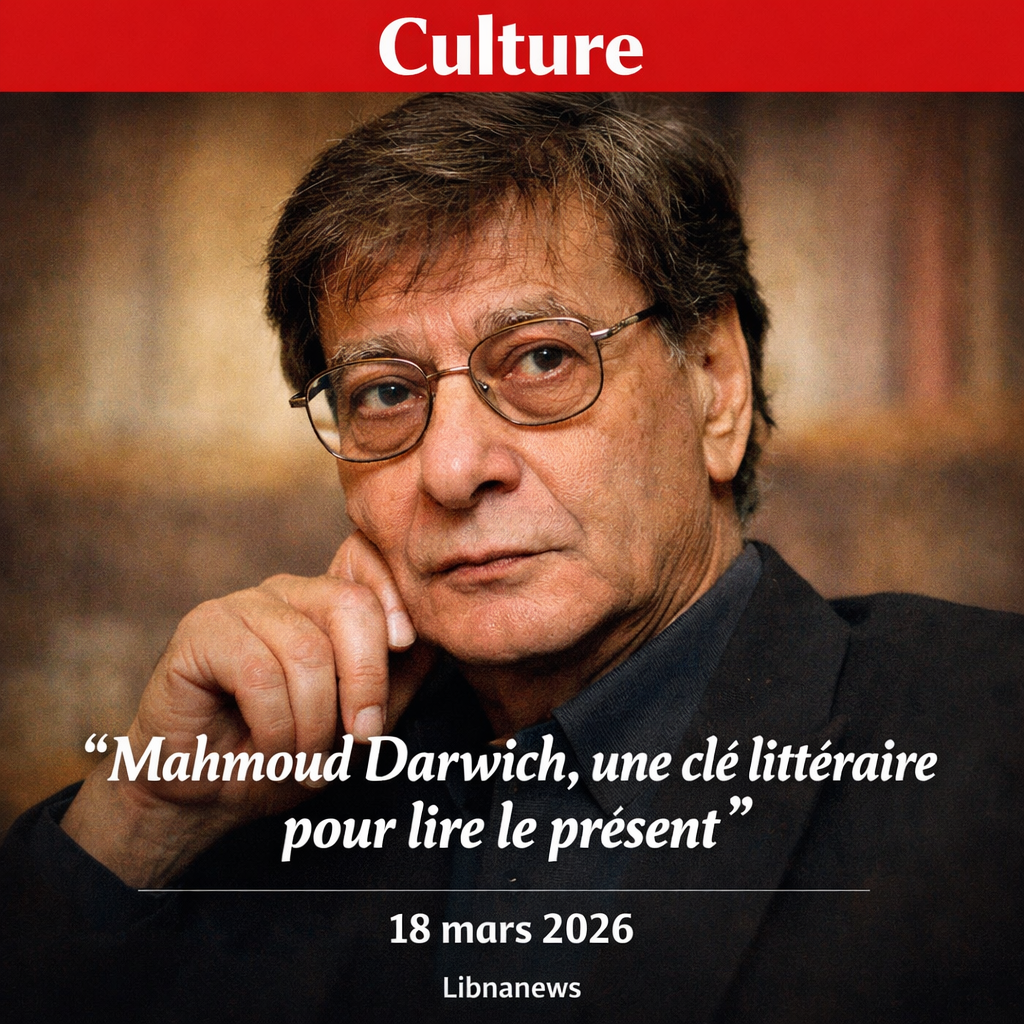
There are writers who are commemorated, and others who read because their language continues to illuminate the present time. Mahmoud Darwich belongs to the second category. More than fifteen years after his death, his work is neither a fixed heritage nor a mere cultural tribute. It remains an active word in the Arab world, because it has been able to transform the Palestinian experience into a universal poetic matter, without ever ripping it from its concrete history. In the last few days, an articleAl Quds Al ArabiThe strength of this presence was restored through the dialogue between Darwich and Elias Sanbar, as well as the resumption in Paris of the long composition « The earth is transmitted as the language », sign that in March 2026, Darwichian poetry continues to be read, spoken and reinterpreted on contemporary cultural scenes. This return has nothing to do with nostalgic ritual. On the contrary, he says that Darwich remains one of the few authors able to provide, through literature, a sensitive intelligence of the Arab present.
This news from Mahmoud Darwich comes first from the nature of his work. Born in 1941 in Al-Birwa, a Palestinian village destroyed in 1948, and then became one of the great voices of contemporary Arab poetry, Darwich gave a literary form to experiences that lost nothing of their intensity: exile, dispossession, waiting, wounded memory, tension between the earth and absence, between identity and its fragility. LEncyclopaedia Britannicarecalls that his writing gave voice to the Palestinian struggle and that his poems are particularly marked by loss, exile and resistance. But to reduce Darwich to a « poet of the cause » would be to read it too closely. His strength consisted precisely in bringing the Palestinian experience out of political rhetoric to include it in a language of doubt, lack, love, fear and survival. That is why his poetry remains legible beyond Palestine alone: it affects the way in which Arab societies experience uprooting, war, humiliation and the persistence of the desire to stand.
If Darwich remains a major literary reference for understanding the present, it is also because his work never separates intimate history from collective history. At home, memory is not a museum. It acts as a moving force, sometimes painful, sometimes saving, which prevents complete erasure. In its texts, land is not only a lost or claimed territory. It is a space inhabited by names, voices, daily gestures, mothers, villages, smells, seasons. The language, for its part, is not only used to describe this land. It becomes the extension, the surviving proof, sometimes the last place where membership can still be accommodated. The recent articleAl Quds Al Arabidedicated to « The earth is transmitted as the language » insists precisely on this articulation, recalling that a great Parisian scene chose to highlight this work in March 2026. This detail counts. It shows that at a time when the Palestinian question returns to the centre of the world consciousness, Darwich reappears not as an archive, but as a word capable of linking inheritance, transmission and news.
A work that has kept on talking to the present
In the Arab intellectual landscape, Mahmoud Darwich occupies a singular place. He was not only a poet of collective emotion. He was also a writer of complication. Its importance lies in its refusal to reduce Palestine to a slogan and identity to a closed formula. His writing advances in contradiction. She claims to be a member, but is wary of being locked up. She sings the earth, but knows that exile even transforms the memory of the place. It carries a national memory, while keeping open the possibility of a wider human experience. This tension explains its longevity. Where other voices remain attached to a specific historical moment, Darwich continues to circulate because he has given a lasting form to realities that have not disappeared.
The contemporary Arab world, through forced displacement, long wars, hard borders and broken societies, finds in its work a familiar emotional and political lexicon. At Darwich, exile is never just a geographical outing. It becomes a condition of being. You can be exiled away from your country, but also at home, in a besieged city, in a controlled language or in a time that no longer recognizes you. This depth explains why it remains so present in the readings of the current crisis. His work allows us to think together of material catastrophe and internal persistence. It says how a people can be struck, dispersed, displaced, while still carrying an imaginary, a memory and a word. This is exactly what makes his poetry so current in debates about Gaza, Palestine, Lebanon, Syria or other Arab spaces worked by war and fracture.
Darwich’s importance is also due to his ability to transform poetry into a place of thought. It does not give immediate political answers. He does not write editorials in verse. It produces something else: a poetic intelligence of the tragic. In his texts, the historical drama never completely crushes the inner life. Love, mother, bread, coffee, landscape, tongue, fatigue, body, childhood and death coexist with national dispossession. This coexistence is essential. It recalls that societies in crisis are not only made up of power relations, destruction statistics or military maps. They are also made of human beings who remember, who desire, who fear forgetfulness and who continue to name the world at the same time as it vacculates. This is where Darwich remains a landmark. It prevents the reduction of the crisis to its own political mechanics.
Exile, not as a theme, but as a condition
One of the major themes of Mahmoud Darwich’s poetry is exile. Yet this word must not be understood in the most limited sense. Exile at home does not mean only forced departure, border crossing or life away from home. It refers to a lasting fracture between self and place, between name and home, between memory and present. This fracture is going through the Palestinian condition, but it is far beyond that framework. It also sheds light on the contemporary feeling of an Arab world where millions live between displacement, waiting, impossibility of return and fear of erasure.
This topic of exile resonates today with a particular force. The region is marked by massive population movements, destroyed cities, generations growing between two languages, two homelands or two forms of absence. Read Darwich in this context, it is not only returning to a great Palestinian poet. It is to find a grammar of uprooting that helps to think of contemporary Arab life. At home, exile is not an accident that closes with time. It becomes a structure of meaning. It transforms the relationship to memory, body, language and the future. He forces us to wonder what remains when the place withdraws, when the house disappears, when the earth continues to exist but under the other’s gaze, under control, or in memory alone.
That is why his work remains so present. She’s not just talking about a past drama. She speaks of a present condition. Contemporary Arab societies, even when they are not directly Palestinian, recognize in Darwich a part of their own experience: that of an unstable relationship to space, of an unceasingly discussed identity, of a memory threatened by violence or time. Darwich transforms this instability into a poetic form. He doesn’t solve it. He makes it readable. And this is often what literature does best when politics fails to say the real.
Memory as resistance against erasure
The second major Darwichian theme, inseparable from the first, is that of memory. Again, we must guard against too simple a reading. Memory in his home is neither pure celebration of the past nor mere sentimental fidelity. It’s a fight against erasure. She works against the disappearance of names, the destruction of places, the confiscation of the narrative. In this sense, it is never passive. She’s acting. She collects the fragments. It restores a human density to what violence wants to silence.
This memory is deeply linked to the current situation. The contemporary Arab world is crossed by conflicts that not only destroy lives, but also archives, houses, neighbourhoods, landscapes and cultural continuity. In this context, rereading Darwich reminds us that the crisis is not just material. She’s also narrative. Who’s talking? Who names? Who transmits? Who preserves the tracks? The resumption in March 2026 of « The earth is transmitted like the tongue » reminds us precisely that, at Darwich, transmission is at the heart of the poetic gesture. The earth is not reduced to a soil. It is also what is bequeathed by speech, by rhythm, by collective memory. This intuition remains strikingly topical in a time when we see how the struggle for existence also involves the struggle for narrative.
Darwich then helps us understand that memory is not the enemy of the present. It is one of the raw materials. In contemporary crises, the past continues to return, not as a mere memory, but as an active element of identities, conflicts and imaginations. His poetry gives this return a particular depth. It shows that it never lives only the immediate present. Survivors, absences, upset inheritances are also present. That is why his work still speaks so strongly to Arab readers of different generations. She puts words on this life in the strata of time, on this feeling of being both here and elsewhere, now and in the shadow of an unclosed past.
A poetry that connects the intimate and collective
What also distinguishes Mahmoud Darwich from part of militant poetry is his ability to connect collective history with intimate experience. He doesn’t write from a stand. He’s been writing from an injury that thinks. In him, the exile passes through the body, the fatigue, the voice, the desire, the relation to the mother, to the beloved, to the landscape and even to silence. This dimension is crucial to understand why his work remains current. In the contemporary Arab world, crises are often described through geopolitics, armed confrontations, foreign interventions or regional alignments. All this is necessary, but incomplete. Literature, for its part, recalls what people experience in the depth of these events.
Darwich specifically offers this other reading. His poetry does not ignore politics. She’s going through him all the time. But she moves him to the land of existence. She asks what becomes of a human being when history takes him away from his place, when he has to transmit an injured memory, when he lives in the midst of loss and self-sustaining. This question is eminently contemporary. It applies not only to Palestine, but also to all Arab societies subjected to war, exile, internal fractures and the fragility of belongings.
In this, literature offers a different reading of the crisis. It does not replace political analysis or journalistic work. It complements them by reintroducing what strategic discourses often leave out of scope: the texture of lived time, the persistence of memory, the anguish of disappearance, the fragility of identities exposed to violence. Read Darwich today, therefore, is refusing a purely eventful reading of the Arab world. It is to recognize that current crises are not only facts but also experiences. And that these experiences require a language capable of carrying both pain, lucidity and dignity.
Darwich and reading the contemporary Arab world
Finally, Mahmoud Darwich’s lasting strength comes from his access to a broader understanding of the contemporary Arab world. His work does not only refer to Palestine as a special case. It makes Palestine a scene where broader questions are concentrated: dispossession, domination, memory, identity, language, the relationship between the individual and history. It is this condensation capacity that explains its continuous centrality. Through it, a national experience becomes a form of regional knowledge.
The recent return of Darwich in cultural news, through the Parisian scene and the text ofAl Quds Al Arabi, provides a discreet but strong proof of this. When a poet who died in 2008 returns with such obviousness in the present debate, it is not because he would have become an icon without content. That’s because his language continues to provide tools to think. In a world saturated with images, immediate reactions and instant comments, Darwich imposes another temporality. It obliges us to reread the present in the light of the long durations: loss, exile, transmission and memory.
This temporality is precious. It prevents us from confusing topicality and understanding. The contemporary Arab crisis is not only captured by the flow of news. It involves mediations, works, forms capable of including the event in a larger history. Darwich performs this function. It does not give the whole of the real, but it restores an essential depth. It recalls that peoples do not only live through diplomatic decisions, conflicts and power relations. They also experience words, rhythms, memories and stories that prevent them from disappearing symbolically before they even disappear politically.
That’s why Mahmoud Darwich remains much more than a major name for modern Arabic poetry. There remains a literary reference to understand the present, because it articulates what the contemporary Arab world still experiences with such intensity: exile without fence, threatened memory, disputed land, language as refuge and dignity as a form of resistance. As the region continues to go through wars, movements and crises of representation, its work appears less as a monument of the past than as an ever-active reading key, a way to inhabit Arab time without yielding to either amnesia or simplification.



