

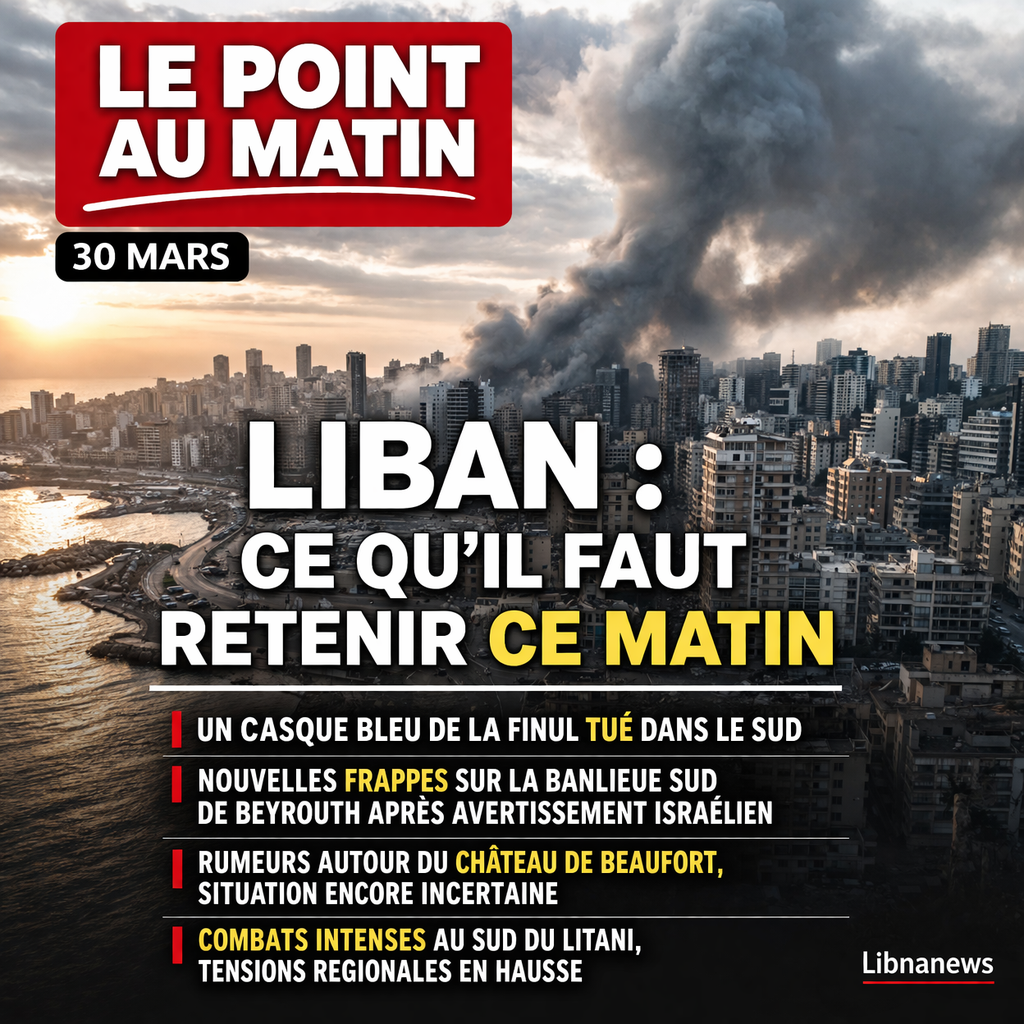
TheLebanonwaking up this Monday on a cluster of disturbing signals: a Finul Blue Helmet was killed in the South, new strikes targeted the southern suburbs of Beirut after Israeli warning, and fighting south of the Litani continues to fuel rumours, grey areas and increasing tensions. Over the last 24 hours, the sequence confirms a military, humanitarian and informational intensification, while the Lebanese front is now inseparable from the wider war between Israel, Iran and, in the background, the United States.
In detail, Finul announced that one of its soldiers was killed in the night when a projectile exploded in one of its positions near Adchit al-Qoussair in southern Lebanon. Another Blue Helmet was seriously injured, while the Indonesian Ministry of Foreign Affairs reported that the victim was Indonesian and that three other contingent members were injured by indirect artillery fire nearby. The United Nations mission said it was unable, at this stage, to establish the origin of the projectile and opened an investigation. This point is central: it recalls that international positions, supposed to play a stabilizing role, are now also exposed to a more diffuse conflict, made up of close strikes, cross-fires and moving front lines.
On Lebanese ground, the last 24 hours have also been marked by new Israeli bombings. Local images and dispatches reported a strike on the southern suburbs of Beirut following an Israeli warning targeting several neighbourhoods. In the south, local media continued to report raids, artillery fire and fighting on several axes, while pressure was increasing throughout the border strip and towards the heights from Hermon to Shab`a farms. This sequence confirms a method that has now been run: warning, partial or total emptying of an area, and then strike presented by the Israeli army as directed against Hezbollah infrastructure. For the inhabitants, it maintains permanent instability, as even areas already largely deserted remain under threat.
Sunday also left a very heavy mark on the human balance. The Lebanese Ministry of Health reported that the number of deaths since 2 March had risen to1 238, for3,543 injured. The last survey refers49 deathsand116 injuredon the last 24 hours, with among the victims124 childrenand52 medical and relief personnel. These figures do not all speak of the reality of the ground, but they draw a clear trend: humanitarian degradation is accelerating even as the response capacities are being eroded. The UN agencies and WHO, for their part, recalled that at least75 attacksagainst the health sector had been reported since 2 March in Lebanon,51 deathscare providers and115 injured.
The other event of the last few hours remains the death of three journalists in southern Lebanon, immediately denounced in Beirut as an attack on the press. The victims include Ali Shoeib, correspondent for Al-Manar, and Fatima Ftouni and Mohammed Ftouni d’Al-Mayadeen. The episode weighed heavily in the Sunday sequence, not only for its symbolic load, but also because it is part of a series of attacks affecting journalists, rescuers and civilian personnel near the front. The Lebanese authorities described this as a crime against journalists, while Paris recalled that media professionals should never be targeted. In the country, this case reinforces the idea that the protection lines usually accepted in wartime are narrowed day by day.
A more mobile south front, but still opaque
The most sensitive point this morning is the evolution of the contact line south of Litani. Several signals show an expansion of the Israeli operation. Follow-up of the night reported an Israeli will to extend the area of action in southern Lebanon, while Lebanese media relayed an Israeli cross-border operation from Mount Hermon to southern Lebanon. At the same time, LBCI reports highlight an expansion of operations along the northern heights from the Hermon to the Shabaa farms. This combination suggests a strategy of locking high axes and dominating points, with a clear military objective: to remove fire and reduce Hezbollah’s harassment capabilities on the northern border of Israel. But it also leaves a broader political question: how far is this de facto buffer zone expected to spread?
It was in this context that rumours were circulated during the night and in the early morning about a capture of Beaufort Castle, or Qalaat al-Shaqif, in southern Lebanon. The site, charged with a high symbolic and strategic value, dominates an important part of the southern relief. Open source tracking accounts referred to his capture by Israeli forces. At the time of writing, no independent and explicit confirmation emerges from the main Lebanese dispatches consulted this morning. This caution is all the more necessary since Beaufort has been reporting for decades both the battle of positions and the battle of narratives. In the state, it is therefore more rigorous to speak of apersistent rumoragainst a background of Israeli progress, not a definite fact.
The fog around Beaufort is not anecdotal. He says something about the current war at theLebanon: a war where tactical information circulates very quickly, often before being crossed, and where every height, every village and every road node can become within hours a military, media and psychological issue. For Israel, allowing the idea of progress in this sector to be filtered would have operational and symbolic value. For Hezbollah and its supporters, denying or relativizing such an advance is also a battle of perception. At the local level, there is more to it than anything else: the increase in danger, the destruction of roads, the isolation of entire areas and the growing difficulty for relief workers to intervene quickly. This reading derives from the information already available, but remains partly an analysis based on still moving elements.
Beirut under threat, South under fire
This morning’s strike on the southern suburbs of Beirut after Israeli warning reminds us that no compartment of the Lebanese theatre is now isolated. The pattern observed since the beginning of the month is repeated: Israel continues to treat the Dahiyeh as a space of recurrent strikes, even when a large part of the population has already left. This logic weighs far beyond the target neighbourhoods. It feeds anxiety in Greater Beirut, disrupts economic flows and maintains a climate where the displacement of the inhabitants itself becomes an indicator of war. Again on Sunday, Palm celebrations took place in several churches under the threat of conflict, indicating that the country is trying to maintain a minimum civilian life despite the intensification of strikes.
In the south, the situation seems even more tense because the war overtakes increasing logistical and humanitarian constraints. The bridges and roads are damaged, the rescue teams work under the risk of a second strike, and the communes near the front line empty in successive waves. The last report of the Risk Management Unit refers to136 147 internally displaced persons. In some areas, residents no longer leave only to escape a strike, but because they can no longer anticipate where the danger line really is. The topography of the South, made up of heights, valleys and villages connected by a limited road network, reinforces this vulnerability. As the fighting moves, the entire architecture of the territory becomes a risk factor.
24 hour indicators
| Indicator | Last known level |
|---|---|
| Deaths in Lebanon since 2 March | 1 238 |
| Injured since 2 March | 3,543 |
| Deaths in the last 24 hours | 49 |
| Injured in the last 24 hours | 116 |
| Children killed since 2 March | 124 |
| Survivors killed | 52 |
| Displaced | 136 147 |
These numbers give an order of magnitude, not a complete picture. They must be read as benchmarks of evolution. The number of internally displaced persons remains, for example, lower than other broader humanitarian estimates, because counting methods vary among agencies. On the other hand, the dynamics are consistent from one source to another: civilian losses are increasing, the health sector is paying an unusually heavy price, and military pressure is combined with a collective exhaustion effect. The death of an Indonesian Blue Helmet adds an additional alarm signal: even international stabilization devices are no longer sheltered in the current operational environment.
International plan redefines every Lebanese hour
It became impossible to read the Lebanese situation without looking at what was played in the night at the regional level. The Israeli army announced that it was continuing to strike military infrastructure in Tehran, while Iran continued to send missiles to Israel according to the Israeli army. In the Gulf, Kuwait reported an attack on a desalination plant also producing electricity, with an Indian worker killed, and Saudi Arabia reported intercepting five ballistic missiles heading towards its eastern province. The conflict therefore extends far beyond the face-to-face Israel-Iran: it affects maritime routes, energy sites and regional partners, which immediately reverses Lebanon, both direct theatre and projection area of a wider conflict.
Donald Trump has further tightened the tone, saying that there is a « regime change » in Iran and arguing that 20 tankers could transit through the Strait of Ormuz in the coming days. At the same time, he suggested that the United States could very easily take control of the Iranian island of Kharg, the country’s major oil terminal. These statements do not in themselves alter the military situation in Lebanon, but they reinforce the impression of an escalation without stable doctrine: on the one hand, a maximalist American word; on the other, tactical openings evoked around Ormuz. For Beirut, this means above all that the Lebanese front remains vulnerable to decisions taken far beyond its borders.
The economic impacts are already visible. In Asia, the markets opened in sharp decline and the oil went up again, with a barrel of WTI going up over $100 according to several market tracking reports this morning. Israel, for its part, validated a highly defence-oriented 2026 budget, with more than 30 billion shekels added to the ministry concerned, bringing this item to over 142 billion shekels according to the Knesset Finance Committee. The Israeli Ministry of Defence has also announced an order for $148 million in 155-mm shells from Elbit Systems. These accounting and industrial decisions are important to Lebanon, as they indicate that war is not being thought, on the Israeli side, as a mere sequence of a few days.
IAEA also reported that the Khondab heavy water complex was no longer operational after the Israeli strikes, but that no declared nuclear material was there. This element is not directly relevant to Lebanese territory, but it sheds light on the nature of the regional moment: operations are now targeting sites of very high strategic value, with potential effects on the military, diplomatic and energy posture of the entire region. For Lebanon, this means a simple thing: the more the conflict is rooted in long-range objectives, the more distant the prospect of a local respite.
What it changes for Lebanon this morning
On a Lebanese scale, there are three clear trends. First, the war has entered a phase in which there are no longer only numerous incidents: they respond to each other. A strike in Beirut was no longer dissociated from a thrust south of the Litani, nor from a night of strikes on Iran. Then the protected space is reduced. Civilians, relief workers, journalists and even peacekeepers are increasingly exposed. Finally, the information battle becomes almost as structuring as the field battle, as illustrated by the Beaufort case. In this landscape, editorial prudence is not a weakness; It is a condition of reliability. This synthesis is based on the elements identified this morning and their perspective.
For the next few hours, several points will have to be closely monitored: the identification of the origin of the projectile which struck the position of the Finul, the possible confirmation or infirmation of the situation around the Beaufort castle, the consolidated balance of the night strikes in the South and Beirut, and the local consequences of a possible new tension around Ormuz. To this is added another factor, less dramatic but decisive: Lebanon’s ability to maintain its relief, health and internal displacement channels while military pressure remains high. This morning, the country is not only under bombs. It is also in a tipping zone where each hour of war is a bit more of a risk map.






