

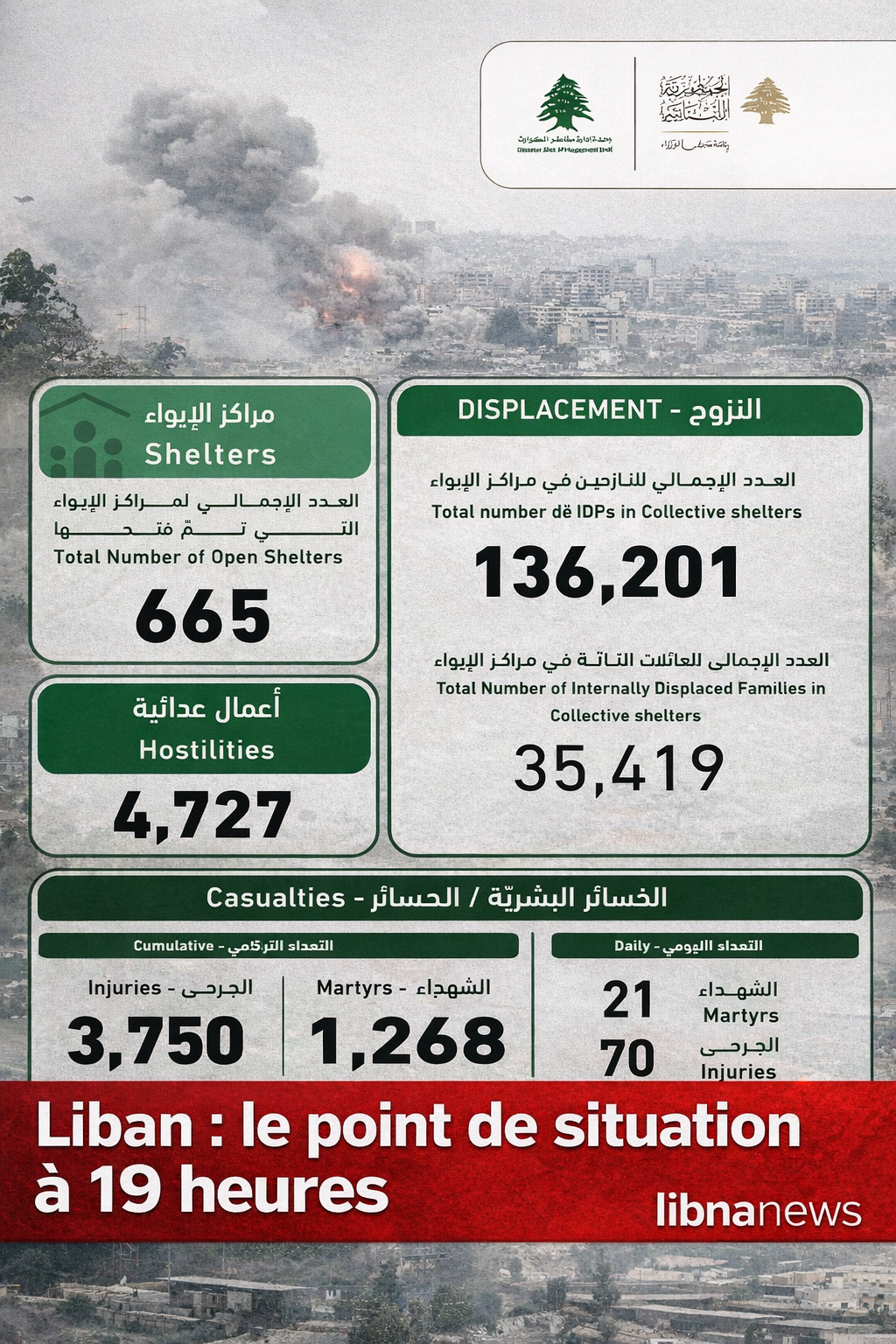
At 1900 hours, Lebanon faces a military and humanitarian situation of increasing gravity. The official balance sheet shows that4,727 hostile acts,1,268 deaths,3,750 injured,21 deaths during the dayand70 injured during the day. In humanitarian terms,669 accommodation centresare open and welcome136 201 internally displaced personseither35,419 families. This assessment gives the real measure of the day: the country no longer suffers only a succession of strikes or clashes, but an established war, with massive human cost, continuous pressure on reception structures and a rapid deterioration of living conditions in the affected areas.
This assessment must be read as the centre of gravity of the situation. The bombardments of the day, the reported fighting on several southern axes, the tensions around UNIFIL and the diplomatic initiatives at the United Nations take their full meaning from this official photograph. Lebanon is not just living an extra day of war. He saw a sequence in which human losses were accumulating, there were tens of thousands of displaced people in collective centres, and the prospect of a rapid return to the southern areas seemed to be moving away.
Bombardments on the south, but also on the southern suburbs
On the ground, the day was marked by continued Israeli strikes on several locations in southern Lebanon. Bombardments targeted, inter alia, the Qasmieh, Srifa, Deir Kifa, Majdal Zun and other areas of the Tyre District, with several local deaths and injuries reported throughout the day. The strikes hit traffic axes, vehicles and inhabited areas, confirming an intensification that now exceeds the immediate border fringe.
But the day was not limited to the rural South. Thesouthern suburbs of Beirutwas again struck, in a context of intensive overflight of Israeli aircraft over Beirut and its southern periphery. This strike on the southern suburbs is a major feature of the 19-hour table, as it shows that Israeli military pressure does not remain confined to the border theatre. It also affects a central urban space, densely populated, politically sensitive and already weakened by previous waves of strikes.
This geographical extension of the bombings directly increases the humanitarian crisis. Every strike on a village in the South is pushing new people northward. Each strike on the southern suburb of Beirut, in turn, increases the anguish of an expansion of the war to the main urban centres of the country. At 1900 hours, Lebanon appeared to be caught between two simultaneous realities: a South under permanent bombardment and a capital that remained exposed, at least in its southern periphery, to targeted strikes.
The South: not a withdrawal, but a claimed retention
At this time, the central point is not that of an Israeli withdrawal from southern Lebanon. On the contrary, it is that of amaintenance claimedand a willingness to transform the land in a sustainable manner. The Israeli statements of the day are in line with thebuffer zone to Litani, with control of bridges, maintaining a safe presence and preventing the return of a large part of the displaced inhabitants south of the river. This political line profoundly changes the reading of the situation. It is no longer just a series of ad hoc military operations. This is a long-term territorial control project in part of southern Lebanon.
This is crucial to understanding the human balance. The 136,201 internally displaced persons accommodated in collective centres are no longer just a matter of a few days’ emergency. If Israeli military control south of the Litani settles, then the displacement crisis changes in nature. It is becoming a long-term crisis, with all the consequences for housing, schooling, care, supplies and social balance in the regions hosting displaced persons.
The South is thus at the crossroads of two dynamics. The first is military: shelling, drone strikes, artillery, fighting on several axes. The second is territorial: destruction, control, blocking of access and questioning the return of the inhabitants. At 7 p.m., it is this second dimension that gives the situation a deeper political depth than the only fighting of the day.
Ongoing fighting and resistance claims
At the strict military level, the day was also marked by continued fighting and several announcements of operations claimed against Israeli positions or equipment. The actions relayed in the afternoon included demands for drone strikes against an air defence system in northern Israel, as well as attacks on military vehicles and gatherings of soldiers at points on the front. There have also been reports of clashes in the area of Ainata.
As always in this type of sequence, these claims must be distinguished from independently verified facts. They nevertheless testify to an ever-active front, where the logic of attrition continues. South Lebanon is not only under bombardment. There is also a space for direct confrontation, with exchanges that mix drones, shooting, incursions, targeted strikes and attempts to pressure each other on opposing positions.
This fact helps explain why the official balance sheet is progressing day by day. Part of the loss resulted from the impact on the inhabited areas. Another is the persistence of an active theatre of war, where the lines remain moving and where strikes can affect both military objectives and civilian or semi-civil spaces, particularly on roads, on the outskirts of villages or in densely populated areas.
The diplomatic dimension: United Nations, UNIFIL and increasing pressure
The 7 p.m. situation cannot be complete without the diplomatic aspect. It is now taking on a new dimension with the sequence around UNIFIL and the Security Council. Following the recent death of three Indonesian peacekeepers in southern Lebanon, the case was brought to the United Nations in a tense environment. The first UN findings suggest a roadside explosion in one case and the explosion of one projectile near one UN position in another. The Secretary-General of the United Nations recalled the seriousness of acts that could constitute serious violations of international humanitarian law.
To this is added the French protest after the incidents against the French contingent near Naqoura. This sequence raises diplomatic pressure around the South Lebanon. The issue is no longer just one of a confrontation between Israel and Hezbollah, nor only one of Lebanese civilian casualties. It also becomes the security of peacekeepers, the freedom of movement of UNIFIL and the risk of the space south of the Litani slipping towards an area of lasting military hold under international high tension.
The diplomatic dimension has not yet produced any de-escalation visible on the ground. But it already changes the political framework. South Lebanon is again becoming a subject of international security in its own right. This means that developments on the ground, whether in bombing, fighting or the plight of displaced persons, are now being monitored from a broader perspective: that of regional stability, international law and the role of the United Nations.
A country under military and humanitarian pressure
At 7 p.m., the overall reading is clear. At the same time, Lebanon faces a rise in human cost, a geographical extension of the strikes, a gradual lockdown from the South and an internationalization of the UN file. TheOfficial balance sheetremains the first element:1,268 deaths,3,750 injured,21 deaths in the day,70 injured during the day,136 201 internally displaced personsin collective centres. It is this figure of the displaced, as well as that of the dead and wounded, that shows that war is now transforming the very organization of the country.
At the same time, the bombings of the day remind us that the war remains active, mobile and unpredictable. The South was hit on several points. The southern suburbs of Beirut were again targeted. And the prospect of a return of the inhabitants to their villages seems even more uncertain in the light of the Israeli declarations on the buffer zone to the Litani.
At this time, therefore, Lebanon appears caught between three emergencies. The urgent need to protect civilians under bombardment. The urgent need to absorb a massive displacement which already weighs heavily on reception structures. And the political urgency to deal with a situation in which the South is no longer just a battlefield, but also a territory whose immediate future lies between destruction, military control and international diplomatic pressure.






