

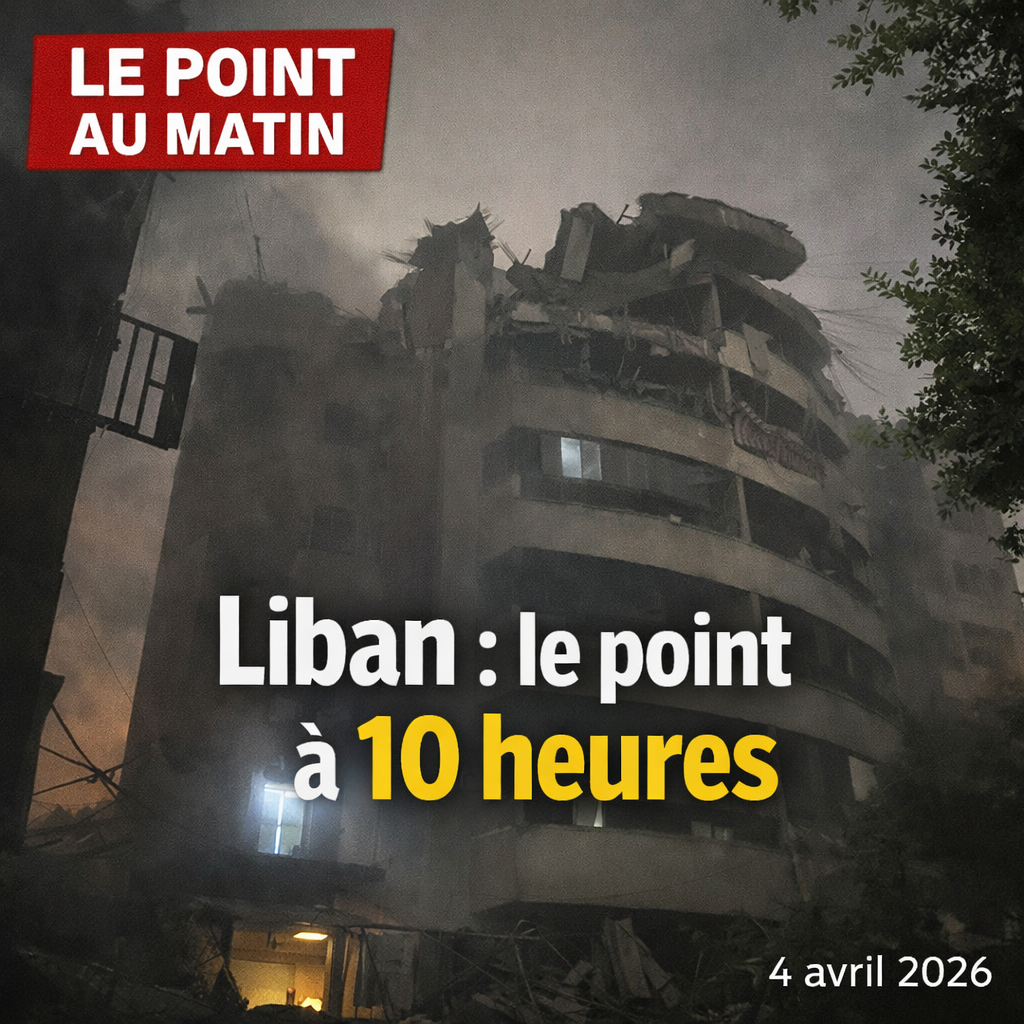
At 10 a.m. this Saturday, April 4, 2026, the image emerging from the last 24 hours in Lebanon is that of a country once again compressed between the intensification of Israeli strikes, the rise of fire exchanges in the South, the pressure on the roads and the widening of the humanitarian shock wave to Beirut. The Lebanese media followed hour by hour show different priorities, but they converge on one point: the open sequence on Friday marked an additional level, both military, political and civilian. Local channels mainly documented the southern suburbs, border villages and western Bekaa, while international agencies and media have put these developments in a broader sense of regional war and increased pressure on Lebanon.
South suburb returns to centre of gravity
The southern suburbs of Beirut focus attention first. During the night and early morning, MTV reported a strike on Al Jamous Street in Dahié. The chain had already relayed Israeli evacuation warnings on Friday targeting several sectors, before a series of strikes on the southern suburbs. Reuters also confirmed that Israel hit Beirut on Friday after issuing warnings to neighbourhoods in the capital, presenting these areas as linked to militant infrastructure. Naharnet reported four strikes on the southern suburbs Friday night. The Saturday night episode does not therefore register as an isolated incident. It continues a more sustained campaign against urban sectors already weakened by mass displacement.
Beyond the strikes, the security climate has deteriorated in several regions. MTV reported on Saturday morning that Israeli aircraft were flying at low altitude over several areas of the country. This information, apparently ad hoc, sheds light on the nervousness that dominates the terrain. Protracted overflights keep people under psychological pressure, complicate civilian movements and fuel the feeling of a war without a clear border between the front line and the hinterland. In television newspapers and alert wires, this type of signal has become almost as central as the immediate balance sheets, because it informs about the permanence of the risk. The past day was therefore not only marked by visible impacts; It also confirmed the installation of a continuous, diffuse and ubiquitous threat.
LBCI, for its part, insisted on two signals that say a lot of the current atmosphere. On one side, on Friday, the chain relayed the renewal of Israeli warnings against areas in the southern suburbs, including Haret Hreik, Ghobeiry, Laylaki, Hadath, Burj al-Barajneh, Tahuitet al-Ghadir and Shiyah. On the other hand, it highlighted Israeli announcements of possible strikes against Sohmor and Machghara bridges in order to prevent the transfer of reinforcements and weapons, according to this version. This coverage complements that of MTV by showing that Lebanese information, despite different angles, overlaps on a major point: the last hours have been marked by a simultaneous extension of pressure on densely populated urban areas and on the infrastructure that connects the country’s centre to the southern front. The war is no longer read only by the map of the bombings, but also by the map of the movements that it seeks to prevent.
South Lebanon: a sequence of armed reciprocity
On the southern front, indicators have accumulated again. Al Manar issued a long series of press releases on Friday night and night claiming rocket fire at Safed on several occasions against Israeli military positions and rallies in the Maroun al-Ras area, as well as in the Ainata area. Taken separately, each of these communiqués is a matter of war communication. Taken together, they show a dense operational tempo on the same day. This multiplication of demands tends to confirm that the South is not only subject to Israeli strikes, but is also the scene of continued response by Hezbollah. The reading of the last 24 hours is therefore that of a sequence of armed reciprocity, where each camp seeks to impose its rhythm, its narrative and its ability to harm.
In Christian localities near the border, tension has taken on an even more concrete form. MTV indicated on Friday that an evacuation warning concerned the northern part of Ain Ebel, in the direction of Bint Jbeil, while relaying the mayor’s response, who said that the inhabitants would remain there. The same channel had already broadcast, a few days earlier, images showing the withdrawal of Lebanese Army personnel from Rmeish and Ain Ebel. These elements alone do not mean a general shift in the state system, but they reflect an essential fact: in some villages on the southern edge, the Lebanese authorities’ margin of manoeuvre is reduced as Israeli warnings, strikes and military pressure progress. The contrast between the order to leave and the decision to stay also sums up one of the dramas of the moment: for a part of the inhabitants, fleeing seems more necessarily safer than staying.
The movement observed in the South is also part of a broader strategic framework. Reuters reported on March 31 that the Israeli Defense Minister said he wanted to establish a buffer zone up to Litani after the war. This line of reading helps to understand the events of the last 24 hours: evacuation orders, strikes on the axes and increasing pressure on border villages are not just a matter of ad hoc tactical responses. They draw a broader geography of control, where the southern depth of Lebanon becomes the central issue of the ongoing battle. For Beirut, this means that it is no longer simply a matter of managing an active border, but of facing an attempt at military remodelling of all space south of the Litani.
Bridges and roads become targets
The western Bekaa and the roads were also affected. Naharnet reported on Friday night the destruction by Israeli aircraft of the bridge between Sohmor and Machghara, in western Bekaa. MTV, for its part, relayed the statement of an Israeli military spokesman claiming that the Litani bridges had been targeted to prevent the passage of combatants to southern Lebanon. LBCI also relayed explicit warnings on the Sohmor and Machghara bridges. When put to an end, these elements suggest that strikes against bridges are not just a point-in-prohibition tactic. They are part of a broader territorial logic: hindering movement, reshaping logistical depth and making it more difficult to move between central areas of the country and the South.
The choice of infrastructure is far beyond the military objective. In Lebanon, a bridge is never just a traffic structure. It is also a link between refuge areas, still inhabited villages, supply routes and relief routes. In the current context, the destruction or neutralization of such axes as Sohmor-Machghara directly affects the mobility of displaced families, the logistics of traders and the ability of services to reach certain localities. In a few hours, therefore, the safe travel map can be upset. And that’s precisely what comes out of the Lebanese media coverage: the war not only damages neighbourhoods or positions, it actually reorganizes the ways in which the country continues to operate.
Beirut under pressure, up to daily life
Another indicator deserves attention at 10 a.m.: the gradual contamination of daily life beyrouthine. Reuters reported on Friday that the American University of Beirut is changing its online courses after an American alert about the risk of Iranian attacks on Lebanese universities, while the US embassy is calling its nationals to leave the country. Although this is not directly related to the southern front, it reflects a change of scale. When universities adapt their operations and diplomatic representations increase their alert level, war ceases to be perceived as a localized danger. It is part of the very organisation of the city, higher education, travel and urban routines. In Beirut, therefore, the last 24 hours have not only produced new images of destruction; They have also accelerated the transformation of a capital into a permanent precautionary area.
This development is all the more serious as it occurs in a city already saturated by displacement. The Associated Press estimated on 1 April that more than one million people had been displaced by the strikes and evacuation orders in Lebanon. Reuters recalled on Friday that Beirut was absorbing some of this pressure, even though the capital is no longer safe from strikes. In this context, each new alert has a double effect: it increases immediate fear, but it also erodes the very function of refuge that Beirut still retained for some of the families. The capital thus becomes a paradoxical space, both a destination for retreat and an increasingly exposed territory.
A humanitarian crisis that thickens
The last 24 hours have not created the humanitarian crisis, but they have aggravated it in two ways at once: on the one hand, the geographical expansion of the areas under pressure; on the other, the reduction of spaces perceived as relatively safe. Naharnet mentioned on Thursday the rise of hostility towards displaced Lebanese people facing evictions and increasing fear. The Associated Press also described on Friday an increase in tensions against Shia internally displaced persons, in a country where reception becomes more difficult as resources run out and strikes reach areas previously considered safer. In other words, displacement ceases to be a durable solution if the receiving areas also live under threat or social tension.
Reuters also reported on 31 March that the Lebanese Government was preparing for a long-term displacement crisis in a context of insufficient humanitarian funding. The Minister of Social Affairs, Haneen Sayed, spoke of planning over several months, even though only part of the basic needs were covered. This data also sheds light on the situation of the last few hours. The more the strikes hit the roads, the suburbs of Beirut and the villages of the South, the longer the displacement continues. And the longer it continues, the more costly it becomes socially, economically and politically for an already fragile state. The 10 o’clock point therefore refers not only to recent military events; It refers to the thickening of a civil crisis whose mechanisms become more difficult to contain every day.
UNIFIL is more vulnerable, international leadership is weaker
The picture is still darkening when the situation of UNIFIL is added and international safeguards are eroded. Reuters reported at the end of March that three Indonesian peacekeepers had been killed in southern Lebanon and that the mission ‘ s ability to act was severely reduced by fighting. In recent days, MTV also relayed the words of a senior United Nations official indicating that UNIFIL’s work was facing restrictions due to the security situation. This does not only alter the military power ratio. This also reduces the capacity for documentation, mediation and deterrence that the international presence still offers, even imperfectly. When peacekeepers themselves become vulnerable, the message sent to civilians is brutal: the area is no longer only disputed, it becomes less governable.
This weakening also weighs on the diplomatic reading of the crisis. A South Lebanon where UNIFIL acts less freely, where international troops themselves suffer the effects of the conflict and where contact lines move rapidly becomes more opaque for chanceries. This opacity often feeds climbing. It limits independent verification, slows down mediation, and leaves more room for antagonistic narratives produced by the belligerents themselves. In the last 24 hours, the Lebanese media have not only documented strikes and demands. They also showed a weakening of the external mechanisms capable of slowing down degradation.
The Lebanese State tries to maintain a public speech
In this context, Lebanese institutions seek to preserve signs of continuity. The official NNA agency has highlighted, in the last 48 hours, the political positions calling for the strengthening of the State, the diplomatic follow-up by the Presidency and the economic consequences of the conflict. The Minister of Economy, Amer Bsat, described the current war as a major economic shock. NNA also reported the cancellation of the monthly gathering of families of victims of the Beirut port explosion, which indirectly reflects the level of security tension and the difficulty in maintaining up to the most regular civic meetings. In another recent dispatch, the Agency highlighted European support for Lebanon and calls for de-escalation. These signals do not amount to a structural response, but they show that the state apparatus is still seeking to maintain an institutional voice in the midst of military acceleration.
The economic dimension should not be underestimated. When the Ministry of Economy speaks of a major shock, it is more than just a cyclical slowdown. Damaged bridges, threatened roads, massive displacements and security uncertainty simultaneously affect domestic trade, supply chains, services, education and consumption. In a country that has barely emerged from years of financial crisis, the resumption of a war cycle on such a scale further undermines household resilience. The last 24 hours cannot therefore be read from a security perspective alone. It must also be understood as a further tightening of the economy on a Lebanon already very weakened.
What the Lebanese media show, beyond the raw facts
What the Lebanese media also reveal is a fragmentation of the focal points. Continuous information channels focus on alerting, hitting and moving, with a very fast pace of publication. The official agency places greater emphasis on diplomacy, positions and institutional life. Al Manar closely follows Hizbullah’s military communiqués to the point of showing the very pace of confrontation. LBCI placed greater emphasis on Israeli warnings and targeted infrastructure. Naharnet and the international agencies place these events in a broader architecture: regional expansion of the war, discussions on a buffer zone to the Litani, pressure on UNIFIL and worsening of the human balance. For the Lebanese reader, this diversity is not an editorial processing detail. It is a useful grid for understanding a country that, in the last 24 hours, has experienced a war on the ground, a battle of narratives and a crisis of civil resilience.
On a scale of observable facts, five lines of force dominate this 10-hour situational point. First, the southern suburb of Beirut has again become an active target, meaning that the capital can no longer be regarded as a mere retreat zone. Second, the South remains engaged in a cycle of sustained strikes and responses, with an unusual density of military communiqués over a single day. Third, bridges, roads and crossing points are gaining increasing strategic value, which directly threatens civilian mobility. Fourthly, border villages live under the double constraint of evacuation orders and the refusal of many inhabitants to leave. Finally, the capacity for international supervision is reduced at the very moment when the population would need it most. The set consists of a sequence in which Lebanon is not only exposed to additional strikes; it is confronted with an accelerated recomposition of its internal security space.
The sharpest markers between Friday morning and Saturday 10 a.m.
- Israeli strikes on the southern suburbs of Beirut, with a new episode reported to Al Jamous in the night;
- Low-altitude overflights in several Lebanese regions;
- Evacuation warnings in southern localities, including Ain Ebel;
- strikes on traffic infrastructure, including the Sohmor-Mashghara Bridge;
- Multiplication of Hezbollah’s demands for fire to the north of Israel and border contact areas;
- The pressure on internally displaced persons continues to increase, with Beirut remaining both a relative refuge and a space now threatened.
This point about the last 24 hours in Lebanon, therefore, not only draws a new surge of violence. It shows a country where the geography of the war is widening, where the rear is approaching the front, where the logistical axes are becoming targets, and where the central question is no longer just where aviation is going, but which spaces are still habitable, manageable and accessible in the coming hours.






