

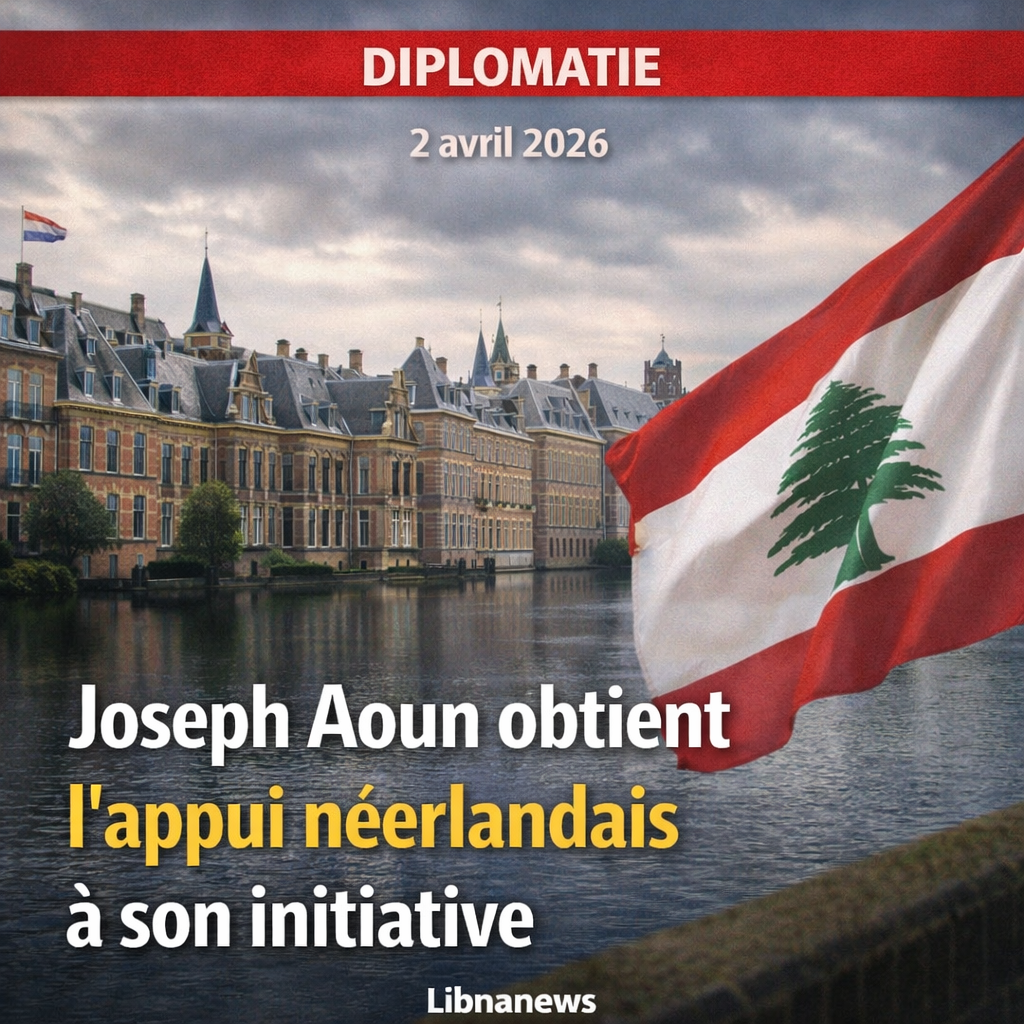
The President of the Republic, Joseph Aoun, received a telephone call from Dutch Prime Minister Rob Jetten, who reaffirmed his country’s support for Lebanon in the current crisis. The conversation focused on assistance to internally displaced persons, Beirut’s negotiating initiative to stop the escalation, as well as capacity-building for the Lebanese army.
President Joseph Aoun received an additional political signal from Europe. In a telephone interview with Dutch Prime Minister Rob Jetten, the Head of State obtained a reaffirmation of the Netherlands’ support for Lebanon, as the country is undergoing a phase of high security, political and humanitarian tension. The message conveyed by The Hague is both humanitarian, diplomatic and security.
According to the information provided at the end of the exchange, the Dutch Prime Minister assured that his country stood alongside Lebanon and its people « under the difficult circumstances » that he was going through. He also expressed the willingness of the Netherlands to contribute to aid for Lebanese forced to leave their villages and localities. In a context of population displacement, this humanitarian dimension is central to the Presidency’s contacts with several Western capitals.
Beyond emergency support, the appeal highlighted another aspect of Lebanese diplomacy: the desire to transform European support into political coverage for a de-escalation initiative. The Head of State has been trying for several weeks to convince his partners that the end of the crisis involves both a halt to the escalation, a resumption of the negotiating framework and the strengthening of State authority throughout the country. This line was at the centre of the interview with the Dutch leader.
Public support for the negotiating initiative
One of the most significant points of the appeal concerns Dutch support for the initiative defended by Joseph Aoun. Rob Jetten expressed his country’s support for the « negotiation initiative » announced by the Lebanese President to end the escalation and allow the State to fully deploy its authority throughout the country.
This formulation is politically important. It shows that The Hague is not limited to general support for Lebanon’s stability, but explicitly supports the Presidency’s logic of stopping the security deterioration by a negotiated path, backed by a more assertive return of the Lebanese State. In the current sequence, Beirut seeks to ensure that this framework is recognized as the only realistic outcome to avoid military sluggishness, aggravation of the human cost and deeper institutional fragility.
Dutch support is thus part of a broader diplomatic dynamic. Joseph Aoun has already highlighted, in March, Lebanon’s readiness to resume negotiations to end the Israeli escalation and to restore a security framework enabling the State to resume the initiative. Reuters also reported that he had expressed Beirut’s willingness to move towards direct discussions in order to bring the conflict to a halt and reaffirm Lebanese sovereignty.
For the Presidency, the issue goes beyond the suspension of hostilities. It is also a question of putting the state back at the centre of the game, at a time when regional war, destruction and balance weigh heavily on the Lebanese scene. The fact that a European head of government publicly repeats this logic gives the Lebanese initiative additional political support, although its concrete translation will depend on the evolution of the balance of power on the ground.
Support for the army, the pillar of the political message
The other major part of the interview focused on the Lebanese army. The Dutch Prime Minister has indicated that his country is ready to support this institution in order to enable it to assume « its national responsibilities ». This sentence, in the current context, has nothing to say. It reaffirms the central role assigned to the army in any strategy of stabilization, territorial control and reaffirmation of state authority.
For the Lebanese President, this is essential. Since his arrival in Baabda, Joseph Aoun has regularly placed the military institution at the heart of his speech on sovereignty, internal security and the restoration of state credibility. External support to the army, whether political, logistical or capacitary, is presented as a necessary condition to enable Lebanon to cope with the security pressure without slipping into institutional disintegration.
Dutch support is therefore part of a precise reading grid. Helping the army is not just strengthening a military apparatus. It is to support one of the few pillars still able to link territorial stability, state continuity and the prevention of a wider vacuum. In European chancelleries, this idea gradually gained ground as the Lebanese crisis deepened.
The official website of the Dutch government also features Rob Jetten as the Prime Minister in office since February 2026, while several recent European initiatives have focused on strengthening the role of the Lebanese army in the stabilization scenarios put forward by Beirut and its partners.
Assistance to internally displaced persons at the centre of priorities
The conversation also focused on the situation of Lebanese displaced by fighting and insecurity. Rob Jetten expressed his country’s willingness to help those who had to leave their villages and localities. This humanitarian dimension has become indispensable in all diplomatic exchanges related to Lebanon.
Through this commitment, the Netherlands implicitly recognizes the extent of the social and territorial pressure on the country. Internal displacement is no longer merely a collateral consequence of the clashes. They now affect the daily balance of many regions, reception capacity, public services, local structures and, more broadly, national cohesion.
For Baabda, the humanitarian issue is closely linked to the political issue. The more pressure on internally displaced persons increases, the greater the risk of the security crisis producing additional internal tensions. That is why the Lebanese executive is seeking a double commitment from its partners: immediate assistance to the people concerned, but also support for a political exit that limits the worsening of the crisis.
The support announced by The Hague therefore comes at a time when the Lebanese State is trying to convince that international solidarity cannot only be charitable. It must also consolidate institutions, support the army, support de-escalation efforts and provide Lebanon with the means to prevent the ongoing war from producing more lasting fractures.
Joseph Aoun highlights sovereignty and bilateral relations
Joseph Aoun thanked the Dutch Prime Minister for his positions. He described the current situation in Lebanon and stressed « the determination of the Lebanese State to implement the decisions taken to preserve its sovereignty, independence and territorial integrity ».
This formulation summarizes the heart of the presidential message. Faced with external pressure, military escalation and fragile internal balances, the Head of State seeks to establish a simple political line: Lebanon intends to defend its unity, preserve its independence and reaffirm the authority of its institutions. In his speech, sovereignty is not a slogan, but a condition for a lasting exit from the crisis.
The President also expressed his willingness to strengthen and develop Lebanese-Dutch relations « in different areas ». This may seem secondary to the security emergency, but it is not. It shows that Beirut intends to include these exchanges in a broader relationship than crisis management alone. In other words, the Presidency seeks not only specific gestures of solidarity, but also a deepening of political, institutional and practical ties with European partners willing to accompany Lebanon.
In the current climate, this openness also has a broader diplomatic function. It allows Lebanon to increase support points in Europe, not to depend on a single channel, and to make a Lebanese initiative exist in a regional landscape dominated by military power relations. Every support from a European capital adds a layer of legitimacy to Beirut’s approach.
A diplomatic sequence to consolidate
The appeal between Joseph Aoun and Rob Jetten did not change the balance of the conflict alone. But it is part of a diplomatic sequence that the Lebanese presidency seeks to consolidate. The objective is clear: to secure international support for a negotiated de-escalation, to anchor the role of the Lebanese army as a pillar of stability and to keep attention to the human cost of the crisis, including through the internally displaced.
In this way, Dutch support performs several functions at the same time. It provides a European guarantee to the President’s political initiative. It reaffirms that the army remains a central interlocutor for any prospect of stabilization. It also broadens the circle of countries ready to publicly display their readiness to assist Lebanon in a particularly delicate phase.
For Joseph Aoun, the challenge now is to turn these messages of support into more tangible results. The Presidency seeks to put the Lebanese position in a framework where State sovereignty, assistance to civilians and institution-building would advance together. It is on this link between relief, negotiation and state authority that today lies the essence of its diplomatic offensive.






