

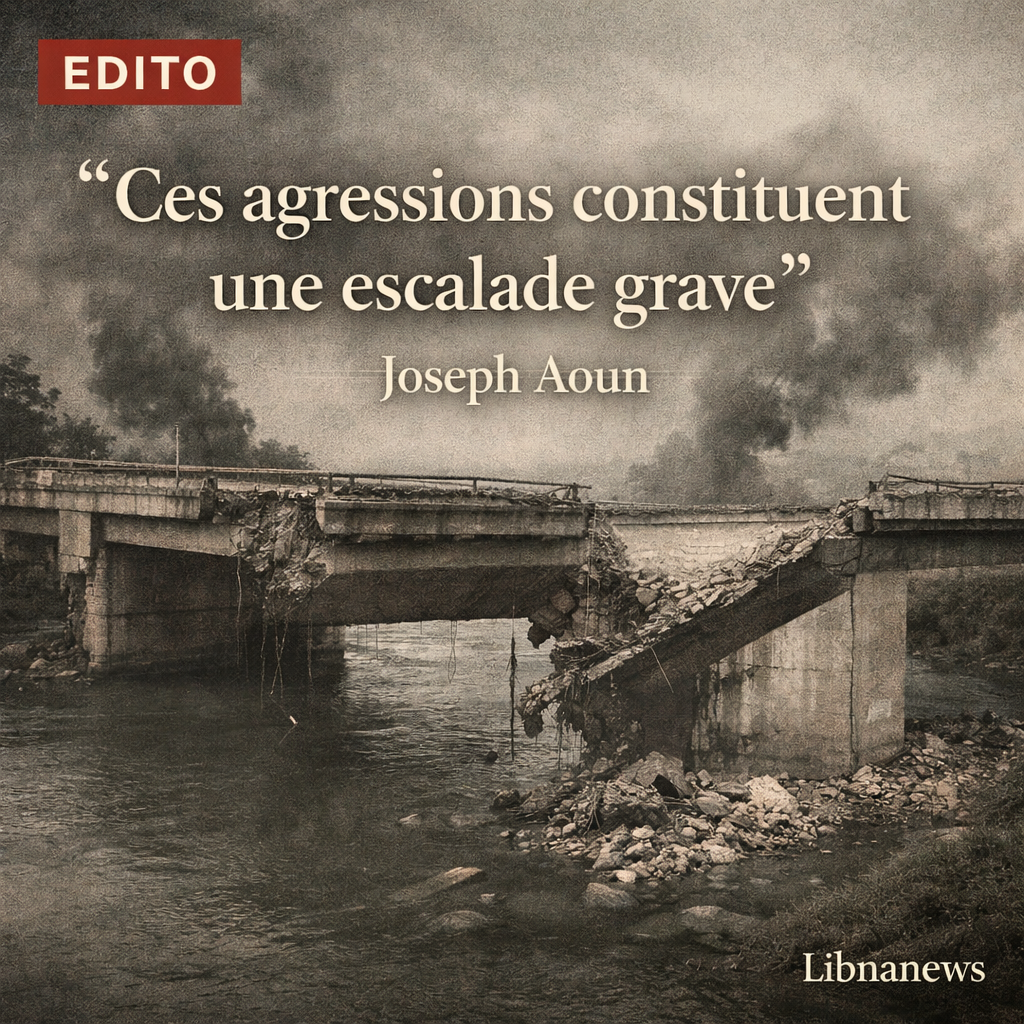
The President of the Republic, Joseph Aoun, on Sunday denounced Israel’s targeting of vital infrastructure and facilities in southern Lebanon, in particular the Qasmiyeh bridge on the Litani River and other crossing structures. In a particularly firm statement, the Head of State states that these attacks constitute « a serious escalation » and « a flagrant violation of Lebanon’s sovereignty », while seeing it as « an introduction to a land invasion » against which Beirut claims to have warned « through diplomatic channels ».
The presidential text leaves little room for ambiguity. Joseph Aoun accuses Israel of engaging in « a systematic destruction of infrastructure, vital civilian facilities and residential areas in Lebanese villages », a policy which, according to him, » amounts to collective punishment against civilians ». He added that such acts were « rejected, condemned and unjustifiable » and clearly violated the rules of international humanitarian law, which prohibited targeting civilians and their essential property.
The text of the presidential communiqué
The communiqué transmitted by the Presidency states in particular:
» These attacks constitute a serious escalation and flagrant violation of Lebanon’s sovereignty, and are seen as an introduction to a land invasion against which Lebanon has warned, through diplomatic channels, against the risk of being carried out. »
The President continued:
» These guidelines reflect a dangerous drift towards the systematic destruction of infrastructure, civilian facilities and residential areas in Lebanese villages, which is akin to a policy of collective punishment against civilians, a policy rejected, condemned, unjustified and in clear contradiction with the rules of international humanitarian law that prohibit targeting civilians and their basic facilities. »
About the bridges on the Litani River, Joseph Aoun writes again:
« The targeting of bridges on the Litani River, a vital road for civilian displacement, is an attempt to cut off geographical communication between the area south of the Litani River and the rest of Lebanese territory. It hinders the delivery of humanitarian aid and is part of suspicious plans to establish a buffer zone, consolidate the reality of the occupation and continue Israeli expansion within Lebanese territory. »
Finally, the Head of State directly calls on the United Nations and the Security Council to act:
« In the face of this escalation, Lebanon calls on the international community, in particular the United Nations and the members of the Security Council, to shoulder their responsibilities and take immediate steps to deter Israel from implementing this attack. The continuation of silence or passivity encourages the escalation of violations and undermines the credibility of the international community. »
Qasmiyeh and the Litani bridges in the centre of climbing
The presidential statement comes after a new sequence of Israeli strikes on the bridges in southern Lebanon. Reuters reported that Israel struck on Sunday a major bridge on the coastal axis at the level of Qasmiyeh, after the Israeli Defense Minister announced the order to destroy all the Litani bridges that Israel considers used by Hezbollah.
For Baabda, the stakes far exceed the only tactical dimension. The communiqué stresses the function of these bridges as a « vital artery » for civilians, relief and humanitarian assistance. The Presidency is therefore not just talking about destroyed works. It describes an attempt to fragment southern Lebanon, to isolate the area south of the Litani River and to create, by force, a new territorial reality.
The latest Israeli statements
Joseph Aoun’s statement is in the context of a sharp tightening of the Israeli discourse.
On Sunday, the Israeli Defense Minister, Israel Katz, declared that he and Benyamin Netanyahu had ordered the army to destroy « immediately » all bridges over the Litani, which Israel claims were used for « terrorist activities », in order to prevent the passage of Hezbollah and weapons southward. According to Reuters, he also asked the army « to speed up the destruction of Lebanese homes in contact villages, » citing what was done in Beit Hanoun and Rafah in the Gaza Strip.
The day before, Israeli Chief of Staff Eyal Zamir announced that there would be « no more containers, » but only « initiative and attack ». He added that Israel would not return to the policy of « rounds » and limited escalations in Lebanon, and that the army would not stop until the « threat » was removed from the border.
These statements give special emphasis to Baabda’s reading. When the Presidency speaks of « introduction to a land invasion », it is part of a sequence in which Israeli officials no longer talk about only targeted strikes, but about the destruction of bridges, the accelerated demolition of border houses and the end of any logic of restraint.
Political as well as diplomatic alert
Joseph Aoun’s statement marked a sharp tightening of presidential language. It is no longer limited to reporting violations of sovereignty. It calls into question a broader Israeli strategy, coupled with three objectives: to cut off territorial continuity in southern Lebanon, to hinder the arrival of humanitarian aid, and to prepare a buffer zone imposed by force.
The heaviest expression remains that of « land invasion ». It puts the declaration well beyond a classical diplomatic protest. The Head of State explicitly states that Beirut sees, in the destruction of bridges and civilian infrastructure, the warning signs of a wider Israeli land operation.



