

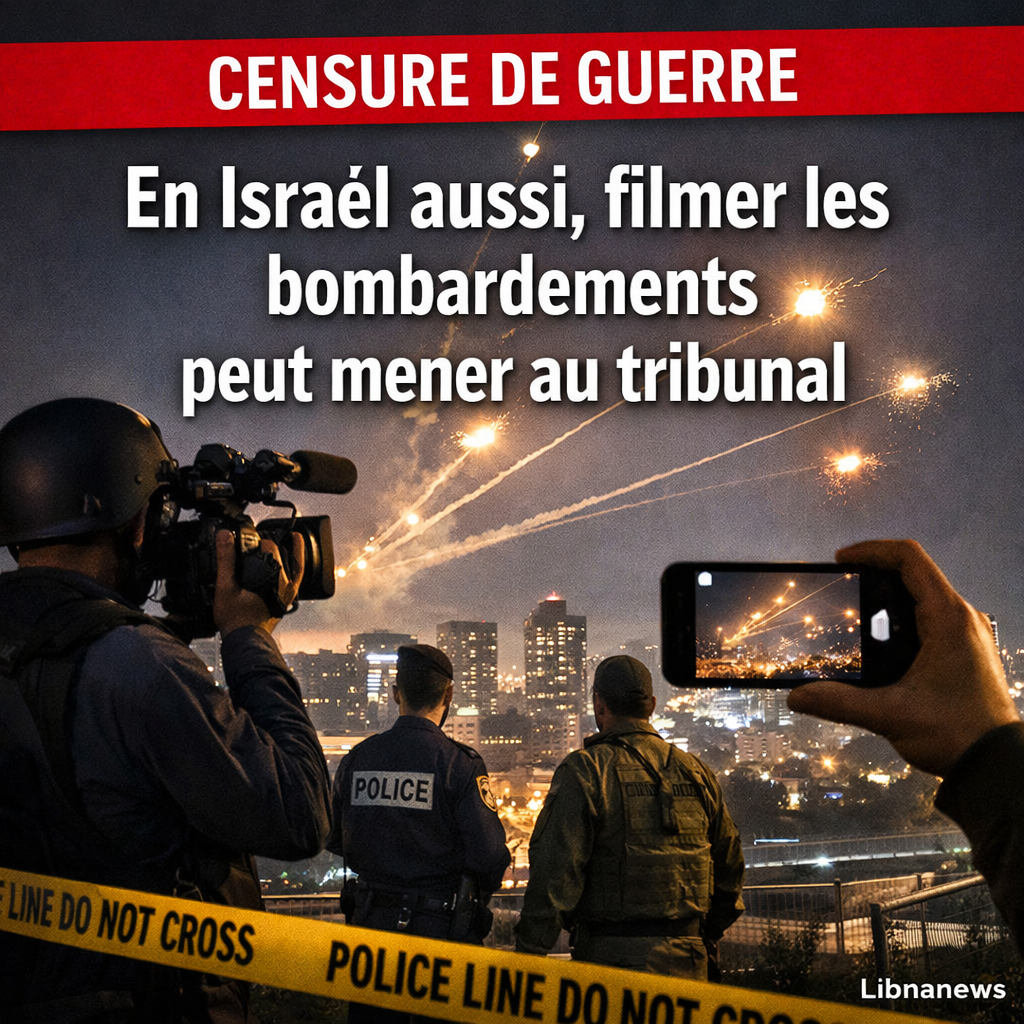
Censorship of war images is not a singularity of the Gulf monarchies. In Israel too, the State closely controls what can be filmed, disseminated and commented on when missiles strike the territory, interceptions take place or sensitive sites are affected. The war with Iran further hardened this mechanics. The authorities invoke a simple justification: to prevent the enemy from locating its strikes, to evaluate the effectiveness of Israeli defences and to identify military or strategic infrastructure. But behind this security argument is another reality: modern war is also played in the control of the visible. In Israel, filming an impact, broadcasting too precise a direct or showing an interception may expose not only to a ban on publication, but also to seizures, arrests, loss of accreditation and, in some cases, criminal prosecution.
Ancient censorship, but clearly reinforced by war
First of all, we must recall one essential point: in Israel, military censorship does not date from the present war with Iran. It is old, institutionalized and governed by a formal procedure. The Israeli government website provides a list of topics to be submitted to the military censor before publication. This list covers, inter alia, current or future military operational plans, intelligence, defence capabilities, specific strategic site details, and information that may inform an opponent of the country’s military posture. The basic principle is clear: since a publication can cause substantial damage to the security of the State, it can be blocked or amputated before dissemination.
This system, already robust in normal times, has been tightened in successive conflicts, and even more so with escalation against Iran and Hezbollah. TheTimes of Israelreports that the army has tightened its restrictions in recent months, to the point of prohibiting directs showing the horizon line when the sirens sound, as well as the dissemination of intercept images and places of impact when they allow sensitive information to be deduced. Hardening therefore not only targets military secrets in the classical sense. It now extends to the visual topography of the war, that is to say, anything that can help an opponent correct his or her shot, measure the effectiveness of his or her strikes or identify the dead angles of the Israeli defence.
Contemporary warfare has changed the scale of the problem. In the past, the censor focused first on the print press, accredited correspondents or television channels. Today, the mobile phone, the direct on social networks and the instant circulation of videos force the authorities to think differently. The issue is no longer just to reread an article before publication. It is to stop the distribution in real time of raw images which, even without military comment, can deliver to the adversary information of great value. This evolution explains why Israeli censorship, without changing its nature, has changed its density. It now touches much more frontally the ordinary digital space.
What the Israeli State considers dangerous
The central point in Israeli doctrine is not just truthfulness. This is the potential utility of the image to the enemy. A video can be perfectly authentic and nevertheless forbidden. This is what distinguishes security censorship from a simple mechanism to combat false news. The danger, in the eyes of the authorities, is not just a lie; It’s revelation.
An impact image can identify an exact neighbourhood. A sequence filming debris can help reconstruct the accuracy of a strike. A direct showing the horizon line at the time of an attack can provide markers on trajectories. An intercept video may suggest the density of missile coverage or the speed of reaction of some batteries. A plan taken near a base, a military seat, an energy centre, a port or an airport can, even unintentionally, offer very useful elements to an opponent who observes in real time. It is exactly this logic that the military censor and the police authorities put forward.
TheCommittee to Protect Journalistsshowed that this interpretation was translated in practice in 2025 by orders prohibiting foreign media from broadcasting from impact areas without prior authorization. The organisation also points out that the restrictions do not only concern conventional television, but can be aimed at publishing on social networks when military sites or sensitive locations are involved. The core of official reasoning is simple: if the image helps the enemy, it no longer falls within the ordinary right to document the event. It becomes a national security problem.
This doctrine has a major consequence: in Israel, the true is not protected by the mere fact of being true. It may be censored, seized or repressed if it exposes the materiality of defence or vulnerability. This explains why the authorities are so interested in directs, implicit geolocations and images taken as close as possible to the affected sites. Control is not just about editorial content. It concerns the visual granularity of the real.
Journalists are not safe
The first category exposed is naturally that of journalists. Again, the risk is not limited to a simple request for blurring or a call to order. It can be physical, material, administrative and criminal.
TheCommittee to Protect Journalistsdocumented cases where the Israeli police prevented international media from broadcasting live from missile-affected sites, on the grounds that these broadcasts revealed accurate locations. The organization also refers to confiscations of equipment and actions against press teams. This approach recalls that in sensitive areas the issue is not only the final publication. The filming itself can be interrupted, and the material seized, even before a sequence is actually broadcast.
The administrative risk is equally high. In Israel, foreign journalists depend on accreditation, access permits and a certain level of cooperation with the authorities. In such a system, non-compliance with the censor’s rules or safety instructions may lead to exclusion from the field, withdrawal from accreditation or drastic reduction of reporting capabilities. For a foreign writer, this threat can be almost as dissuasive as a legal procedure. It reduces access to information at the source and pushes self-censorship to preserve the country’s presence. This dynamic has long been observed in contexts where national security serves as a priority for media management. In Israel, the current war has made it even more tangible.
Finally, the criminal risk does exist. CPJ notes that, in June 2025, Israeli officials claimed that broadcasting from impact zones without prior written permission could constitute a criminal offence. Therefore, it is no longer merely a red line of ethics or administration. If the publication is interpreted as a violation of the rules of censorship or as a potential aid to the enemy, it can be treated in the repressive context.
Ordinary citizens and Internet users are also affected
The mistake would be to believe that Israeli censorship only targets the accredited editors and correspondents. The transformation of war information into mobile video streams has expanded the scope of risk to ordinary people. A resident filming from his window, a passerby who captures an intercept, a motorist who shows debris fallen to the ground, an Internet user who republishs a geolocalizable video: all can enter a dangerous grey area when the contents touch sensitive places or reveal elements that the army considers exploitable.
The problem is all the more serious as direct and publishing accelerate everything. In a war context, a video does not need to be edited or commented on at length to produce a military effect. A few seconds may be enough to locate an impact point, confirm that a projectile has reached its target, or show that an intercept has failed in a given area. That is why the Israeli authorities now treat certain publications on social networks as real security objects. The civilian’s telephone becomes, in their eyes, a potential source of open intelligence for the adversary.
However, the necessary nuance must be maintained. Available sources do not show that a single and new rule would automatically send any citizen who filmed an explosion from his balcony to prison. The reality is more graduated. The risk increases significantly when the video shows a sensitive site, specific impact, defence elements or unauthorized live broadcast. In such cases, the person may be subjected to arrest, interrogation, forced deletion of content, seizure of material, or even prosecution. So censorship is not mechanical, but it is real and potentially heavy.
Arrests and interventions already visible
Hardening is not theoretical. It has already produced concrete cases that measure the current climate. Among them, the arrest of two CNN Türk journalists at the beginning of March 2026, after a direct near the Kirya in Tel-Aviv, had greatly affected the observers. According to several media outlets, they were suspected of filming a sensitive security site. The case shows that the interpretation of the authorities can be very strict when shooting takes place in close proximity to critical infrastructure. She points out that the reaction can be immediate: stop shooting, arrest, investigation, or even detention.
This type of episode produces a deterrent effect far beyond the individual case. He reminds foreign teams that the capture of images is no longer just a matter of classical journalistic reflex. It must now be thought through the Israeli security grid, under the risk of triggering a police response. From the moment such a precedent exists, the terrain changes. Journalists, fixers, cameramen and editors know that the margin of error is being reduced, and that professional good faith is not always enough to avoid coercive action.
A Censorship Beyond the Only War with Iran
To understand the scope of the phenomenon, we must also look at the broader legislative framework. At the end of 2025, the Knesset extended until the end of 2027 a law allowing the authorities to restrict foreign media broadcasts deemed harmful to the security of the State. According to the official communiqué of the parliament, possible measures include the cessation of broadcasting, the closure of offices, the seizure of equipment and the blocking of websites or satellite transmissions. This text was first associated with the tensions around Al Jazeera and the Gaza war, but it shows one important thing: in Israel, security now serves as a legal basis for extensive media restrictions, including against foreign actors.
This point counts because it reveals that control of war images is not limited to improvised measures under the effect of urgency. It is part of a broader trend towards closer relations between the State, media and national security. The war with Iran acts as an accelerator, but not as an absolute rupture. It reinforces an already perceptible movement: the idea that information in wartime, especially when it is visual and immediate, must be disciplined more and more firmly.
Official argument: preventing « helping the enemy »
From the Israeli point of view, the justification is constant. The head of the military censor, quoted in the Israeli press, explains that the mission of the device is to prevent a publication from providing assistance to the enemy in time of war. This formula is crucial because it summarizes the whole doctrine. It is not just about protecting military secrets in the narrow sense. The aim is to prevent any dissemination that improves the opponent’s knowledge of the effects of his own strikes or the Israeli response.
In this way, even an apparently banal video of a night sky crossed by intercepts can become problematic. It can show the density of a salve, the temporal sequence of the response, or the direction of the projectiles. In the same way, the image of an affected neighbourhood, even without comment, can allow a post-flash check. This is precisely why the authorities are trying to block directs showing horizon lines, impacts and certain infrastructures. The aim is not only to maintain internal opinion. It is also to reduce the adverse ability to learn in real time.
But the question is not only military
Reducing censorship to pure military rationality would be incomplete. As in other countries at war, the control of images also affects the political management of vulnerability. Showing a precise impact, an overburdened defence or an affected sensitive area can feed another reading of war, more worried, more critical, more difficult to contain. A state that leaves all the images of its faults unfiltered, also leaves a story of vulnerability to be installed. Security is therefore not just missile control; It is also the control of what society sees from its own exposure to danger. This interpretation is a matter of analysis, but it is consistent with the extent of the restrictions described by the press organizations and the Israeli media themselves.
The image war is decisive here. An amateur video often has more strength than a press release. It doesn’t go through the spokesperson’s filter. She shows, she locates, she imposes visual proof. For this reason, States engaged in modern conflicts are less interested in prohibiting speech than in regulating the visible. Israel does not escape this logic. Its old and legally established censorship system even gives it more structured tools than many other countries to do.
What they risk in practice
The answer, in substance, must be formulated without excessive simplification. In Israel, those who shoot bombardments, interceptions or their consequences may risk several things, depending on the location, context and nature of the images.
They can first be prevented from filming or broadcasting on the spot. They can then see their content blocked, deleted or banned from publication. Journalists may lose their accreditation or access to the field. The equipment can be seized. The police may conduct interrogations or arrests when the capture is directed at a site deemed sensitive or violates security instructions. Finally, when authorities consider that a broadcast has crossed a safe red line, criminal proceedings may be initiated. These risks are particularly high for directs, for geolocation images, for shooting around impact zones and for any content revealing a base, headquarters, port, strategic industrial site or defence device.
The simplest red line can therefore be summed up as follows: the more an image allows you to understand where it hit, what was touched and how Israel responded, the more its author exposes. In wartime, visual documentation is no longer a neutral gesture. It can become, in the eyes of the authorities, an act with direct military consequences. It is this reading that justifies, from the point of view of the State, the harshness of the restrictions.
Filming the war in Israel is no longer a mere witness reflex
At the end of the day, censorship does exist in Israel, and it is not confined to editorials. It also affects individuals and social networks when an image can serve as a reference point for the enemy or reveal the vulnerability of a sensitive site. The war with Iran has made this logic more visible, extensive and coercive. The state no longer merely corrects or denies. He warns, seizes, prohibits and threatens to prosecute.
Filming a bombing in Israel is not automatically a crime. But filming in the wrong place, showing the wrong detail or spreading too quickly what the authorities consider to be exploitable can turn a simple gesture of witness into the field of national security. And in a country where military censorship has an old legal framework, institutional legitimacy and active police apparatus, this shift can be costly.



