

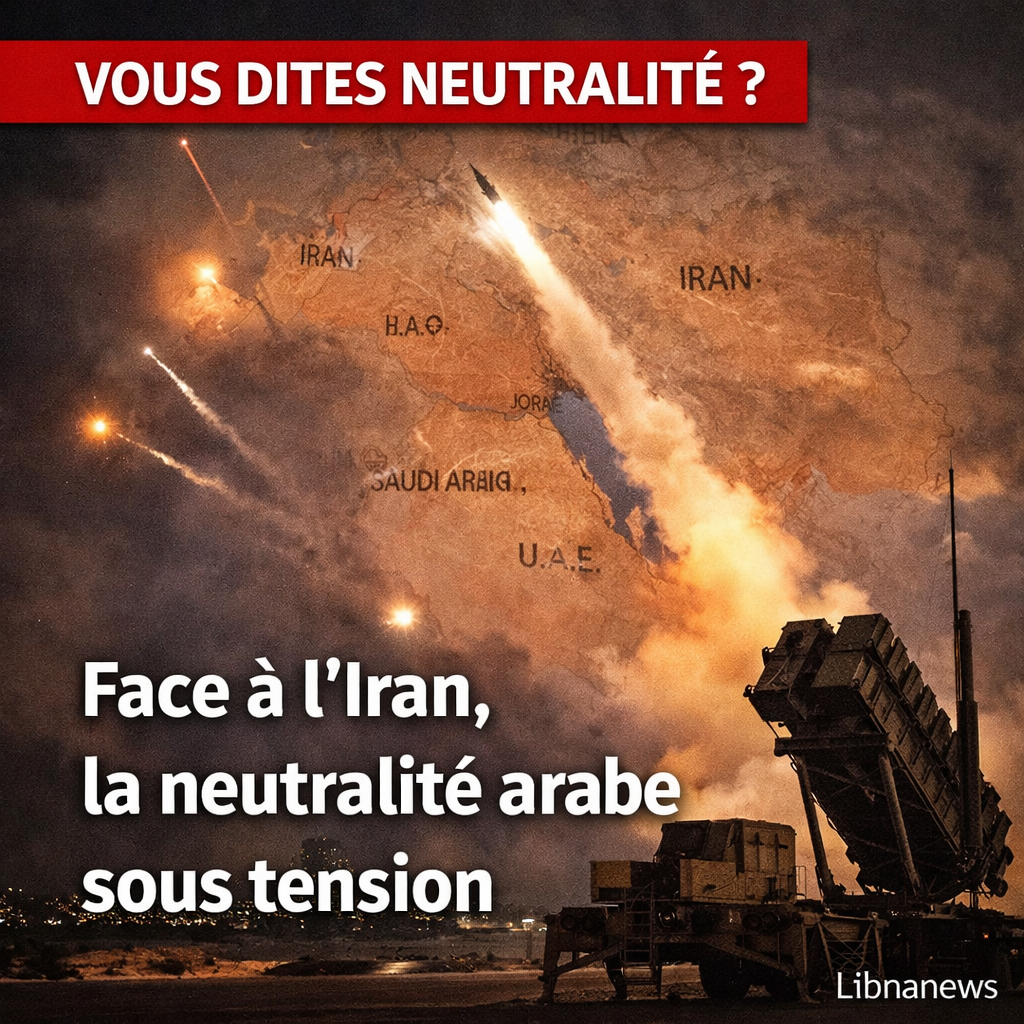
The Arab capitals repeat that they do not want war with Iran. They invoke sovereignty, de-escalation and refusal to be drawn into a confrontation decided in Washington or Tel Aviv. Yet, military reality is more troubled. Several Gulf States and Jordan intercept Iranian missiles and drones, house decisive American bases and participate in integrated air defence devices with the United States. On the other hand, there is no public evidence that they are similarly blocking Israeli offensive operations against Iran. This asymmetry feeds on a central question: is there still talk of neutrality, or of selective non-belligerence that protects regimes while ultimately exposing them to a deeper internal crisis?
Neutrality proclaimed, but already broken by the facts
Diplomatically, the Gulf monarchies have been seeking to reassure Tehran for months. Reuters reported as early as October 2024 that several Arab States had told Iran that they did not want their airspace or bases to be used for an attack against it. This line had a simple meaning: to avoid being re-qualified as co-belligerents and to protect energy, trade and domestic stability-based economies. Since the opening of the present war, this speech has not disappeared. It remains the official framework of most Arab capitals.
But military facts draw another map. Saudi Arabia admitted that it intercepted the majority of missiles and drones targeting it, following Iranian strikes on Riyadh and on energy installations. The United Arab Emirates, Kuwait, Qatar and Jordan are also strengthening their defences, to the point that Ukraine has announced that it has sent anti-drone specialists to five countries in the region to help counter the Iranian Shaheds. Neutrality, under these conditions, is no longer a passive state. It is an armed neutrality, under American umbrella, that acts as soon as the Iranian threat approaches.
The knot of the problem is there. These countries do not want to enter the war, but they are already participating in its operational environment. They defend themselves, they coordinate, they alert, they intercept. And in doing so, they produce a military effect that objectively benefits the United States and Israel, even when they present their decisions as mere national protection measures. Neutrality therefore still exists in diplomatic language. In the field, it increasingly resembles indirect involvement.
Do they intercept Israeli planes as they intercept Iranian drones?
It is here that the argument of neutrality is most clearly broken. At this stage, there is no evidence in the solid public sources consulted that Arab countries intercepted Israeli aircraft en route to hit Iran. However, there are documented elements on the interception of Iranian drones and missiles, particularly by Jordan in April 2024, and then by several Gulf States in the current sequence. Asymmetry is therefore visible: what comes from Iran is stopped when it threatens regional space; What goes from Israel to Iran is not publicly treated.
This difference is primarily explained by the political and military cost of such a decision. Intercepting a drone or missile entering its airspace is a sovereign defence. Intercepting an Israeli aircraft would involve taking a direct confrontation with Israel, taking the risk of an open crisis with Washington and making visible a regional air coordination that many regimes prefer to keep opaque. In plain terms, the Arab armies block what exposes them immediately; At least they have not publicly chosen to counter Israeli offensive strikes.
This nuance is decisive. It shows that Arab neutrality is not symmetrical between Iran and Israel. It is calibrated first according to the survival of regimes, the strategic relationship with the United States and the fear of direct confrontation. The political result is formidable: in the eyes of Tehran, this posture can be read as complacency; In the eyes of large fractions of Arab opinion, it can be seen as a one-way neutrality.
American bases everywhere, an impossible involvement to erase
The question of American bases further complicates the picture. Bahrain hosts the headquarters of the Fifth American Fleet. Qatar is home to Al Udeid’s Combined Air Operations Center, which controls and controls air power throughout the CENTCOM area. Kuwait serves as a platform for support, reception, deployment and integration of US forces. These facilities are not marginal. They form the operational framework of the American system in the Middle East.
This does not automatically mean that each strike against Iran takes off from an Arab base or transits with the explicit agreement of all host States. On this point, it is necessary to remain rigorous: the sources consulted do not provide detailed public evidence of a general, clear and accepted authorization given by the Gulf countries for offensive strikes against Iran in the current sequence. On the contrary, several of them sought to tell Tehran that they did not want their territory to be used against him.
But this legal prudence does not remove strategic reality. Hosting an air command centre, naval facilities, logistics hubs and support units amounts to participating, at least indirectly, in American operational depth. The opening in January 2026 of a new air defence coordination cell in Al Udeid between CENTCOM and regional partners confirms even that integration is strengthening in the midst of crisis. In other words, even when they do not publicly authorize strikes, host states remain embedded in a military architecture that shapes war.
Intelligence, radar, coordination: how far does cooperation go?
The question of espionage requires a more measured answer. Yes, there is extensive security cooperation between Washington and several Arab States. Yes, this cooperation involves the flow of detection, early warning, aerial surveillance and command. The CAOC of Al Udeid’s mission is precisely to command and control American air power in a vast theatre. The new coordination unit opened in January 2026 with regional partners is in the same direction.
On the other hand, to assert that Arab states « speech for Israel » in the sense of open, systematic and offensive participation in the preparation of Israeli strikes would go beyond the available public evidence. Security exchanges and defence cooperation that benefit the United States can be established. It can also be seen that the normalization undertaken by the Emirates and Bahrain with Israel has allowed, according to Reuters, closer coordination on perceived threats from Iran. But moving from this reality to the certainty of widespread offensive espionage would require stronger public elements.
The most accurate formulation is therefore: security cooperation, detection sharing and integrated devices, yes; open public evidence of systematic espionage carried out on Israel’s behalf in each operation against Iran, not established. This distinction counts because it separates rigorous analysis from militant suspicion. It does not erase the depth of security ties; It simply avoids transforming a strong geopolitical plausibility into demonstrated.
The risk of open military collaboration with Israel
Perhaps the most explosive subject, politically, is not what already exists, but what could happen if the war crossed a new threshold. As long as Arab armies merely intercept threats in their skies or protect infrastructure, they can present their actions as defensive. But if coordination were to go so far as to visibly accompany or facilitate strikes against Iran, the jump would be huge. This would require more open cooperation with the Israeli Air Force, if only to manage air corridors, deconfliction, radars, friendly enemy identification and missile protection.
This is precisely what many diets want to avoid displaying. Since the Abraham accords, the Emirates and Bahrain have normalized their relations with Israel, particularly with a view to better coordination with regard to Iran. Reuters recalled in 2025 that this normalization had enabled a security rapprochement against perceived threats from Tehran. But the Gaza war, and then the current escalation against Iran, have made this proximity much more costly internally and regionally.
For Saudi Arabia, the stake is even more delicate. Riyadh did not normalize with Israel and reiterated that a formal relationship presupposes a credible settlement of the Palestinian question. An open military coordination against Iran, in this context, would pulverize Saudi narrative balance: that of a power that wants to contain Tehran without appearing as Israel’s auxiliary. Such a development could perhaps have a cold strategic logic; It would be politically flammable.
Arab reprisals could also open an internal front
This is the other dead end of the debate. If some Arab States moved from defence of their territory to explicit reprisals against Iran, they would not only be exposed to an external response. They would also create a risk of internal destabilization. In several Gulf countries, the memory of denominational tensions remains alive. Bahrain experienced a mass uprising in 2011 largely led by a Shia population demanding more rights. In Saudi Arabia, the eastern province has already experienced Shia protests, based on reports of discrimination and regional rivalry with Iran.
It would be abusive to suggest that the local Shia populations would act mechanically as a relay in Tehran. National situations are more complex, and social or political demands are not limited to a simple logic of external alignment. But it would be just as naive to ignore that, in regimes where the confessional issue remains sensitive, an open war against Iran could reactivate old fractures, fuel marginalization discourses and offer Tehran an additional lever of political pressure. This is an analysis hypothesis, not an established fact; However, it is based on well-documented precedents.
Bahrain illustrates this danger better than any other. The kingdom, an ally of Washington and linked to Israel, must already deal with a public opinion sensitive to the Palestinian question and with the memory of a harshly repressed protest. Reuters reported in 2023 that Manama sought to preserve his relationship with Israel while managing the popular anger linked to Gaza. If, tomorrow, this relationship were to lead to a more visible military coordination against Iran, the Bahraini power should absorb not only the risk of a regional response, but also the risk of aggravation of its own internal vulnerability.
Why Arab regimes are stuck between Washington, Tehran and their streets
The strategy of the Arab capitals derives from this impossible equation. They need American protection, especially when Iranian missiles hit refineries, gas terminals or cities. Reuters has shown in recent days how the Iranian attacks on energy infrastructure in the Gulf have destabilized the region, caused production cuts and caused world prices to rise. No Gulf regime can see this as an abstract threat.
At the same time, however, these same regimes know that too visible alignment on Washington and Israel can cost them very much. He can expose them to direct Iranian reprisals. It can also further damage their regional legitimacy when the war in Gaza has already deteriorated Israel’s image in Arab opinion. Finally, it can create an explosive gap between the prudence of chanceries and the anger of societies, especially if cooperation with Israel becomes more open. That is why Oman denounces the war, why the Gulf seized the UN Human Rights Council after the Iranian attacks, and why even the countries closest to the United States continue to talk first of all about de-escalation.
The paradox is cruel. The more Iran hits Arab infrastructure, the closer Gulf regimes are to the US defensive system. But the more this rapprochement becomes visible, the more they expose themselves to the accusation of abandoning their neutrality. And if that slippage were to include more explicit coordination with Israeli aviation, then the crisis would no longer be just regional. It would also potentially become a legitimacy crisis at the very heart of the Arab States concerned.
The real word: selective non-belligerence
At the end of this sequence, the word « neutral » seems too generous. The Arab countries concerned do not want to enter the war officially. They do not treat Iran and Israel in a perfectly symmetrical fashion. They intercept Iranian projectiles, house American bases, fit into regional defence architectures and, for some, have already built closer ties with Israel against the background of Iranian threat. On the other hand, there is no public evidence that they intercept Israeli aircraft going to hit Iran or that they openly assume offensive participation in these operations.
The most just term therefore is probably that ofselective non-belligerence. These regimes seek to remain out of the formal war, while increasingly acting against Iran’s military effects when they threaten their territory, bases, cities or economy. It is a line of survival, not a moral or strategic equidistence. And it is also a fragile line: if the war continues, if the strikes multiply, if the coordination with Israel becomes more visible, this middle position could become untenable much faster than the Gulf palaces now think.



