

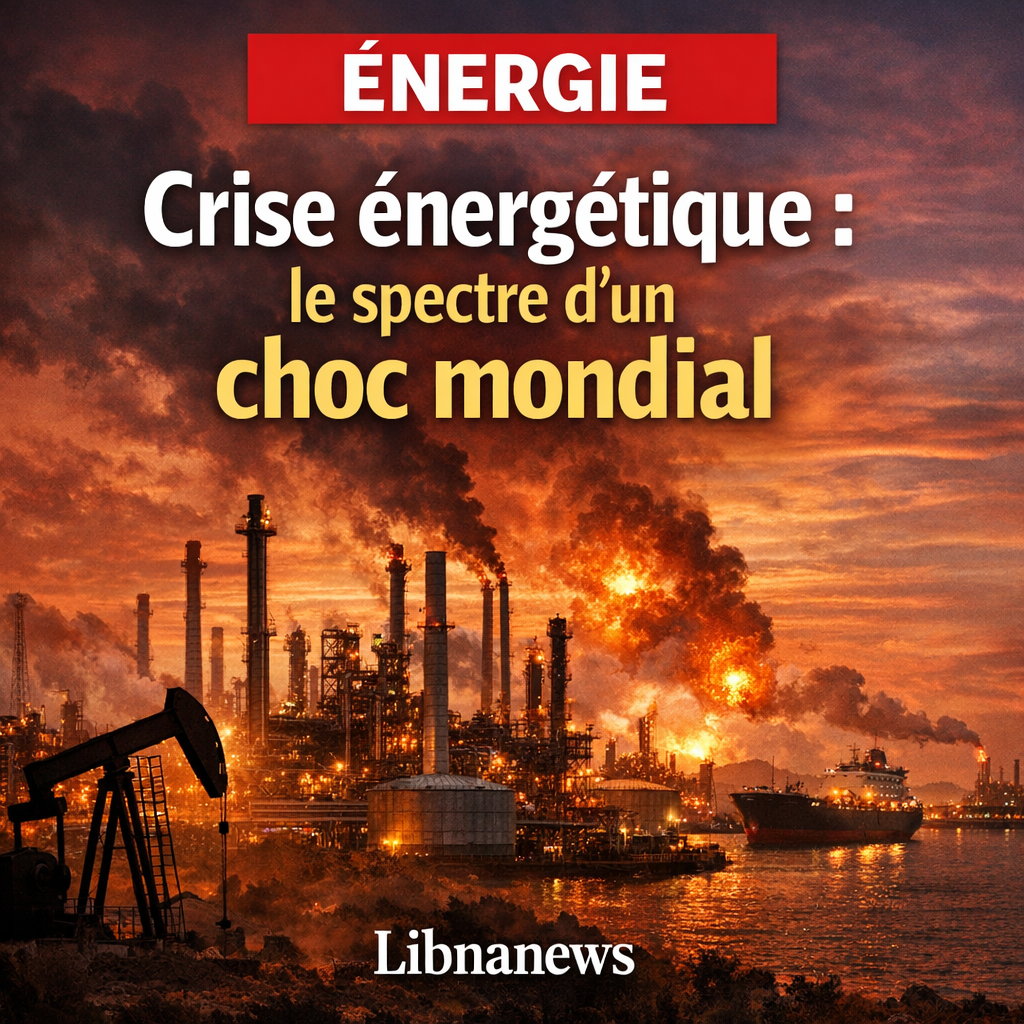
The alert is no longer a mere market signal. By saying, Monday, March 23, that the world could experience its most serious energy crisis in decades, the Executive Director of the International Energy Agency, Fatih Birol, has put war in the Middle East at the centre of the global economic equation. Its diagnosis is based on a rarely advanced order of magnitude with such sharpness: about 11 million barrels of oil per day have already disappeared from the market, more than the cumulative losses associated with the two major oil shocks of the 1970s. To this is added an estimated contraction of 140 billion cubic metres of gas, almost twice the gas shock observed after Russia’s invasion of Ukraine. IEA has already coordinated the release of 400 million barrels of strategic stocks and is discussing further measures with its Member States.
The magnitude of the shock is fuelling a question that markets, central banks and governments dare to evacuate more: is the world approaching a more serious global economic crisis than the oil shocks of 1973 and 1979? The comparison was not excessive. First, it is imposed by the volume of supply losses. It is also imposed by the nature of the historical moment. Large economies are emerging from a difficult inflation phase, remain highly indebted, face persistent trade tensions and remain dependent on vulnerable logistical infrastructure. In such an environment, an energy shock never remains at the price of the barrel. It spreads to transport, industry, agriculture, world trade, financial markets and, very quickly, to household morale and investment decisions.
The change in financial markets is already a first measure of this concern. The world’s major stock markets have declined to a lower four-month period, while investors are looking up at the risk of stagflation, a combination of sluggish growth and persistent inflation that was precisely the 1970s. Oil has gained about 80 per cent since the beginning of the year, according to market data from the international financial press, and several scenarios now point to the possibility of new developments if the Gulf infrastructure remains under threat or if maritime traffic in the Strait of Ormuz remains hampered. This deterioration is not only speculative. It reflects the idea that the world economy could be confronted in the coming months with more scarce, expensive and unstable energy.
A more complex crisis than the oil shocks of the 1970s
Economic memory combines the 1970s with two founding breaks: the 1973 Arab embargo and the 1979 Iranian revolution. In both cases, the contraction in oil supply had led to an increase in prices, a sharp slowdown in growth and a sharp acceleration in inflation in importing countries. The current shock is even more worrying: it is not limited to oil. It simultaneously affects gas, LNG, shipping routes, transport insurance, fertilizers and some of the most strategic energy assets in the Middle East. This extension multiplies the propagation channels and makes comparison with the 1970s almost insufficient. The world of 2026 is less intensive in oil per unit of wealth produced, but it is much more interdependent, much more financialized and much more sensitive to logistical disruptions.
Ormuz Strait crystallizes this vulnerability. When a crossing point concentrates such a large proportion of global hydrocarbon flows, the threat to it acts as a crisis accelerator. Volumes withdrawn from the market are only part of the problem. Uncertainty about future flows is equally important. It leads buyers to secure their cargoes, insurers to increase their premiums, shipowners to change their routes and states to seek additional reserves. Each precautionary response raises the overall cost of the system. The market then pays not only the real shortage, but also the fear of a larger shortage. It is in this type of sequence that energy shocks cease to be sectoral to become macroeconomic.
The return of this risk also comes at a time when the safety margin has been reduced. Central banks had begun to regain control of inflation, but without regaining full normal monetary conditions. States remain constrained by high deficits and weak public finances. In Europe, the European Central Bank stands ready to react if the rise in energy prices spreads to the economy as a whole through second-round effects, notably via wages and service prices. This vigilance shows that the scenario of a temporary shock is alreadycompetited by that of more persistent inflation. However, persistent inflation, against a background of slowing down, is precisely the root of the dreaded global economic crisis.
How an energy shock becomes a global economic crisis
The first mechanism is direct. When oil and gas prices rise, households pay more for fuel, heating and part of their current consumption. Companies are seeing their production costs increase, especially in chemicals, steel, transport, logistics, agri-food and electricity intensive activities. This increase is not confined to the energy bill. It spreads through value chains and eventually reaches the prices of goods and services. The International Monetary Fund has warned that a prolonged rise in energy prices could raise global inflation and reduce output, with an impact of up to 0.2 percentage points of GDP depending on the duration and severity of the shock.
The second mechanism involves world trade. When energy becomes more expensive, marine freight, aviation, petrochemicals and fertilizers are under immediate pressure. The World Trade Organisation already considers that a continuation of the crisis could further slow the growth of international trade, expected to reach only 1.9 per cent by 2026, and reduce about 0.5 per cent if energy and fertilizer prices remain high on a sustainable basis. This risk is central because it reminds us that energy crises do not only affect refineries or motorists. They go up the chain to agricultural prices, the cost of freight transport and, finally, food security in several import dependent regions.
The third mechanism is financial and psychological. Sustainable energy costs change the behaviour of investors, entrepreneurs and households. Stock markets are declining, bond yields are rising suddenly, the currencies of importing countries are weakening and the most expensive investment projects are postponed. Households, for their part, reduce discretionary spending and favour precautionary savings. This slide may seem diffuse, but it acts fast. When it becomes general, it reduces private demand, hinders hiring and amplifies the initial slowdown. The energy crisis then turns into a crisis of confidence and then into a crisis of growth.
The main shock transmission channels
- high oil and gas prices for households and businesses;
- increase in the cost of shipping and insurance premiums;
- increased fertilizer prices and pressure on food prices;
- decrease in consumption due to erosion of purchasing power;
- deferment of industrial and technological investment;
- monetary tightening possible to contain inflation.
The United States is no longer safe
There is a great temptation in Washington to believe that American oil abundance protects the US economy from external shock. This reading has become too simple. While the United States produces massive oil and gas, it remains part of a global market where energy prices are growing globally. As international crude climbs, fuels and diesel follow, U.S. exports become more attractive and the pressure on domestic consumers. Market analyses published this March 23 also describe an American « oil shield » that cracks, with a Brent mounted around $110 and a WTI close to $99, even as U.S. exports are breaking records. This mechanism reduces the gap between energy power and economic immunity.
The political danger in the United States comes from this contradiction. A producing economy can continue to benefit from high energy incomes, while seeing its households pay more for gasoline, transportation and certain everyday goods. In a country where consumption accounts for the bulk of growth, this erosion of purchasing power remains decisive. Markets are starting to integrate. Business banks have reviewed their growth and rate scenarios, and Goldman Sachs has even considered that a severe oil shock could significantly reduce Wall Street. The American problem is therefore not the lack of energy. This is the fact that domestic energy is not enough to offset the inflationary effects of a disorganized global market.
Europe facing the return of the stagflationist trap
For Europe, the risk takes a more conventional form, but no less dangerous. The continent has already experienced a major energy crisis after the invasion of Ukraine, with a surge in gas prices and a tough monetary policy to bring inflation under control. He is now facing a new shock from the Middle East, even as disinflation remained fragile. The ECB cannot prevent the initial increase in oil or gas, but may be forced to intervene if this increase spreads to the underlying wages and prices. This is precisely what its vice-president, Luis de Guindos, recalled by warning that the institution would act in the event of second-round effects.
This puts the spectre of stagflation at the forefront. If energy prices rise as activity slows down, central banks find themselves caught between two conflicting objectives. Supporting growth requires more flexible financial conditions. Controlling inflation requires more firmness. Investors have understood this dilemma. The bets on rapid monetary relaxation have declined, while the expectations of rising rates are reshaped in several monetary zones. For European households, the result is doubly penalising: a heavier energy bill and potentially more expensive credit. For businesses, this means compressed margins and a more uncertain investment environment.
Asia, a major epicentre of importing vulnerability
If the shock continues, Asia could concentrate a significant part of the impact. Many of the region’s large economies import most of their energy and depend on a dense maritime trade to feed their industry. They are therefore exposed to both rising prices, logistical disruption and increased competition for access to available cargo. Moody has warned that Asia-Pacific growth could slow to 4% in 2026, down from 4.3% in the previous year, due to the combination of geopolitical tensions and commodity prices. In the case of India, the Agency also stresses the relative weakness of strategic reserves and the dependence on subsidy policies, both of which can become costly when prices remain high.
This picture is important for the global economy, as Asia today plays a central role in manufacturing production, component trade, shipping and global demand growth. A marked slowdown in the region would not remain regional. It would affect supply chains, industrial goods prices and trade dynamics. In a much more integrated world than in 1973, Asian shocks spread rapidly to other continents. This is also why the current crisis may seem potentially larger than the historical oil shocks: it affects economies that now weigh much more in the manufacture and circulation of goods.
Gas and fertilizers, the silent engines of the crisis
Reducing the current crisis to a mere oil shock would be an error of analysis. Natural gas and liquefied natural gas now play a key role in electricity supply, industry and agricultural input production. The estimated loss of 140 billion cubic metres of gas is therefore mechanically widening the scope of the crisis. It threatens electricity producers, increases industrial costs and increases tensions in the already highly competitive LNG market. Several regional infrastructures have suffered damage, including some of Qatar’s LNG capacity according to assessments in the international economic press, which reinforces the prospect of lasting disruption rather than just an episode of volatility.
The issue of fertilizers makes this diagnosis even more worrying. Gas is an essential input for the manufacture of nitrogen fertilizers. When it becomes scarce or more expensive, agricultural prices end up following. China has already tightened its fertilizer exports to protect its domestic market, adding additional tension to a world market weakened by war. The IMF has explicitly mentioned fertilizers among the sectors likely to transmit the energy crisis to global inflation. This means that an oil and gas crisis can, in the medium term, be found in the price of bread, cereals, fresh products and animal feed. The shock then becomes social, well beyond the energy sector alone.
Strategic stocks can amortize, not neutralize
One of the few shock absorbers available remains the use of strategic reserves. IEA and its members have already mobilized a record 400 million barrels, or about 20% of the stocks available in their common arrangements. The Agency now consults its Member States on possible further releases. This response may contain some of the panic and give governments time. However, it does not have the power to rebuild the lost flows in a sustainable manner. If the Strait of Ormuz remains disturbed, if regional energy infrastructure continues to be targeted and if geopolitical tensions prevent a rapid recovery of traffic, reserves will only smooth the shock. They will not remove perceived shortages or structural increases in costs.
Economic history also shows it quite well. Emergency measures are useful to avoid sudden disruption, but they do not replace a functioning market. Fatih Birol recalled that governments could be required to reactivate energy saving policies already used in past crises, such as telework, carpooling or speed limits. The simple return of this type of tools in the public debate speaks a lot of the level of tension. When an agency set up to secure the energy supply of developed countries once again refers to these schemes, it considers it plausible that a crisis is long enough to demand action on demand, and not just on supply.
The decisive difference is less due to the amount of oil missing than to the density of economic interconnections. The world of the 1970s was simpler, less integrated and less dependent on tight flow logistics. The world of 2026 is better able to react quickly, but also more exposed to rapid contagions. Energy disruption almost instantly affects financial prices, insurance premiums, transportation costs, agricultural inputs and central bank strategy. It is this accumulation that underpins the fear of an exceptional global economic crisis.
A crisis that is already fighting power relations
Like all major energy shocks, it produces immediate losers and temporary winners. High dependence importing countries are seeing their bills increase and their financial vulnerability increase. Conversely, some exporters are benefiting in the short term from the surge in prices. This redistribution, however, has nothing to stabilize. It feeds protectionist temptations, encourages national retention strategies and risks further fragmenting the global market. Energy trade can become instruments of geopolitical negotiation rather than mere trade flows. This increases uncertainty and reduces the ability of the market to rebalance itself.
In this context, the real question is no longer whether the shock is serious. It is to measure its duration and its ability to contaminate the rest of the world economy. As long as supply losses remain massive, markets fear long-term or intermittent closure of Ormuz, fertilizers and freight are rising, and central banks are preparing to arbitrate between inflation and growth, the scenario of a more severe global economic crisis than the oil shocks of the 1970s can no longer be ruled out as an extreme hypothesis. It became a central risk in the year 2026.



