

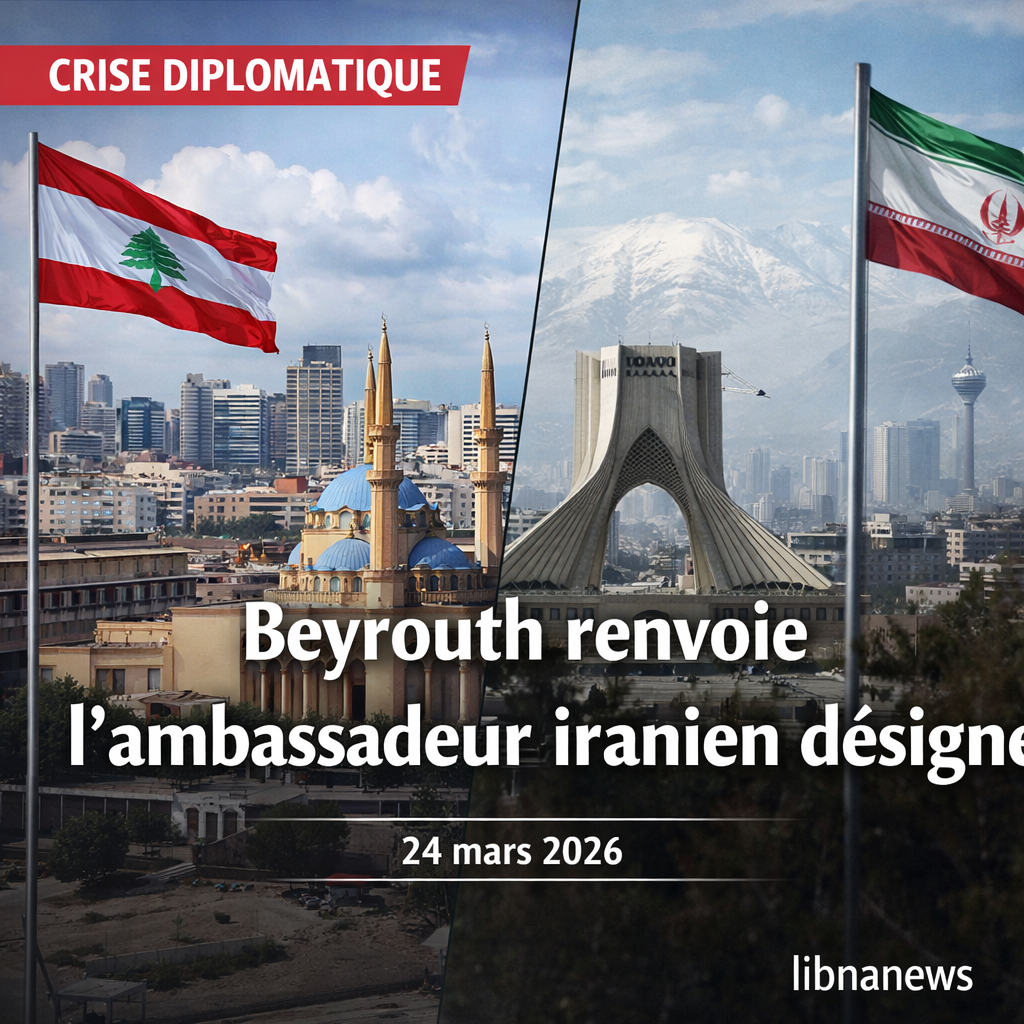
Lebanon abruptly raised its voice against Iran. Foreign Minister Youssef Raji announced on Tuesday the withdrawal of the approval of the Iranian ambassador appointed in Beirut,Mohammad Reza Raouf Sheibanito which a deadline until Sunday was granted to leave the country, as well as the reminder for consultations of the Lebanese Ambassador to Iran,Ahmad Sweidan. This decision comes in an atmosphere of extreme tension, at a time when Beirut is under strong Israeli and American pressure, and a few hours after another Iranian threat of « heavy » reprisals against Israel if attacks against Lebanese and Palestinian civilians continue.
The announcement was confirmed by the Lebanese National Information Agency, which reported that Lebanon was withdrawing the approval of the Iranian ambassador-designate and ordering him to leave the territory no later than Sunday. In the same movement, Beirut recalled its ambassador to Tehran, Ahmad Sweidan. This double measure marks one of the most severe diplomatic actions taken by the Lebanese State against Iran since the beginning of the regional escalation.
The name of the Iranian envoy targeted is that ofMohammad Reza Raouf Sheibani, a seasoned diplomat already passed through Beirut and appointed by Tehran to take over the embassy in Lebanon. The representative of Lebanon recalled is wellAhmad Sweidanwhose credentials had been delivered to Tehran in recent weeks. By withdrawing the approval of one and recalling the other, Youssef Raji’s ministry turned a latent dispute into an open diplomatic crisis.
The Lebanese decision falls within a context of intense external pressure. Since 2 March, when the war suddenly worsened on the Lebanese front after Hezbollah entered the regional sequence related to the Iranian-Israeli conflict, Israeli strikes have spread to the south of the country, the Bekaa and Beirut. Reuters reported on 20 March that, according to the Lebanese authorities,more than 1,000 people had been killedandabout 1 million displaced19 March. The Agency also noted, based on ACLED data, that 666 deaths had been recorded between 1 and 16 March, and that 80% of those deaths had occurred in attacks where civilians were the primary or single target.
This military pressure adds political pressure. Paris itself considered it « unreasonable » to demand that Lebanon disarm Hezbollah while under bombs, a sign of the tension surrounding the demands made to Beirut by its Western partners and Israel. At the same time, the Hebrew state rejected the offer of direct discussions mentioned by President Joseph Aoun, while its ministers multiplied statements on a new security reality south of the Litani.
The day before, this pressure materialized in the heart of the capital. On Monday, an Israeli strike targeted an apartment atHazmieheast of Beirut. The Lebanese Ministry of Health reported at least one death. The Israeli army claimed to have struck a member of theforce Al-QudsGuards of the Revolution in Beirut. The Hazmieh neighbourhood, which is adjacent, inter alia, to institutional and diplomatic areas, was shaken by this attack, which further reinforced the feeling that Beirut itself has become a direct theatre of regional confrontation.
This climate enlightens Youssef Raji’s decision. The head of Lebanese diplomacy acts as Iranian influence in Lebanon has become a frontal subject, and the war pushes the state to publicly redefine its red lines. The reminder of Ahmad Sweidan and the withdrawal of the approval of Mohammad Reza Raouf Sheibani send a double message: in Tehran, first, to point out that Beirut no longer accepts certain political or diplomatic overflows; then, to show that part of the State is seeking to resume the initiative on the question of sovereignty.
The sequence is all the more heavy since, at almost the same time, Iran was still raising its tone. On Tuesday, the Revolutionary Guards warned that if the « crimes against civilians in Lebanon and Palestine » continued, the Israeli army would be targeted by « heavy missile and drone strikes ». This threat is part of a continuing expansion of the conflict, as Israel continues its operations against Hezbollah in Lebanon and Iranian targets, while Donald Trump tries, at least verbally, to open a diplomatic window with Tehran.
For Beirut, the signal is particularly sensitive. On the one hand, Israel is intensifying its bombings, destroying bridges south of the Litani, advancing its military pawns and demanding broader security control. On the other hand, Iran maintains a rhetoric of response on behalf of Lebanon and the Palestinians, which further exposes Lebanese territory to be treated as a front of the regional axis. In this vice, Youssef Raji’s decision appears to be an attempt to regain institutional distance from Tehran, even though the Lebanese state remains militarily and diplomatically fragile.
The gesture is therefore more than a protocol incident. It reflects a deep crackdown on the Lebanese state apparatus in the face of a war that crosses its borders, strikes its cities, emptys its southern regions and reduces its diplomatic margin. By sending the appointed Iranian ambassador back and recalling his own envoy to Tehran, Beirut chose to make visible a political rupture that the war made more difficult to conceal every day.



