

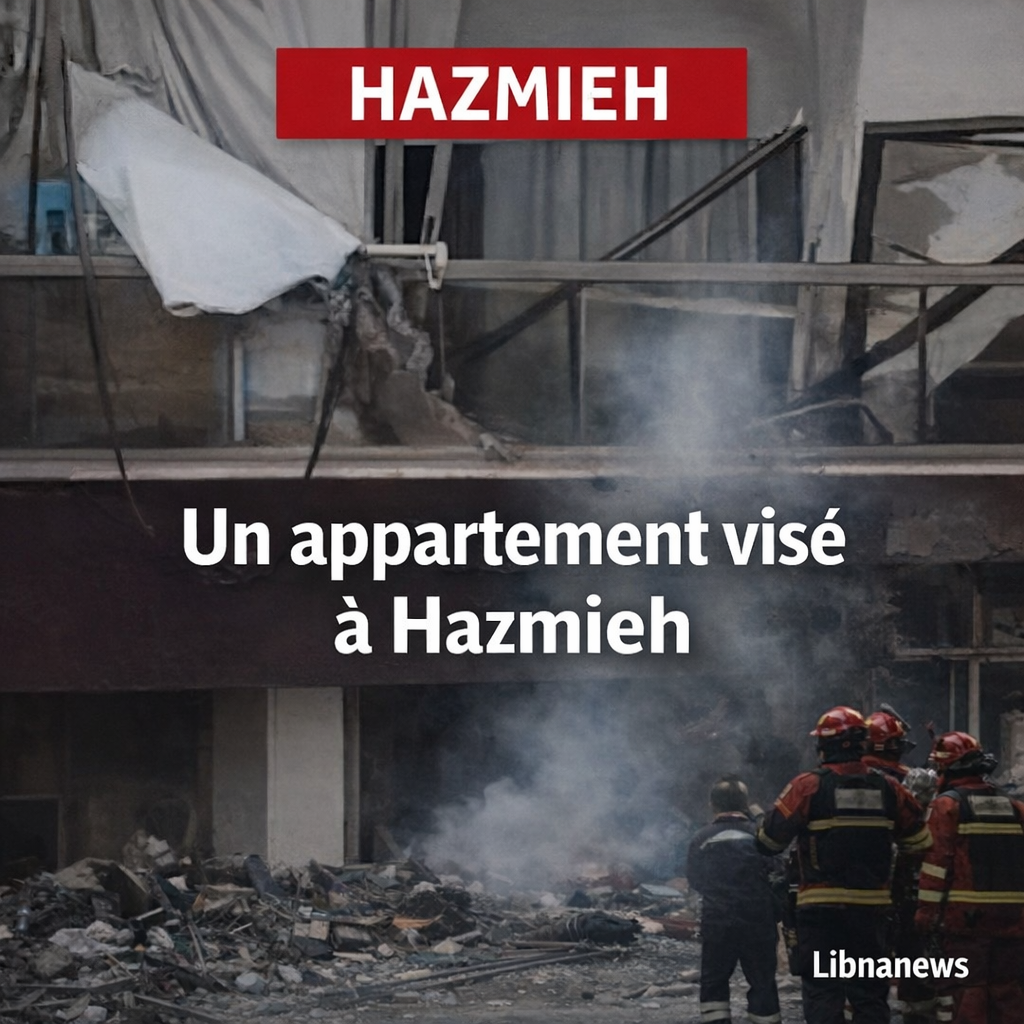
A strike recently targeted an apartment in the Hazmieh area, east of Beirut, reviving concern about the extension of the strikes to residential areas outside the traditionally targeted strongholds. The provisional assessment provided by the Ministry of Health indicates a death. For its part, the Israeli army claims to have targeted a member of the Iranian al-Quds Force. Beyond the immediate impact, the attack revives a broader issue: that of a widening war geography, with strikes now affecting neighbourhoods where the civilian population fears a banality of risk.
What we know at this time
The evidence remains limited, but several points overlap. On Monday, a strike hit an apartment in Hazmieh, in East Beirut. The Ministry of Health announced, in its initial assessment, the death of one person. At the same time, the Israeli army claimed to have targeted a member of the Al-Quds Force, an external branch of the Iranian Revolutionary Guards. At this stage, the identity of the person concerned has not been formally detailed by the Lebanese authorities, and no broader assessment has yet been provided for any further injuries or human damage.
Available information places the impact in a residential building in Hazmieh. There is evidence shortly after the strike that a building apartment was directly affected, with significant material damage to the building and its immediate vicinity. The residential nature of the target site enhances the sensitivity of the event, in an area where the perception of risk is not the same as in neighbourhoods in the southern suburbs regularly placed under threat. At this stage, the official balance sheet remains provisional, which means that it can still evolve in the coming hours according to relief operations and on-site checks.
The strike is also part of a wider sequence. Consistent information describes it as the second attack against Hazmieh in the recent period, and more broadly as a new strike in a predominantly Christian residential area east of Beirut. This element counts politically, as it further expands the mental map of the war in the Beyrouthin agglomeration. For several days, the inhabitants have already followed with anguish the multiplication of strikes on the southern suburbs, on the axis of the airport, on bridges and on several southern localities. See Hazmieh joining this list feeds the idea that lines of distinction between exposed and relatively preserved areas become increasingly fragile.
Why Hazmieh is an important signal
Hazmieh is not just a point on the map. The area occupies a pivotal place in the urban continuity of Beirut and its immediate periphery. When a strike hits an apartment, the effect exceeds the immediate balance sheet. It acts as a psychological shock for a population that felt less directly exposed than other sectors. In modern wars, this displacement of fear counts almost as much as the target itself. It changes habits, accelerates departures, emptys some buildings, freezes commercial activity and creates a feeling of total unpredictability.
This psychological dimension is all the stronger as the strike hit a place of residence. When an attack targets an apartment, the message perceived by civilians is brutal: there is no longer a clear border between military space and domestic space. Even when the Israeli army claims to target a specific person, the materiality of the place hit remains that of a residential building. This means exposure of neighbours, potential collateral damage, immediate panic in the neighborhood and increased pressure on rescue services. This type of operation thus feeds an anguish spread throughout Greater Beirut, far beyond Hazmieh.
The other reason Hazmieh takes into account is the gradual transformation of operating procedures. Since the beginning of the climb, the strikes have affected not only southern Lebanon and the southern suburbs, but also more central areas, roads, bridges and buildings outside the perimeter that many had previously associated with direct confrontation. The Hazmieh strike confirms this evolution: the war is no longer only distant for a large part of the inhabitants of the capital, it becomes a mobile urban threat, capable of appearing in densely populated and mixed areas.
Israeli statement on a target linked to al-Quds Force
The Israeli army claims to have targeted a member of the Iranian al-Quds Force. This statement must be presented for what it is at this time: the Israeli version of the operation. It follows a logic already observed in recent weeks, where Israel claims to pursue in Lebanon cadres, managers, logistics relays or members linked to the Iranian military apparatus and its allied networks. At the beginning of March, the Israeli army had already announced that it had eliminated the commander of the al-Quds Force for Lebanon in a strike in Tehran, which shows that it presents the Lebanese theatre as a direct extension of its confrontation with Iran.



