

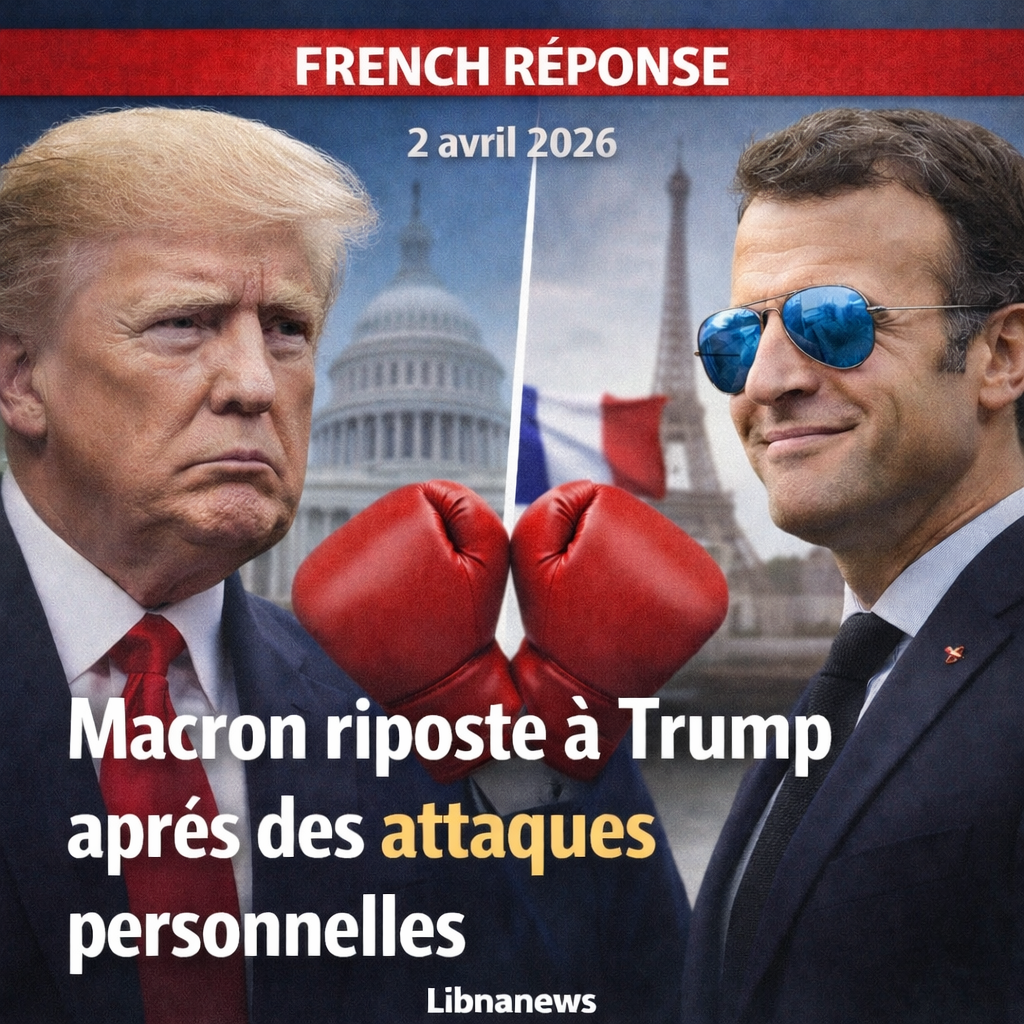
On official trip to Seoul with his wife, Emmanuel Macron chose to respond soberly, but firmly, to Donald Trump’s attacks on his couple. The French president considered these words « not elegant or up to date », before extending the criticism to the political background of the moment: on Iran, NATO and the Strait of Ormuz, he accused his American counterpart of scrambling the game by saying « every day the opposite of what was said the day before ». This tense sequence prolongs a relationship of strategic disagreements, public spades and, now, personal attacks.
Emmanuel Macron answered without stuttering, but without letting it pass. On his arrival in Seoul, where he made a state visit, the French head of state reacted to Donald Trump’s comments, who had revived the controversy by taking his couple and mockingly evoking an episode that happened in 2025 with Brigitte Macron. « The words that I have heard and to which you refer are neither elegant nor up to date, » the French president said, adding that they « do not deserve an answer. » The formula is brief, but it marks a line: do not feed Trump’s personal scene, while disqualifying it publicly.
This development came after a new release of the American president, who had said that his French counterpart « was mistreated by his wife » and that he « retards » with a blow received in the jaw. The charge explicitly targeted Emmanuel and Brigitte Macron, on a non-diplomatic register, in an already tense moment between Washington and several European capitals. It is part of a sequence in which Donald Trump blames France and other allies for not supporting the American offensive in the Middle East or the logic of military coercion around the Strait of Ormuz.
A personal answer, then a political counterattack
Macron’s answer was not limited to the presidential couple’s question alone. A few hours later, still from Seoul, he focused the debate on the strategic terrain. The French president criticized Donald Trump for weakening NATO by maintaining « every day the doubt about his commitment ». According to him, an alliance loses its substance if its principal member leaves the uncertainty about its fidelity to its commitments. This criticism directly targets Trump’s repeated statements about a possible American withdrawal from the Atlantic Alliance, in a context of deep disagreement with Europeans over Iran and Ormuz.
Emmanuel Macron also attacked the US President’s method. « You have to be serious, and when you want to be serious you don’t say every day the opposite of what we said the day before, » he said. In the same sequence, he denounced a communication that « goes too much in all directions » and pleaded for « stability, calm, a return to peace. » This sentence is central at this moment. It summarizes the French criticism of an American diplomacy that is considered to be both erratic, spectacular and destabilizing, for both allies and opponents.
The French President finally rejected the option of a military operation to reopen the Strait of Ormuz by force, as the United States wished. He described such a « unrealistic » perspective, pointing out that it would take « an infinite time » and would involve « a lot of risks ». This divergence largely explains the verbal escalation between Washington and Paris. France defends a diplomatic exit and an internationalized framework, when Donald Trump demands a rapid alignment of his allies with a logic of military pressure.
The dispute exceeds the Macron couple
The personal attack against Brigitte Macron is therefore not a simple isolated slip. It intervenes against the backdrop of a transatlantic crisis. For several days, Trump has been blaming France. On 31 March, he accused Paris of being « very unhelpful » after French refusal to allow certain US military flights related to the conflict with Iran. Elysée replied by saying that he was « surprised » by this criticism, ensuring that the French position had not changed since the beginning of the war and that it was consistent with the line set from the beginning.
The heart of the dispute is here. For Washington, Europeans take advantage of the American umbrella while refusing to support the United States when they open a new front. For Paris, NATO is not intended to serve as a framework for offensive operations in the Gulf and the Alliance cannot be redefined in the wake of pressure at the moment. France officially recalled that NATO serves Euro-Atlantic security, not offensive missions in Ormuz. This clarification was formulated after Donald Trump’s threats to withdraw the United States from the Alliance if Europeans continued to reject his agenda.
In this sense, Macron’s sentence on a president who says « every day the opposite of what was said the day before » does not only respond to Trump’s style. It aims at a method of government that produces strategic instability. In the eyes of Paris, the question is no longer only that of the tone used, but that of American reliability. When Washington threatens NATO one day, calls for military support the next day, and then lets the idea of disengagement hover, it is the entire credibility of the Alliance that finds itself affected.
A long story of picks between Trump and Macron
The relationship between Donald Trump and Emmanuel Macron has never been linear. It experienced phases of cordial display, then strong tensions, often public. As early as November 2018, Trump had found Macron’s idea of a real European army to be « very insulting, » a challenge to the role of the United States in the security of the continent. This polemic had quickly slipped towards burden-sharing within NATO, a subject Trump has been accusing Europeans, and France in particular, for years of taking advantage of American protection without paying enough.
A year later, in December 2019, tension had risen again after Macron’s formula on a NATO in « brain death ». Trump then denounced a statement « very, very bad » and « very insulting, » adding that « no one needed NATO more than France ». He also took the opportunity to attack the French economic situation. This episode had set up a pattern called to repeat itself: to every French critic of the Alliance or the American strategy, Trump responded by a public attack combining politics, pressure and personal questioning of the French leader.
Disagreements were not limited to NATO. They also covered customs duties, the French tax on digital giants, the wine trade, Iran, and, more recently, the attitude to be adopted in the face of the ongoing war. In each sequence, Trump often chose verbal escalation, where Macron preferred a more institutional registry. But the novelty of 2026 was clear: the dispute was no longer confined to diplomatic differences. She crossed the threshold of the intimate attack, directly targeting the French presidential couple.
A personal attack that changes the level of confrontation
This change of registry immediately provoked reactions in France. Beyond the Elysée, several politicians judged Trump’s words to be displaced. What strikes in this sequence is the apparent desire of the US President to ridicule his counterpart at the very moment when the two countries oppose a question of war, alliance and energy security. So the attack on Brigitte Macron didn’t do anything bad. It serves as an extension of broader political pressure against Paris.
In return, Macron chose a readable counter-strategy. On the one hand, he lowered the attack by calling it an indignant head of state. On the other hand, he immediately goes back to the geopolitical level, accusing Trump of weakening NATO, making the situation more confused and turning international crises into a spectacle. This dual movement allows him not to lock himself in a worldly controversy, while showing that the central question remains American coherence over Iran, Ormuz and the Atlantic Alliance.
This response is also part of the line that the French President has been trying to impose for several days in Asia. In Tokyo and Seoul, Macron defended the idea of a more « predictable », more stable and more committed to international law. In a hollow, this diplomatic sequence contrasts two styles of power: a White House that improvises and threatens, and a French head of state who tries to pose as a defender of constancy, calm and orderly diplomacy.
The background of face-to-face: Iran, NATO and Western leadership
Beyond words, the Macron-Trump duel reveals a deeper fracture in the western camp. France refuses to participate in a military operation to « liberate » the Strait of Ormuz and rejects the idea of diverting NATO from its defensive mission. Trump, on the other hand, presents European refusal as a political and strategic betrayal. This delay explains his verbal offensive against Paris. It also sheds light on the virulence of the French response on the need to be « serious » and coherent.
In this context, the personal attack against Emmanuel and Brigitte Macron appears to be the most visible part of a broader confrontation over Western leadership. Trump wants to impose an alliance on the map, conditional on immediate support for his operations. Macron defends an alliance based on stable commitments, clear procedures and a distinction between collective defence and unilateral offensive operations. The Seoul episode shows that the French president is no longer content to disapprove. It now responds frontally, both in form and in substance.






