

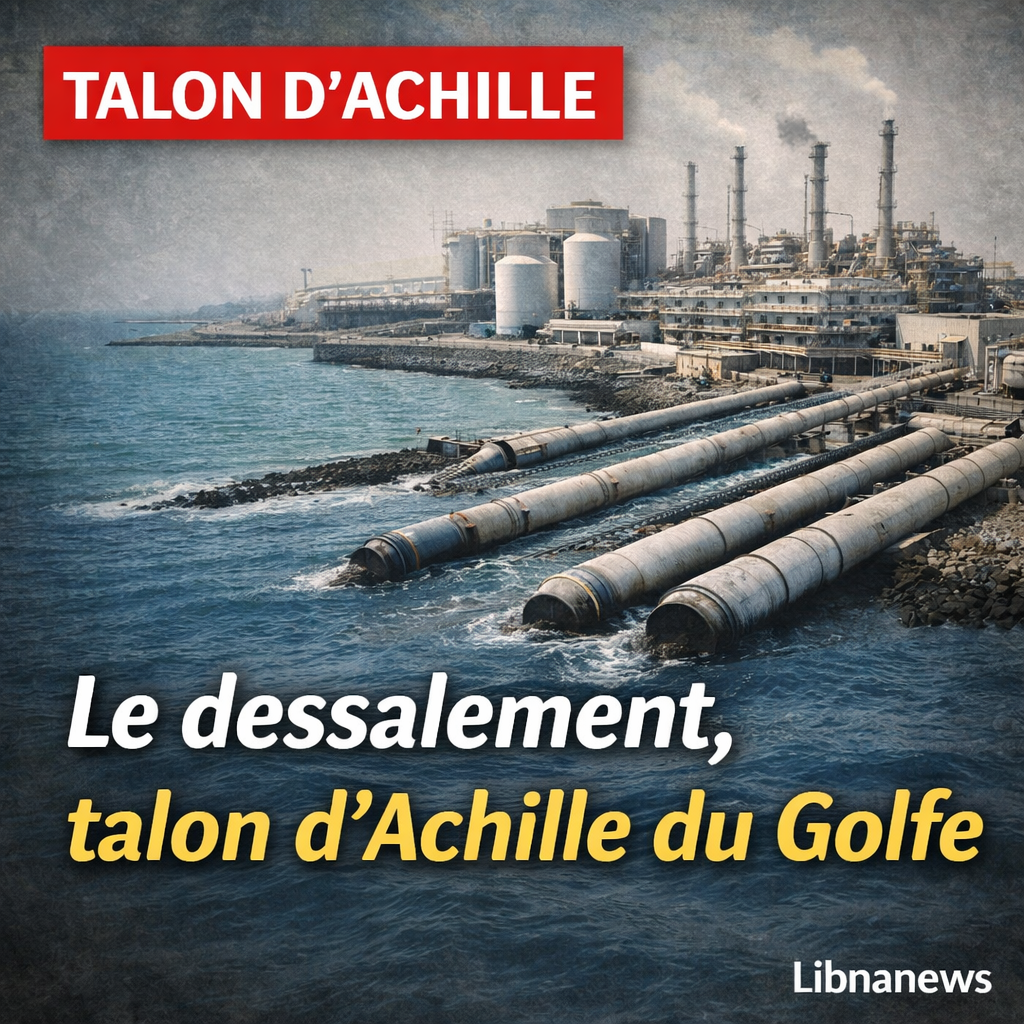
By threatening to hit Iranian power plants if Tehran did not completely reopen the Strait of Ormuz, Donald Trump did not only harden the tone. He moved the escalation to civilian infrastructure. The Iranian response was consistent. If the energy facilities of the Islamic Republic are targeted, reprisals will in turn affect critical infrastructure of the Arab allies in Washington, particularly desalination plants. It is this sequence that must be placed at the heart of the subject. Desalination does not enter the war as an abstract target. It is a direct consequence of an American threat to Iranian civilian infrastructure.
In the Gulf, this threat is not directed at a secondary sector. It is the most intimate point of dependence of Arab monarchies. Oil provides revenue, export power and geopolitical weight. Water provides daily life, hygiene, hospitals, the continuity of large cities and social stability. This water, on much of the Arabian peninsula, is not naturally available in sufficient quantity. It is produced industrially on the coast in huge desalination plants. Threatening these sites therefore threatens the normal functioning of entire societies.
A mirrored response, not an isolated threat
The first mistake would be to present Iran as having suddenly chosen to make Gulf water its main target, without context. The facts say something else. The climbing chain is clear. Washington raised the possibility of an attack on Iranian power plants. Tehran replied that such a strike would result in reprisals against energy, technology and desalination infrastructures in the region. The symmetry is obvious. A threat to Iranian electricity is threatening the Gulf water. The political sense of this symmetry is central, as it shows that belligerents no longer speak only the language of bases, missiles and front lines. They are now talking about vital networks.
This mirror logic is not just rhetorical. It corresponds to Iran’s long-standing view of its power relationship with more powerful conventional opponents. The Islamic Republic has neither Israeli air superiority nor the American naval projection. On the other hand, it can identify the fragile points of the regional ecosystem: straits, terminals, networks, shipping, energy, now water. Desalination enters into this mapping because it offers Tehran a politically effective threat. An affected refinery raises prices. A desalination plant threatened to cause fear. This reading is an analysis, but it is supported by the nature of the publicly mentioned targets and recent work on water vulnerability in the Gulf.
The message to the Arab capitals of the Gulf is clear. If they facilitate, support or cover an American campaign against Iranian civilian infrastructure, they in turn expose where their vulnerability is most acute. So Iran is not just speaking in Washington. He also speaks in Riyadh, Abu Dhabi, Doha, Manama and Kuwait. He reminds them that no alliance with the United States turns a technical dependency into a sanctuary. Again, the analysis derives directly from the nature of the targets cited by Tehran and the context of their designation.
Desalination, the invisible pillar of Gulf security
In order to understand the gravity of such a threat, we must start from the fundamentals. The Gulf is one of the world’s poorest freshwater regions. The World Bank points out that the Gulf Cooperation Council countries are faced with the virtual absence of perennial surface waters and chronic overexploitation of groundwater. Desalination helped to circumvent this constraint. It has made possible urban growth, industrialization, population growth and the daily continuity of cities built on the edge of the desert. Without it, the current economic and social organization of the region would simply be impossible.
This dependency is not marginal. According to an analysis published in March 2026 by the Center for Strategic and International Studies, desalination covers 77.3 per cent of total water demand in Qatar, 67.5 per cent in Bahrain, 52.1 per cent in the United Arab Emirates, 42.2 per cent in Kuwait and 31 per cent in Saudi Arabia. These percentages do not only describe a technological option. They measure the real degree of water vulnerability in the Gulf States. When a country produces such a share of its water through fixed and industrialised coastal facilities, its internal security depends on a system that can be located, disturbed and, in some cases, rendered unusable.
| Country | Share of total water demand covered by desalination |
|---|---|
| Qatar | 77.3% |
| Bahrain | 67.5% |
| United Arab Emirates | 52.1% |
| Kuwait | 42.2% |
| Saudi Arabia | 31 % |
Source: CISS, March 2026.
Saudi Arabia alone summarizes this contradiction. The Saudi public actor Saline Water Conversion Corporation is the world’s largest producer of desalinated water, with more than 6.6 million cubic metres per day in its 2022 annual report. Its report also indicates that the kingdom alone accounts for about 22% of the world’s desalinated water production. This leadership is often read as a sign of technological power. It can also be read as an increased exposure. The more a country supports its water security on a vast network of desalination sites, the more critical nodes it increases to protect.
The real weakness: dependence on a continuous system
Desalination is often seen as an industrial feat. That’s right. But this feat rests on a continuous chain, so on a cascade vulnerability. A factory does not produce alone, in a vacuum. It needs a water intake at sea, stable power supply, pumps, membranes, chemicals, pipes, pumping stations, tanks, maintenance teams and distribution networks. Water security in the Gulf is therefore less dependent on passive stocks than on permanent production. This changes the nature of the risk. You can’t think of water as a strategic oil reserve.
This reliance on continuity explains why desalination plants have become so sensitive in strategic calculations. A brief disturbance can be absorbed locally by tanks. Prolonged interruption at several sites, or degradation of the associated power grid, can quickly create a national problem.The Worldrecently recalled that regional experts are concerned not only about the vulnerability of the facilities themselves, but also about the vulnerability of the strategic reservoirs and interconnections planned for crisis management. Clearly, it is not just a factory that can become a weak spot. It is the entire integrated water system of the Gulf.
This reality introduces a new hierarchy of vulnerabilities. For a long time, the Arab monarchies thought of their security around hydrocarbons. They have protected export terminals, pipelines, ports, fields and straits. All this remains decisive. But a water crisis would be more immediately political than an oil crisis. A decline in revenues can be amortized by financial reserves. A breakdown in the supply of drinking water quickly results in tensions in homes, hospitals, schools, working-class neighbourhoods, air-conditioned buildings and industrial areas. Water affects the daily link between the state and the population. This conclusion is an inference based on the level of water dependence documented by the specialized sources.
Easy-to-target, hard-to-sanctuary facilities
The vulnerability of desalination plants is also due to their geography. They are located on the coast. Their water intakes, pipes, ponds and discharge areas cannot be completely buried, easily displaced or effectively concealed. In a reference study on the geopolitics of desalination, L In other words, technical success produces strategic visibility.
These sites do not resemble hardened bases. Their logic is that of efficiency, efficiency and continuous maintenance. They also depend on electricity. This is a decisive point, and it refers directly to the original American threat. If Washington chooses Iran’s power plants as potential targets, it is precisely because by hitting electricity one disorganizes an entire civil ecosystem. The same reasoning applies to the Gulf States. A desalination plant can be neutralized by directly hitting it, but also by degrading its power supply, ancillary facilities or logistical access. The war against water can therefore take many forms.
The risk is not limited to the visible explosion of a strike. The CIS stresses another fragility: the reverse osmosis plants, increasingly used in the Gulf, depend on a minimum quality of pumped water. Significant marine pollution, oil spills or debris may be sufficient to interrupt or significantly reduce the capacity of the operation.The Worldrelayed the same warning about the current environmental risk in the Gulf: coastal desalination facilities may become inoperative in the event of major oil pollution, with potentially massive consequences for populations.
It is often overlooked, but it changes the nature of the threat. To disrupt the Gulf water, it is not always necessary to spray a plant. It may be enough to touch what surrounds: energy terminal, ship, port, catchment area, power station, pumping network. A war of energy or shipping can thus produce a water crisis. In a semi-closed sea, dense in energy traffic, this systemic vulnerability is particularly high. This is also what makes the Iranian threat formidable: it plays as much on potential destruction as on uncertainty. This reading is a deduction from the vulnerabilities described by specialized sources.
What Tehran really wants
The Iranian threat against desalination is not just about buildings. It is a social contract. In the Gulf monarchies, the state has long based its legitimacy on security, redistribution and continuity of services. Water is one of the most basic services of this promise. By designating desalination units as targets of reprisals, Iran therefore chooses an even more than economic political register. He made it clear that the consequences of an attack on its power stations would not be limited to markets or exports, but would be part of the daily lives of allied companies in Washington. It is an analysis based on the place of desalination in the Gulf water systems and the sequence of threats.
This dimension distinguishes water from oil. Markets can absorb, to some extent, one-off disturbances in oil supply. States may draw from their reserves, divert cargoes or adjust their production. Drinking water offers much narrower room for manoeuvre. A population can bear a few days of rising gasoline prices. It reacts differently to the idea of a break in water supply, even temporary. This makes desalination a lever of political pressure and a rare efficiency. Again, the argument is based on an inference based on documented levels of dependency and the very nature of the service rendered.
There is a cold strategic rationality in this choice. Tehran knows that it does not need to destroy massively to get an effect. It is enough to bring into the minds of Gulf decision-makers the idea that their vital systems are exposed. The threat on the water then acts as the threat on Ormuz: it changes the calculations even before the possible passage to the act. It is this power of psychological deterrence that makes desalination a major subject of the crisis. In this escalation, the fear of interruption is already valid as an instrument of pressure.
A red line of the law of war
This drift towards civil infrastructure requires a clear legal focus. International humanitarian law prohibits the attack, destruction, removal or unnecessary use of objects necessary for the survival of the civilian population. ICRC customary rule 54 explicitly states this. The water in the Arab countries is of course part of these protected properties, and the infrastructure that allows access to them is directly concerned. A deliberate attack on desalination units would therefore immediately raise the issue of a war crime.
But consistency requires that the reasoning be completed. While desalination in the Gulf is covered by this protection, Iranian power plants for civilian operation also raise a major legal issue when designated as coercive targets. One of the political stakes of the moment is precisely this: escalation is trivializing the idea that one can threaten systems that make ordinary life possible. On the contrary, the law reminds us that there is a red line when the war targets water, electricity and other goods indispensable to the population.
The danger is therefore twofold. It is strategic, because these threats can cause a rapid regionalization of the conflict. It is normative, because it moves war to objects that the law is seeking to avoid military logic. When leaders speak of desalination plants or plants as plausible targets, they do not only raise tension. They bring the region closer to a threshold where civilians become, through the networks on which they depend, the real impact of the war. This conclusion is an analytical reading of the facts and applicable rules.
The Gulf facing its most sensitive dependency point
The Gulf States are aware of this vulnerability. The World Bank points out that the region has been investing for several years in wastewater reuse, water efficiency, reduction of network losses and technological diversification. Some interconnections and strategic reservoirs have been designed to improve resilience. But these tools were first designed to respond to scarcity, population growth and climate change. The current crisis places them brutally in a national security framework.
This shift is important. It means desalination ceases to be an engineering file to become a defence file. In the Gulf capitals, the question is no longer just how to produce more water, cheaper and less emissions. It is about how to protect an immense, interconnected, energy-intensive and vital coastal system from a threat that can take the form of a missile, sabotage, cyberattack, pollution or a simple panic episode. The CISC also notes that the threats to the sector are not only physical, but also cybernetic.
That’s why Achilles’s heel expression is not excessive. Desalination plants are the silent prowess that allowed Arab monarchies to turn the desert into metropolises. They are also the point where this prosperity can waver as quickly as possible if the logic of retaliation prevails. After American threats against Iranian civilian infrastructure, Tehran chose to respond where Washington’s Arab allies are most exposed. Not on a slogan. Not on a symbol. On the water.



