

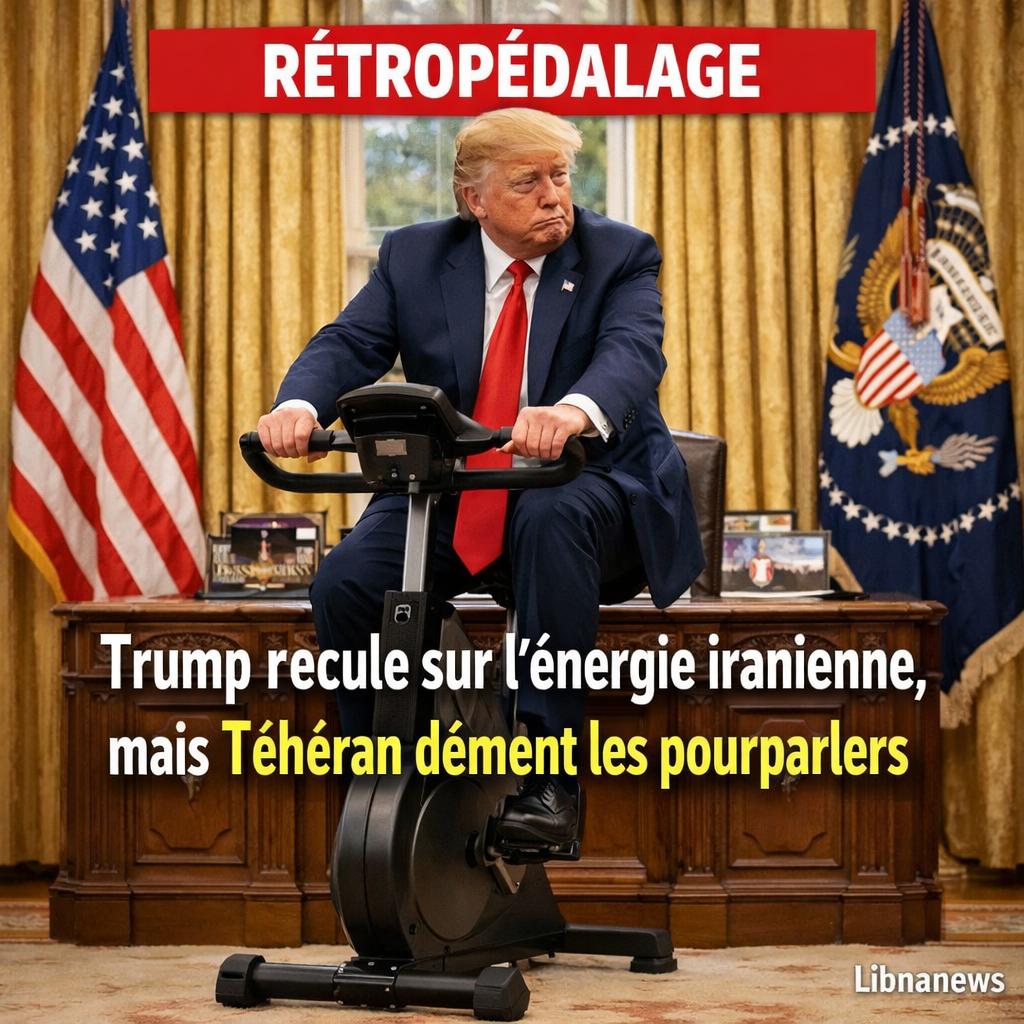
Donald Trump announced on Truth Social the five-day postponement of « any military strike » against Iranian power plants and energy infrastructure. The US President justified this suspension by « very fruitful and constructive » discussions with Iran. But at the same time, the lack of precise official follow-up in Washington and Iran’s refusal to publicly recognize such exchanges undermine the American story. The Associated Press points out that Tehran did not confirm these discussions, while Reuters already reported on 17 March that the new Iranian Supreme Guide had rejected proposals for de-escalation from intermediaries. In the Gulf, the crisis remains complete: the Iranian threats to desalination units and the energy infrastructure of the Arab countries have weighed on the American decision, as have the legal objections raised by a campaign aimed at vital civilian installations.
Why the five-day delay doesn’t fix anything
Donald Trump’s announcement first produced an immediate political effect: it interrupted a sequence of diultimatum that placed Iranian power plants at the heart of the confrontation. Reuters and the Associated Press report that the U.S. President had threatened to hit Iranian electrical installations if Tehran did not reopen the Strait of Ormuz to international navigation. By pushing back the deadline, Washington did not change the stated target. He only frozen, for a few days, a scenario that exposed the entire region to a chain response.
This gel remains extremely conditional. Donald Trump wrote that this suspension would depend on the « success » of the scheduled meetings and discussions in the coming days. At this time, no specific framework has been made public. Neither the White House nor the Pentagon nor the State Department have detailed the channel used, the identity of the interlocutors, the place of exchange or the exact nature of the concessions envisaged. The Associated Press also insists on this point: the US President refers to « productive » conversations but does not provide a verifiable monitoring mechanism. This is one of the central weaknesses of this sequence.
The lack of follow-up gives rise to a wider doubt about the strength of the announcement. TheWashington Postpresents Trump’s message as the first public confirmation of high-level discussions since the beginning of the war, but adds that the situation remains very fluid. In practice, this is not yet an identifiable diplomatic process. It is a presidential statement, isolated, without a public road map, without an announced negotiating format and without parallel validation on the Iranian side. For markets, this ambiguity has sufficed to bring down the price of oil sharply. For diplomats, it is not yet a beginning of political architecture.
Tehran does not confirm, and the available signals instead go in the opposite direction
The most important new element is precisely this: Iran does not confirm the American version. The Associated Press notes that Tehran has not publicly acknowledged the existence of discussions with the United States. This is a decisive point, because Donald Trump presented these exchanges as the direct reason for postponing the strikes. Without Iranian validation, this justification is more like a communication initiative than a consolidated diplomatic breakthrough.
The message you are posting, broadcast via Telegram via a channel presenting itself as close to a source of the Iranian Foreign Ministry, goes in the same direction, but I did not find at this time sufficient independent confirmation to treat it as an official declaration at the same level as a communication from the IRNA ministry or agency. However, recognized sources already describe a context of Iranian refusal. Reuters reported on 17 March that the new Iranian supreme guide, Mojtaba Khamenei, had rejected proposals for de-escalation from two intermediate countries and demanded that the United States and Israel be first « kneeled » before peace. This framework makes the idea of a suddenly fruitful direct dialogue without Tehran’s parallel announcement very unlikely.
This lack of Iranian confirmation changes the political meaning of the American decision. If real discussions exist, they remain either embryonic, indirect or too sensitive to be publicly assumed by Iran. If they do not exist in Trump’s sense, then the five-day delay is primarily a tactical step back from the regional, economic and legal risks of his own initial threat. In both cases, the US announcement suffers from an immediate credibility problem.
Arab pressure on Washington contributed to the decline
The allied Arab countries of the United States have not merely expressed general concern. Their message was strategic. They reminded Washington that they did not want to serve as a zone of shock or become the ground of reprisals between the United States, Israel and Iran. TheWall Street Journaldescribed a strong regional frustration at an escalation in which the Gulf monarchies would pay a disproportionate share of the security and economic cost.
Reuters shows that the only threat to infrastructure already had measurable effects. The Emirati group ADNOC Gas has temporarily adjusted certain productions in the face of maritime disturbances and regional risks. This illustrates one often overlooked point: in the Gulf, energy security depends not only on wells or terminals, but also on logistical confidence, maritime insurance, electrical continuity and coastal protection. Any infrastructure war destabilizes this model within hours.
These Arab pressures probably counted as much as the discussions mentioned by Donald Trump. The US report should therefore be read as the product of at least three simultaneous forces: the Iranian threat of reprisals, the warning of exposed Arab partners and the legal fragility of a strike against vital civilian installations. The White House talks about constructive conversations with Tehran. The regional context suggests above all that Washington measured the potential price of its own escalation.
An American threat outside the framework of international law
Legally, Donald Trump’s initial threat posed a major problem. Civil electrical infrastructure is protected by international humanitarian law as civilian objects, unless in a specific case it becomes military objectives. The principles of distinction, necessity, precaution and proportionality must be respected. The International Committee of the Red Cross recalls that water and electricity facilities must be protected from direct attacks and the effects of hostilities, and that property essential for the survival of the population must not be rendered unusable.
This is where Trump’s formulation becomes central. Publicly threatening « Iranian power plants and energy infrastructure » as a means of political pressure around Ormuz amounted to aiming at a category of vital civilian installations in a broad manner, without public demonstration of a concrete and direct military objective. This logic is outside the ordinary framework of an individualized military target. She exposes her author to a serious legal challenge, precisely because she places essential property at the centre of coercion.
TheWall Street Journalcited experts on the law of armed conflict recalling that electrical infrastructure may, in certain circumstances, be legally targeted, but only if it provides a concrete military advantage and if the foreseeable damage to civilians is not excessive. Nuance is fundamental. It is not enough to invoke a war to make a campaign against a country’s electricity grid lawful. A global threat against power plants, formulated as a political ultimatum, directly runs counter to the cardinal principles of the law of war.
Why the risk of war crimes was real
The term war crime must be handled with precision. Any violation of international humanitarian law does not automatically become a war crime. The facts, intent, targets and foreseeable consequences must be examined. But in this case the risk of criminalization was not theoretical. Had United States strikes targeted mainly civilian facilities without established military justification, or disproportionately with respect to the foreseeable effects on civilians, they could have fed serious accusations of war crimes.
The ICRC recalls that civilian objects should not be attacked and that property essential for the survival of the population is given enhanced protection. In today’s conflicts, attacks on electricity networks have cascaded effects on water, hospitals, communications, the cold chain and relief. This is precisely what makes a threat of destruction of power plants as such legally explosive. The damage is not limited to the affected structure. They extend to the entire network dependent population.
It can therefore be rigorously stated that the American threat was outside the framework of international law if it was directed at civilian installations as such, and that an execution of that threat, without a clear military base and without respect for proportionality, could have been considered war crimes by lawyers, NGOs and international mechanisms. This formulation is more accurate than the automatic affirmation of an already acquired qualification, but it is sufficient to show how the presidential rhetoric had crossed a red line.
The Strait of Ormuz remains the real node of the crisis
Postponement of strikes does not change the heart of the problem. The Strait of Ormuz remains the central axis of confrontation. The Associated Press points out that about one fifth of the world’s oil trade is transiting there. Reuters and theWall Street Journalhave shown that cross threats around the strait have already caused price surges, disrupted flows and caused a strong nervousness in global markets. Until this issue is resolved, the crisis remains complete.
Iran, for its part, did not change its substantive position. On 17 March the new Supreme Guide rejected the proposals for de-escalation. The threats of the Revolutionary Guards, relayed by Reuters on 22 and 23 March, show that Tehran maintains a framework of regional reprisals if its energy infrastructure is hit. Iran threatened to land mines in the Gulf in the event of land invasion. The idea of a simple diplomatic détente therefore seems, at this stage, largely premature.
The market read Trump’s announcement as an immediate relief, not as a settlement. Reuters reports that oil prices fell by more than 13% after the postponement announcement. This movement reflects less confidence in an agreement than temporary relief of an extreme risk. In other words, the operators welcomed the temporary removal of a strike on Iranian power stations, not the demonstrated existence of a peace process.
What the sequence really reveals
Basically, this sequence says a lot about the Trump method. The US President first chose the maximalist ultimatum, threatening vital civilian infrastructure. Then he himself announced a suspension, assigning to discussions of which neither the content nor the political reality are, at this time, publicly established in a solid manner. In between, Arab partners warned Washington of the risk of their desalination plants, power grids and coastal facilities being transformed into targets. At the same time, the legal framework of the American threat was becoming increasingly difficult to defend.
The lack of official follow-up, the lack of details, the lack of Iranian confirmation and the reminder of a refusal to de-escalate reported by Reuters are therefore the heart of the news. They prevent presenting the five-day delay as a clear diplomatic advance. The gesture exists. The mechanism remains unclear. The American speech affirms discussions. Iran’s available signals say at least that no public recognition is given, and no negotiations are acceptable before war-related objectives are met.
Under these circumstances, the five days announced by Donald Trump do not resemble a ceasefire, an agreement, or even a formal negotiation process already in place. They are more like a tactical pause imposed by three stronger realities than presidential communication: the water and energy vulnerability of the Gulf, the pressure of Arab allies on Washington, and the difficulty of supporting, both in law and in strategy, a threat to infrastructure on which the lives of millions of civilians depend directly.



